Poster Print Tests: Matte and Gloss

This is working towards objective 4.C.

After experimenting with screen-printing last week, and since developing a further range of posters I wanted to try digitally printing on both Matte and Gloss stocks to see how viable these would be as commercial prints to sell as a way of engaging with the target audience, whilst be able to collate a final range of prints to take forward into semester two and develop into a realisable outcome.

As previously noted, I didn’t feel that screen-printing allowed for the depth or detail that I wanted to achieve through my design work, and felt that digitally printing would allow for the CADS to almost look photographic, whilst allowing the colours to pop. I also felt that digital posts on Instagram and a ‘digital age’ target audience would appeal better – as evidenced in the insights taken from such Instagram posts which I have previously analysed.

I felt that when I printed the Matte versions of the 4 posters which I have currently developed, I felt these didn’t give the right colour impact and brightness which I had expected and also didn’t feel that the print quality was the best to sell commercially. I then tried Gloss, as also seen below which I feel gave a much better instant impact of colour whilst the print quality was much higher. I noted on the Matte prints, that some of the shadows surrounding the CADs had rasterised strange when exported to a PDF, hence lowering the overall quality of the print. This was not the case with the gloss prints, and feel overall they are much more commercially viable whilst showcasing a ‘shiny’ finish adding even more depth to the gradients and colours used.

Photographs of both the Matte and Gloss print tests can be seen below.

Matte:

20161019_115149_1476874491534_resized

20161019_115153_1476874487126_resized

20161019_115159_1476874482817_resized

20161019_115203_1476874478809_resized

20161019_115216_1476874475017_resized

20161019_115219_1476874470664_resized

20161019_115227_1476874466737_resized

Gloss:

gloss-test

20161026_181713_1477519731067_resized

20161026_181703_1477519778625_resized

20161026_181707_1477519760281_resized


Questionnaire’s: On Hold

After beginning to plan my initial questionnaire’s and surveys surround the beauty/fashion industries and technologies, as seen on a previous post, I have decided that it is best to hold off until post-December when I have collated the majority of secondary resources, allowing me to write better questions and gain better answers.

I also want to spend longer looking at different ways of putting the quesionnaire’s/survey’s together in regards to data analysis. I also do not want to conduct research now which may not be as relevant once I have conducted more theoretical research also, and have carried out some more interviews with Industry (i.e. ASOS), as this may then require the questionnaire’s/survey’s to be re-written and re-sent out.

Furthermore, I also feel it would be beneficial to wait until the research lecture series has been completed so I am aware of the research options I have therefore making an informed and not-rushed decision. I would rather wait and ensure the research and answers are constructive and relevant, when I feel more confident with the research and knowledge I will of obtained in the first semester.

I still plan on researching contexts, technologies and theories for example, whilst interviewing those working in industry currently to help shape the research questions going forward.

In addition, with an International Research trip planned to visit Japan in Jan 2017, in order to explore my research question on a cross-cultural level, I feel this may also influence questions.


The Fashion Conference Symposium at Manchester Art Gallery

After receiving the itinerary for the Fashion Conference Symposium at Manchester Art Gallery on Working in Industry (Friday 14th Oct) I came to realise that the event was aimed more at Fashion Design Graduates and how to start their own businesses post HE opposed to discussing the working Fashion Industry as whole, I decided to not attend as I did not feel I would gain enough out of it to miss a day of lectures. I also feel that now knowing the full itinerary I wouldn’t of been able to aquire all of the information I originally had noted or expected.

I felt that Annabeth’s lecture on Technologies, Video and Animation along with her practice would be of more benefit in advance to the Professional Context presentations. In addition, this would allow me to understand different technologies more which has since helped with further analysis and critique of new technologies in the fashion and beauty industries in relation to my practice. I wouldnt of been able to obtain such relevant and important knowledge had I of missed this lecture in return for the Working in Industry symposium.

Artist Research: Barbara Kruger

During conversation with Bobbi, a fellow MA student regarding our current projects, Barbara Kruger’s work was discussed regarding its relevance to my practice. I had seen Barbara Kruger’s work before in galleries, and furthermore had taken influence from her practice, ethos and methods during my A Level’s studying Fine Arts.

However, in regards to my current practice and experimental projects I am undertaken, Kruger’s work resonates with mine on both a theoretical and visual manner in many respects, using copy to stimulate thought, and visuals to contextualise commercial, media and socio-cultural related issues.

I found the Kim Kardashian W cover to be particularly interesting, especially in regards to its execution. Appearing naked as in many of Kim Kardashian’s most famous Instagram shots and magazine covers, her body is covered by Kruger’s red and white slogans hinting at narcissism and self-obsession, which I found interesting as I have referenced and researched both Kim Kardashian and her sibling, Kylie Jenner in regards to my research question, whilst currently producing experimental posters and prints, for example, aimed at a range of the issues noted in Kruger’s works.

  • Power
  • ‘Social life’
  • Virtual worlds (digital age)
  • Media
  • Politics
  • Cultural hierarchies
  • Protest
  • Feminism
  • Critical Theory

I have also bolded any key points below across several quotes, which I feel really contextualise the relationship between Kruger’s works and my current practice/research. In addition, it is noted below that Kruger often used screen printing and photolithography to produce final resolutions of her works. I have already experimented with screen printing, and have evaluated my techniques and processes in a previous post, however feel that photolithography works much better for monochrome photos, and feel both in terms of cost and time digitally printing, or digitally curating my final resolutions may be the best outcome in regards to gaining best visual impact and detail from my works, whilst appealing to the target audiences of my works more appropriately.

I would be interested in recreating some digital pieces of work influenced directly by Kruger, however keeping true to the tone of voice and aesthetic which has already been established whilst experimenting so far, to see how the target audience engage with photographs rather than graphics, for example.

In a virtual world, virtual words are becoming virtually weightless, dematerialized. The more words wash over us, the less we understand them. And the less we are able to recognize which ones are influencing us—manipulating us subtly, invisibly, insidiously. Barbara Kruger rematerializes words, so that we can read them closely, deeply.” (3)

Barbara Kruger addresses media and politics in their native tongue: tabloid, sensational, authoritative, and direct. Kruger’s words and images merge the commercial and art worlds; their critical resonance eviscerates cultural hierarchies — everyone and everything is for sale.”(1)

“I try to deal with the complexities of power and social life, but as far as the visual presentation goes I purposely avoid a high degree of difficulty.” (4)
“Although my art work was heavily informed by my design work on a formal and visual level, as regards meaning and content the two practices parted ways.” (4)

kruger_your_bodyImage Source

“The year 1989 was marked by numerous demonstrations protesting a new wave of antiabortion laws chipping away at the 1973 Roe v. Wade Supreme Court decision. Untitled (Your body is a battleground) was produced by Kruger for the Women’s March on Washington in support of reproductive freedom. The woman’s face, disembodied, split in positive and negative exposures, and obscured by text, marks a stark divide. This image is simultaneously art and protest. Though its origin is tied to a specific moment, the power of the work lies in the timelessness of its declaration.”(1)

“The work is about…audience and the scrutiny of judgment…fashion and the imperialism of garments, community and the discourse of self-esteem, witnessing and the anointed moment, spectacle and the enveloped viewer, narrative and the gathering of incidents, simultaneity and the elusive now, digitals and the rush of the capture.” There’s much, much more just in case we miss any aspect of what “the work is about.” (3)

Sources:
(1) http://www.thebroad.org/art/barbara-kruger/untitled-your-body-battleground, Last Accessed: 17th October 2016
http://3.bp.blogspot.com/-cvbBJhTPsLY/TiKhoH1-mdI/AAAAAAAABTw/li4M_OKgwgw/s1600/2010-by-barbara-kruger-for-w-magazine-feat-kim-kardashian-0.jpg, Last Accessed: 17th October 2016
(2) http://www.moma.org/collection/works/64897, Last Accessed: 17th October 2016
(3) http://www.smithsonianmag.com/arts-culture/barbara-krugers-artwork-speaks-truth-to-power-137717540/#XFFbuSxTRH8Rzi4i.99, Last Accessed: 17th October 2016
(4) https://www.google.co.uk/search?q=barbara+kruger&biw=1179&bih=1276&source=lnms&sa=X&ved=0ahUKEwiS8c7f6OLPAhVMKcAKHXXxAikQ_AUIBygA&dpr=1#q=Barbara+Kruger+Quotes, Last Accessed: 17th October 2017

Questionnaire and Survey Planning: Beauty Apps & Photo-editing

This is working towards objective 3 and 1.

research-1-1

research-1

Upon further discussion of these questionnaire’s with fellow MA student Bobbi, it arised that some women for example, may take offence to the second form of questionnaire, particularly feminists, whom may think ethically this is wrong. I found this point really interesting as this had not crossed my mind. This form of this particular visual research was to find out what people currently find attractive in a booming digital age whereby many are falling for the trend traps set out by bloggers, brands and celebrities for example over-editing selfies and engaging with makeup trends due to societies ever changing norms and ideals. I want to find out whether this in turn, effects how we see other people as well as ourselves. Does how we perceive other people affect how we end up seeing ourselves or our partners for example?

I take into consideration any ethical issues which may arise, however wish to see if this form of research is beneficiary in regards to unpicking my research question.


Kylie Cosmetics: In Context on Instagram

This is working towards objective 1, 4.C, 4.D.

I have posted several screenshots below whilst looking through Kylie Jenners, ‘Kylie Cosmetics’ Instagram account, in order to gain information on new colours which could be used on the posters and blogging posts I am current experimenting with. I wanted to ensure that I am currently upto date with the 8.6m followers which the account has in order to engage with and appeal to the right audience through my critical-design led approach to blogging posts.

I also found the posts below interesting to show and reflect on in regards to the amount of interaction from followers, whilst noting how new shades, are released with perfect timing for seasonal events keeping up with relevant marketing and promotion, whilst also showing ‘followers’ selfies intermingled with Kylie Jenners – allowing for users to think if they can look ‘to the same standard’ using her products, maybe they will be noticed and featured too. In turn this does affect our self-perception, through changing our attitude and appearance to follow a trend and fit in with a certain community.

In addition it is important for me to see what is happening in this community whilst working on such related design work, and especially whilst starting to plan my initial zine, based on Kylie Jenner and her cosmetics brand. A rationale for this decision can be seen in my previous post regarding planning and prototyping.

Furthermore, it is interesting to see how relatively new technologies such as the KYLIE app for example is intermingled through posts, again advertising another of her products, and leading those to download the app showcasing such a consumer and brand led culture of the digital age. Furthermore videos can also be seen on the Instagram page itself, showing short snippets of advertisements, swatches or tutorials from Kylie. This level of engagement and user-interaction, with links to her website to buy products, and links to other tagged members allows for users to feel apart of the community as noted above.

screenshot_2016-10-15-00-49-18_1476565728513 screenshot_2016-10-15-00-49-47_1476565728831 screenshot_2016-10-15-00-50-25_1476565729055 screenshot_2016-10-15-00-50-36_1476565729287 screenshot_2016-10-15-00-50-47_1476565729561 screenshot_2016-10-15-00-51-24_1476565730517 screenshot_2016-10-15-00-51-31_1476565730789 screenshot_2016-10-15-00-51-56_1476565731931 screenshot_2016-10-15-00-52-58_1476565733664 screenshot_2016-10-15-00-54-11_1476565733332 screenshot_2016-10-15-18-32-21_1476565732878 screenshot_2016-10-15-18-32-31_1476565734112

Image Source

Lecture Notes: Technologies with Annabeth Robinson/Recent Technologies in the Fashion & Beauty Industries

This is working towards objective 1.

Below shows notes taken from todays lecture with Annabeth regarding new technologies and how she uses them within her practice to produce, exhibit and curate pieces of Animation, Film and Video.

This lecture made me realise that even though recently I have been researching different technologies within the Beauty and Fashion Industries, that many of the topics discussed could be relayed back to my research question, allowing me to think further about how technology can help with research, whilst also allowing for platforms to experiment with ideas, processes and techniques. It also made me think about how through my current projects I am engaging with social media to showcase my work, reaching a specifically targeted and tailored global audience, and how this instant access to other cultures for example, is quite a recent development.

I also realised that many of the technologies Annabeth discussed have already been used in someway in both the Fashion and Beauty Industries, therefore allowing me to create a more developed mind-map for this specific topic. I have also shown examples in context below. The main technologies which came to mind were the rise of apps, and social media use allowing for a constant stream of ‘virtual gallery experiences’ as Annabeth also noted today, combined with the idea of Live-Stream Video, Integrated Video (within apps and websites for example), UI and UX design, Augmented Reality, VR, Film and Video, CGI and Face Recognition. In regards to my practice and research question, it is important for me to understand the uses and benefits of these technologies as well as the negative impacts they may have over time. Each of these noted technologies may have benefits to the brand using them and may encourage todays current climate of consumer culture, however, in which ways do these effect the self-perception of the audience? For example, the use of CGI to create Avatars, or Apps to digitally edit our photos. Overtime as technologies become even more embedded in our lives how will this affect us? How will this contribute to societal changes? I also noted from discussions from the class today, that some people still do not part take in new technologies, and don’t have mobile phones, therefore how do these technologies exclude some members of society through presuming that everyone is up to speed and aware of such advances?

Thinking about technologies also allow me to understand how important it is to access the right platforms to reach a cross-cultural audience.

Furthermore, this lecture opened my eyes to the amount of events and lectures which take place regarding technologies in the digital age, which may be of benefit to me to really understand the current societal needs to be so dependant upon technology, which in turn may help with my research and understanding of my research question. This have been noted on the second page of my scanned in notes that are shown below.

mind-maps-1-1

mind-maps-1-2

mind-maps-1-5

mind-maps-1-4

Industry Examples

  • Misha Nonoo premiered her Spring collection on Instagram, told Vogue Runway Director Nicole Phelps earlier this week: “That’s the beauty of digital; somebody has a front row seat while sitting in their armchair.”
  • YouVisit is a platform that creates interactive virtual tours of occasionally hard to access places (namely of restaurants and universities, though it has also showcased festivals and sporting events). YouVisit aligned with Mercedes-Benz Fashion Week Russia with this mission in mind: The result, Mirror to the Soul, is a five-minute whirlwind that gives the viewer a full picture of the event, from backstage to the front row to the street style scrum and an Uber in between. “Mercedes-Benz Fashion Week Russia has always been tech-savvy,” said its founder and president.”
  • “YouVisit worked on a VR “lookbook” for some Moscow-based designers to allow a viewer to survey runway looks from all angles, immediately access more information, and, ideally, eventually have the possibility to place an order. “It could be much more fun than browsing websites, and more useful for marketing,” he added.”
  • “Topshop held a three-day flagship VR experience back in February 2014” – different interpretation of LFW at the same time as the show happening live – allowing for the general public to access an exclusive event in a unique, engaging and interactive way.

best-window-displays_topshop_2014_london-fashion-week_virtual-reality_02

best-window-displays_topshop_2014_london-fashion-week_virtual-reality_03

Image Source

  • Dior presented a headset backstage at its February 2015 show; this past August, Rebecca Minkoff sent out a VR mailer to watch the label’s Fall 2015 runway; and the VR production company Jaunt distributed a cliff-jumping video it made for outerwear-minded retailer The North Face in April.”
  • “The retail climate is increasingly dire, and customer engagement is at an all-time low. The trade papers are full of the news of one of fashion’s premier PR firms picking up a geo-social app primarily used for “cruising,” with the hopes of marketing fashion and beauty brands to its audience. The concept of submerging your desired demographic into your branding does have a certain ring to it. “We can offer that kind of immersion and intimate access that’s delivering that next-level potential to the industry,” said YouVisit CEO Abi Mandelbaum. “We’re excited to bring that to life.” Whether runway shows cease to be relevant—or which brand will be the first to jump—remains to be seen, but there’s one thing for certain: The arms race is on.”
  • “In the me-me-me millennial world, virtual reality has the possibility to be all about you.”
  • Jae Suk Kim, an illustrator who has worked with Bulgari, Cartier, and Louis Vuitton, who you watch snap runway looks on his iPhone until his illustrations come alive as animated GIFs on the runway.”
  • VR — an experience beyond that which you might have gotten in person … One thing that I’ve noticed is that fashion is about a lot more than just the designs,” said Mandelbaum, “it’s about what’s happening in the world, and it’s about the models, the designers, their inspirations, the stories behind them, and that’s what VR allows them to do, to tell all of that in an interesting way. That’s the power of VR; it goes way beyond just what’s happening in the room.
screen-shot-2016-10-14-at-20-58-55
I found the Shisido mirror interesting due to being the first of it’s kind, whilst being Japanese highlighting the international and cross-cultural context of my research question.
Sources:
http://www.dailymail.co.uk/femail/article-2055719/Virtual-changing-rooms-hit-high-street-Debenhams-trial-new-technology.html, Last Accessed: 14th October 2016
http://thebwd.com/topshop-virtual-reality-london-fashion-week-window-display/, Last Accessed: 14th October 2016

Instagram Posts to date: Insights 

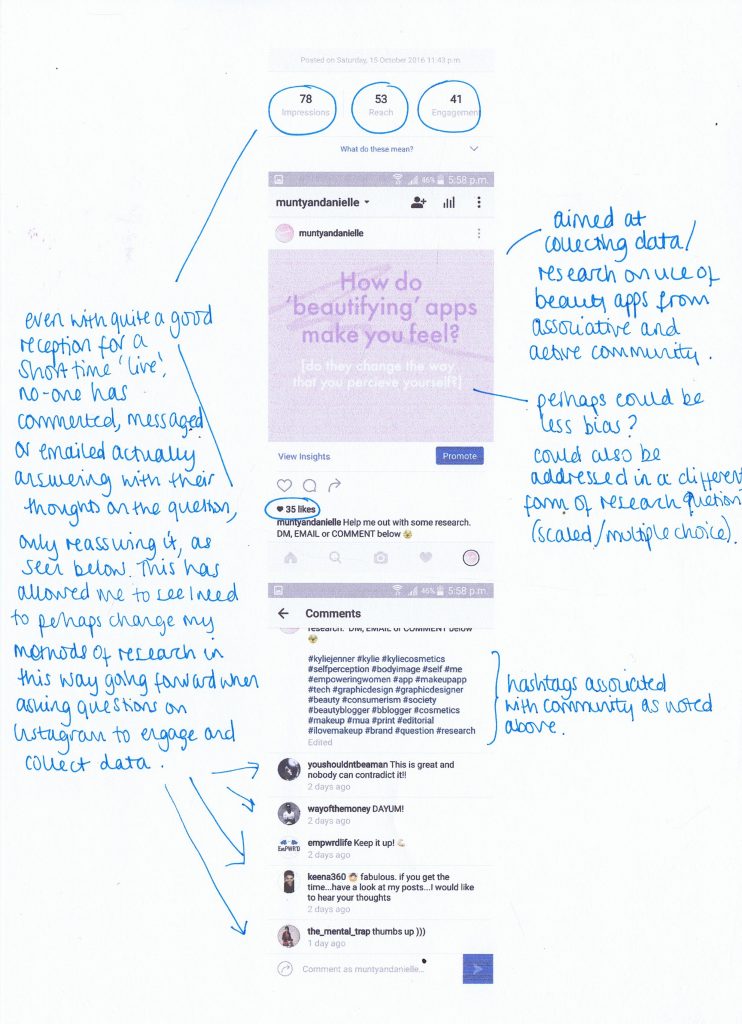
Below shows screenshots of the insights of my Instagram Posts to date.  The first set of posts shown in my ‘Initial Posts’ blog post are not included in the insights below as Instagram only keeps track of engagement of your most recent 12 posts. Therefore going forward I know to note these sooner and more often in order to analyse the engagement of what the audience likes to see more of, therefore in turn hoping to help shape a final range of posts.

Engagement and insights from this set of Instagram Posts show, that the posts relative to Kylie Jenner’s ‘Kylie Cosmetics’ makeup range were most seen, ‘liked’ and commented on, showcasing her current popularity within the social media communities.

I also found that digitally created artwork was much better received also, reinforcing my thoughts on this highlighted in a previous post.

screenshot_2016-10-14-01-16-56-1.png

screenshot_2016-10-14-01-09-19.png

screenshot_2016-10-14-01-09-28.png

screenshot_2016-10-14-01-09-48.pngscreenshot_2016-10-14-01-09-57.png

screenshot_2016-10-14-01-10-05.pngscreenshot_2016-10-14-01-10-12.png

screenshot_2016-10-14-01-10-21.png

screenshot_2016-10-14-01-10-32.png

screenshot_2016-10-14-01-10-41.png


ASOS: Corporate Responsibility & Planning for Interview

This is working towards objective 2, 3 and 5.

I have a contact at ASOS HQ whom has agreed to meet me for an interview regarding the topic of their social and corporate responsibilities around the idea of body image in the fashion industry. The issues of social responsibilities, ethics, and corporate responsibilities can be seen in my previous blog post, Social and Ethical Responsibilities of the Magazine Industry which discussed these issues in context to the industry, whilst in context also to my own practice. I am currently in conversation with my contact at ASOS to arrange a convenient time for the interview to take place. I will confirm details of my contact once I have confirmed the appointment. I plan on taking a series of questions to ask, as well as asking how these issues affect the employees within the design and social media departments on a personal level as also discussed in the previous post noted above.

I was surprised to find so many different organisations and policies which ASOS have been working with to achieve their guidelines and ‘Model Welfare Policy’, which I think as an international fashion platform is an amazing achievement and step forward to addressing the issues noted.

Below I have listed Organisations and Policies surrounding ASOS, all of which support Positive Body Image, whilst promoting support and raising awareness of such issues surrounding the fashion industry. I hope to look further into these/discuss at interview:

  • B-EAT
  • EDAW
  • UK All Party Parliamentary Group on Body Image (APPG)
  • Government Equalities Unit
  • Equalities Ministers Advisory Group
  • ASOS Model Welfare Policy

screen-shot-2016-10-14-at-00-21-01

Image Source

Below shows the full article taken from the ASOS Corporate Responsibility site as seen above. I was again surprised as to how aware as a company they are of the way they could be perceived if they do not account for diversity and positive body image. I personally think guidelines and policies such as are are something which every fashion, and beauty retailer for that matter should and must have, in order to try to and alleviate some of the issues surrounding body image in the industry and encourage a variety of shapes of sizes. This would allow for an inclusive and accessible platform for a community of digital consumers.

From my pre-set objectives in relation to my working research topic, objective 5 is to produce a set of guidelines which could be proposed as a policy to run nationally or internationally within the beauty and fashion industries. I have bolded key points which I feel are particularly relevant to this, and my research topic, whilst also being good starting points for preparing for the interview with ASOS.

This is working towards objectives 2, 3 and 5.

We want to use our influence among young fashion-lovers in a responsible way, by promoting a healthy, positive body image to our customers. We do this by:

  • participating in government advisory panels to tackle body confidence issues
  • bringing in experts to train our employees on body image and health
  • ensuring our own Model Welfare policy and guidelines on digital manipulation are fully applied, to protect our models and our customers
  • enabling customers to post images of themselves wearing the clothes they have bought through our #AsSeenOnMe feature
  • publishing articles on diverse and inspirational young women in our ASOS magazine, focusing on their achievements not their looks
  • working with anti-bullying charity, The Diana Award, recognising that online channels and activities are having a huge impact in the area of bullying and self esteem
  • continuing to fund the charity, B-eat, which provides online support for young adults with eating disorders

HOW WE WORK WITH OUR MODELS

We use over 100 models employed through 21 modelling agencies. The models we work with reflect our dominant customer, that is, twenty-somethings who wear size 8 – 10 (women) and medium (men). Our Curve range is for women’s size 18-30, and we use agency ‘plus size’ models for this range. We have had challenges in finding agencies who supply ‘plus size’ models above a size 16 but we are beginning to make progress in this area.

OUR MODEL WELFARE POLICY

Our Model Welfare Policy states that we will:

  • not work with models who are under 16
  • provide free lunch and snacks to models
  • closely monitor our models and raise any concerns about their health with their agency
  • employ models who are a healthy weight and shape

DIGITAL MANIPULATION

Our internal guidelines on digital retouching dictate that we do not artificially adjust photographs of models to make them look thinner. When we retouch images, it is to ensure that the image looks more like the real product, so usually involves aligning the colour more closely with the real product.

The catwalk videos that we include alongside product descriptions on our website depict the models exactly as they are.

FASHION FOR A WIDE RANGE OF BODY SHAPES

Our garment technology team constantly work to improve the fit of our garments and to ensure that we can deliver the right fit, first time to every customer. We aim to make our fashion fit the customer, not the other way round. To serve our diverse customer base therefore, we offer fashion in over 30 different sizes, including clothing, footwear and jewellery.

  • our Petite range fits people of 5’3″ or less
  • our Curve range fits people of size 18-30
  • our Tall range fits people of 5’10”
  • our Maternity range fits people of size 6-20
  • our Wide Fit footwear range fits people show size 2 to 9

Our ASOS Curve range has been successful with strong sales, and has won several awards:

  • Reveal online award: Best plus size for ASOS Curve September 2015
  • Body Confidence Awards – Responsible Fashion (ASOS Curve)
  • Fabulous for Curves at the 2013 Fabulous High Street Fashion Awards
  • Best Online Retailer at the British Plus Size Fashion Awards in 2013
  • nominated for the Campaign for Body Image in the Body Confidence Awards 2012

EMPLOYEE TRAINING

We are raising awareness among our customer care employees about potential health problems related to body image. The eating disorders charity Beat has provided training on body image health to our customer care team leaders. This will help them to respond sensitively to questions we receive from customers about body image and eating disorders, and direct them to appropriate help where required.

ONLINE SUPPORT GROUPS

In the past 3 years ASOS joined forces with Beat to fund Online Support Groups, which offer a safe and supportive environment for discussion between those with an eating disorder, or between carers, families and friends. Support Groups were trialled in late 2012, and launched in February 2013 to coincide with EDAW – Eating Disorders Awareness Week. With the support of trained staff and Beat volunteers, online Support Groups offer an addition to the Beat Network face-to-face groups, as well as an alternative for people who may not be geographically close to a physical group. They also provide an anonymous space for people who may not feel comfortable meeting others.

Each group has a volunteer facilitator, who is trained by Beat, and a Beat staff member moderates the discussion as well as signposting users to other sources of help, if appropriate.

Find out how to join a Support Group

ENGAGING WITH GOVERNMENT

ASOS participated in the UK All Party Parliamentary Group on Body Image (APPG) in early 2012. The group’s objective was to uncover ways to promote a healthier body image in the wider community.

The conclusions of the group’s final report were critical of the roles of the media, advertising industry and cosmetic surgery. The report also suggested one recommendation for the fashion industry, to set up a roundtable to discuss body image issues. We met with the Government Equalities Unit to discuss how we can explore some of these issues further as an industry and as a result ASOS took part in the Equalities Ministers Advisory Group on Body Image

BODY CONFIDENCE

Body image dissatisfaction in the UK has never been higher, and a huge amount of young people struggle with the issue. ASOS does extensive work to harness its influence among young fashion-lovers to promote healthy body image.

ASOS and the Diana Award aim to work together to launch the #MySense ofSelf programme to equip young people with the tools to challenge social and cultural attitudes towards body image, and to provide a safe environment to discuss body image issues.

The Diana Award is scaling up its anti-bullying work into a full campaign that incorporates raising young people’s self-esteem and body confidence. We will use our reach across the UK and Ireland to provide a resource that addresses the issues.”

Source:
http://www.asosplc.com/corporate-responsibility/our-customers/positive-body-image.aspx, Last Accessed: 14th October 2016