2016 Barbie Doll Releases: Curvy, Petite and Tall

_88544004_barbies-crop_correct

_88544005_curvy_barbie_inf624_v03

screen-shot-2016-11-09-at-21-11-53

Image Source

This is working towards objective 1.

BBC Article: “How does ‘Curvy Barbie’ compare with an average woman?:

I came across this article whilst researching the sizing and scaling of Barbie dolls in relation to a previous post discussing a Barbie store in Tokyo, Japan.

“Mattel has been praised for the release of three new types of Barbie – curvy, petite and tall. They’ve now gone on sale in the UK but how close do the dolls come to representing the average young woman?”

In addition to the Petite, Tall and Curvy Barbie’s which Mattel have released this year (2016), there have also been the release of the “latest Fashionistas line” which represents a wide range of different skin tones and ethnicities helping to be more inclusive of the consumer. Examples of these can be shown below. These have been taken from the Barbie website.

screen-shot-2016-11-09-at-21-20-20

screen-shot-2016-11-09-at-21-20-34

screen-shot-2016-11-09-at-21-20-40

Source

“Mattel says it doesn’t have a scale that would give Barbie’s full-size dimensions. But there is “playscale” – a ratio of 1:6 that governs the size of many toys. If you accept that as a ratio for Barbie then you can multiply all her dimensions by six to find the real-world size.

Like the first ever Barbie, Curvy Barbie is 11in (27.9cm) tall. Multiply by six and you find Barbie would be 5ft 6in. That’s taller than the average UK woman at 5ft 3inand slightly more than the average US woman at just under 5ft 4in.

Real-life Barbie has often been credited as being 5ft 9in, but this may come from measuring the doll in its typical high-heeled shoes before scaling up. To simply take Barbie as 5ft 9in would produce a ratio of 6.35 and different measurements.”

It has been said that “if original Barbie were a real woman she would have a size 2 waist (54cm) and size 2 hips (78cm)” which would make her fit into children clothes, and not even that of a UK Petite Size 4 – equivalent to the US Size 0.

In response to this, studies have been carried out to find out where ‘Curvy Barbie’ would sit in relation to the average dress size. The BBC reported on this, stating that Curvy Barbie equates to “UK size 6/8 waist (63cm or 24.8in) and size 8 hips (91.2cm or 35.9in)” which in comparison to the average 16-24 year old woman is evidently slimmer in regards to size. The average 16-24 year old woman in the UK is 5ft 5in or 164.5cm, and is said to have a waist of 31.3in or 79.5cm which is a UK Size 14. This is according to the 2012 Health Survey of England.

Furthermore, in regards to the Tall and Petite the dimensions at a ratio of 1:6 would mean that “Tall Barbie would be 5ft 11in (180cm) tall, with a size 4 waist (56.4cm) and size 2 hips (78cm). Petite Barbie would be 4ft 11in (158.7cm) tall with a size 2 waist (52.8cm) and size 0 hips (72cm).

However, were Mattel required to accurately reflect the average British and American woman across all ages, the dolls would be overweight or obese.”

This last quote regarding how the average British or American woman as a doll would be reflected as overweight, or even obese, highlights that perhaps as a business this wouldn’t be a viable, commercial product to sell as Barbie dolls are now seen as aspirational characters for children, promoting fancy clothing and good careers reflected by their attire building a picture which a child can mould and shape as their own in their minds. However, with Mattel again claiming that “she [Barbie] is not meant to reflect a real woman’s body … the purpose of introducing three new bodies into the range is variety and differentiation. When you look at the dolls collectively you can see the range in relationship between the dolls. ”

Psychologist Helga Dittmar, from Sussex University, reinforces my point made above, stating, “to say ‘Barbie isn’t supposed to be realistic’ is side-stepping the issue. If there is evidence that the doll does harm, if intended or not, then that is extremely worrisome” reinforcing the ignorance of the manufacture companies and their design ethics as a brand, furthermore pushing mental health effects which can still come into play by these unrealistic standards which are not set as standards, but as society and cultural has changed, has become an ‘ideal standard’ to strive towards.

Furthermore, “Dittmar conducted research in 2006, which found that children aged between five-and-a-half and seven-and-a-half years old, were less satisfied with their own body shape after reading a book featuring pictures of the original Barbie. Those who read the same story without the images were not affected. The girls said they wanted a thinner body shape than they had. They had lower body-esteems after seeing pictures of Barbie. If we show an effect with a single exposure study it stands to reason that the impact increases as time moves on” which again highlights the issues around self-perception, body image and the impact of female representations.

Lenore Wright also added after conducting research at the University of Texas that, “[There has been] an increase in body consciousness, and it’s possible this is being projected on to the doll. Mattel focus groups found many of the young girls called the Curvy Barbie ‘fat'” and notes that the product line up has been heavily criticised by ‘Feminist Scholars’ for stating that “women are defined by their bodies”. I do agree in the sense that women are viewed in certain ways according to their ‘looks’, but do believe that we should be allowed to be who we are, and not feel forced or obliged to change how we look because the media or a plastic doll tells us too.

In addition, the next point raised in the article reminded me of the idea of the Male Gaze, coined in 1975 by Feminist Laura Mulvey, and how “all four of the Barbies have a waist measurement that is close to 70% of their hip measurement. Studies have suggested that men find women more attractive when they have a 0.7 waist to hip ratio, whatever their weight” which again proves that Mattel are aware of what is seen as desirable, subconsciously allowing the child end-user to create, imagine and play with this ‘ideal’ figure, enabling them to grow up with this picture in mind.

I find the release of these ‘new dolls’ an attempt from Mattel to correct going forward some of the damage which they will of undoubtedly caused in the past in relation to self-perception, confidence and mental health for example. However, still being extremely unrealistic even if they now do feature different skin tones, the dolls in my opinion, and through fact and research based evidence still represent women in the wrong way and allows for this to become seen as the norm.

Sources:
Bates, C. (2016). How does ‘Curvy Barbie’ compare with an average woman?. Available: http://www.bbc.co.uk/news/magazine-35670446. Last accessed 9th November 2016.
Mattel. (2016). Fashion Dolls. Available: http://shop.mattel.com/webapp/wcs/stores/servlet/en-us/ms/barbie-fashion-dolls?langId=-1&storeId=10151&krypto=4By64SKM8zN8RdjF8T7mlRjX5H1krXxniy3vt5aUy3WlKN%2BlryvFyaChGm6dY0E9vpKICD7N8yODe9iLQsJoFrU6. Last accessed 9th November 2016.
Moody, A. (2013). Adult anthropometric measures, overweight and obesity. Available: http://www.hscic.gov.uk/catalogue/PUB13218/HSE2012-Ch10-Adult-BMI.pdf. Last accessed 9th November 2016.

Japan Planning: To-do list

This is working towards objective 1 and 3.

In additional preparation prior to beginning to plan my Japan itinerary, I have compiled a list of additional topics which have arisen this week due to starting my initial research which within, I realised there was more to be considered and planned than I had realised. Below shows this list, with topics ticked off as I have researched them. Also shown below is a guidebook on Tokyo I have purchased to used whilst travelling for Phrases and City/Subway Maps in particular.

20161108_224159_1478713355156_resized

japan-notes


Metal Workshop

This is working towards objective 4.C.

Today I visited the Metal Workshop to discuss options regarding making pin badges, which look more substantial and professional as commercial products. Below shows the prototype badges made from card. I took one in to show my idea and talk through the different ways of recreating it, whilst learning about the costs involved and the best materials used to gain the result I am looking to achieve.

img_20161031_223551

Below shows a scan from my notebook, noting options and quick drawings of them. Options include:

  • Using silver & copper with a soldered butterfly pin and clasp on the back.
  • Using just silver and etching processes to allow for enamel to colour the lips, leaving a shiny silver drip. Again a soldered butterfly pin and clasp would be used on the back.
  • Laser cutting: using a range of 3mm acrylic (Workshop). Again a soldered butterfly pin and clasp would be used on the back.
  • Silver Clay using a vacuum formed mould. Again a soldered butterfly pin and clasp would be used on the back.

The costs and suppliers were also talked about and considered, whilst also noting that silver can be expensive if bought quite thick (0.5mm +), where as copper is cheaper and available at college. Silver would need to be purchased from Cooksongold. A photo of this and the estimated costs for the amount of silver required is also shown below.

At this stage, I am currently considering what to purchase, and will purchase alongside fellow MA student Bobbi whilst experimenting to ensure the costs are kept low. Once ordered I plan on visiting the workshop next week to explore a few of the processes noted above in order to see which is most viable to take forward in the future, especially in semester 2.

metal-workshop-notes

Following the session, Bobbi and I visited Hobbycraft to see if we could purchase silver badge pins, however as we need real silver-plated pins due to not being able to solder non-silver pins due to the high-melting point. These could not be found and have been sourced online instead.

However, I also came across several items as documented below which could also be cost effective and low-cost in time also in regards to producing further prototypes in different ways. This involved that of a silicone mould which could be used for the Silver Clay process experiment rather than vacuum forming as another option. However, a vacuum formed chocolate-pop mould has also been documented below, which shows how this could work in regards to making identical badges.

Silk Clay was also found which could be used to experiment with being different to FIMO, however I am more interested to try professional and commercial options at this stage which test and push new skills, opposed to working in a similar way to a previous experiment.

20161109_143553_1478713353830_resized

20161109_143614_1478713352239_resized

20161109_143615_1478713350717_resized

20161109_145723_1478713348480_resized

20161109_164611_1478713346451_resized

HE Institutions: Tokyo, Japan

This is working towards objective 1 and 3.

I have been researching HE Institutions in Tokyo, Japan, prior to my visit in January 2017, in regards to locating large groups of people whom sit within my target demographic audience to conduct research with if possible.

I have targeted Fashion and Beauty-led institutions, resonating highly with both my practice, and my working research question.

I have found that there are 3 main HE Institutions which cover a range of Design-led programmes such as Fashion Design, Graphic Design and Beauty Therapy. I feel by targeting these Institutions I will be targeting young females, whom are interested in the topic of my study, whilst also being with a relevant age bracket of around 17-22 years old, which also again resonates with the target audience of focus in the UK, for example, especially in relation to my recently developed project, “what’s my name again?!” I would aim to either carry out interviews with a group of students, or perhaps even a focus group which may help with time-restraints, however again this may be harder to organise especially with the language-barrier, however this is something I plan on looking at in the next 2 or so weeks, allowing for me to review my ethical policies and consent forms with my supervisor, Anne-Marie prior to contacting Institutions overseas.

During the next semester, I am hoping to begin carrying out interviews and focus groups in the UK with groups of the public, in addition to looking at this in Japan, as I would like to be able to compare and contrast the results from the same, or similar bank of questions, which would be tailored to the audience and topic of research intently. However, I feel by researching into these HE Institutions now, and planning whom I will contact and why, I feel that the process of arranging and conducting interviews/focus groups will be easier.

Furthermore, if unable to book a meeting with the Institutions, I would perhaps like to consider the option of sending a digital questionnaire which could be filled in remotely and digitally, and emailed back to myself, or processed through an official data collection website such as Survey Monkey. Again, I also want to look further into which forms of questionnaire’s, survey’s and interview styles may be used to assess my options and also allow for contingency plans if I am unable to meet with students in Japan, or collect the desired data whilst overseas.

The HE Institutions I have come across can be found listed below, and in due course over the next 2 weeks will evidence any further planning and communication in regards to this particular element of my field-research trip. Contact details and addresses can also be seen below in preparation for contacting the Institutions.

As a back up I also plan to contact the following HE Institutions in the UK due to having such a wealth of international students on their fashion courses. I have began contacting the below institutions by both phone and email to attain contact information for course leaders.

  • CSM
  • Manchester Met
  • Leeds Beckett
  • Leeds Uni

Tokyo:

screen-shot-2016-11-08-at-13-31-32

screen-shot-2016-11-09-at-00-12-28

Image/Contact Details Source

screen-shot-2016-11-08-at-13-32-05

screen-shot-2016-11-08-at-13-32-14

Location:

screen-shot-2016-11-08-at-23-54-22

Google Maps

Barbie Dimensions and the Barbie Store in Harajuku, Japan

This is working towards objective 1.

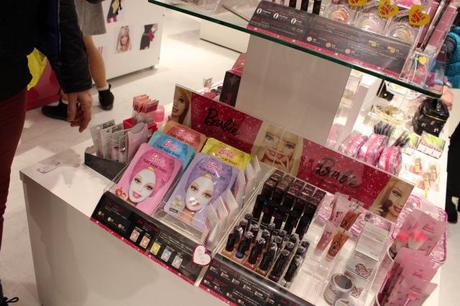
Whilst researching into Harajuku within Tokyo, a district whereby individuality is promoted through a range of cool tech-led cafe’s, vintage stores and classic Harajuku-dress opposed to encouraging a standardisation of dress through international chain stores for in other districts such as Shibuya, for example, I found it strange to find that there was a Barbie Flagship store situated in the centre of Harajuku. I found this interesting due to being a district where being different, unique and having your own identity are praised, whereby Barbie is the epitome of female standardisation and evident in the role of creating an ‘ideal female figure’. On the contrary however, it can also be said that being in an area of Tokyo where ‘kawaii’, meaning ‘cute’ is a prominent trademark per say, it seems perfect sense to place a store of branded, ‘cute’ and Western products in such area.

Upon further research of imagery, it became apparent that the store sells more than toy dolls, it sells clothes, accessories, cosmetics and jewellery along with a long list of other branded merchandise. Falling in-line with consumerism as touched on in my previous project “what’s my name again?!”, this shows how a brand can obtain so much power over their audience and use it to their advantage for further advertising and sales, without regarding any impact on the end-user and their mental health, wellbeing and self-perceptions. Furthermore, the imagery below showcases this alongside life-size, to scale Barbie doll mannequins, showcasing how in real life, if a Barbie doll was an actual living human being, would actually be “5’9″ tall, have a 39″ bust, an 18″ waist, 33″ hips and a size 3 shoe. She likely would not menstruate… she’d have to walk on all fours due to her proportions”. Furthermore, it is reported that “Barbie would weigh 110 pounds and have a BMI of 16.24” making this unrealistic, unattainable nor practical, and also therefore proving how these mannequins give the wrong impression to consumers alongside advertising and promotional materials which promote Barbie as the ideal woman. A BMI of below 17, is also considered in general terms as “anorexic” causing cause for concern in regards to eating disorders and the way the ideal as promoted by Barbie, is actually anorexic and therefore an unhealthy representation of an ‘ideal woman’.

However, the VP of Design for Mattel (Barbie) argues the point that Barbie Dolls were not designed to represent realistic women – “Barbie’s body was never designed to be realistic. She was designed for girls to easily dress and undress. And she’s had many bodies over the years, ones that are poseable, ones that are cut for princess cuts, ones that are more realistic” – maintaining dignity that the dolls are for play, however when children are young, what they see is often what they grow up to know, as previously noted in regards to Jaques and Lacan’s theory on the Mirror Stage. Children are not aware of functionality, they are aware of the aesthetically pleasing design. However, this again questions the social responsibility issues of such corporate companies, whom in my opinion shouldn’t release such products for sale whereby they can be damaging to oneself or ones mental health – especially children, posting an unrealistic figure as their main character of imagination and recreation at a young age.

I really wanted to visit this store on my trip to Tokyo, Japan in order to carry out further research, look at the product packaging, copywriting and take more photographs, whilst seeing what sort of consumer shops there. However upon researching the specific location, found out that this store was shut down permanently in 2015. I have not been able to find a reason why.

barbies-unrealistic-measurements

Source

20140205_barbie_article_main_image

Source

barbie-shop-tokyo-l-ph8ytv

Source

image-3-764x1024

Source

p1020149

Source

Source
Other Sources:
Katz, N. (2011). Life-size Barbie’s shocking dimensions: Would she be anorexic?”. Available: http://www.cbsnews.com/news/life-size-barbies-shocking-dimensions-photo-would-she-be-anorexic/. Last accessed 9th November 2016.
Endicott, S. (2014). ‘Barbie Doll Was Never Designed to be Realistic’ Says Mattel Designer. Available: http://stylecaster.com/beauty/barbie-doll-body/. Last accessed 9th November 2016.

Contextual Research: Japanese Beauty – Sourced Interviews

This is working towards objective 1.
Below shows a range of video interviews I stumbled upon whilst researching Japanese women and Western Beauty ideals. I found these videos extremely helpful as a recent source of information being posted in March 2016, and also felt incase I do not collate the desired research in Japan as needed to help with my studies due to any issues with language or arranging meetings for example, these videos are good sources of quotes, relevant information from the right target audience and most importantly relevant in regards to the questions being asked and answered. 
From watching these videos it is apparent that most would like to, or try to change their appearance in order to fall in line with western ideals of beauty. From the screenshots of the video “what to do Japanese ENVY about foreigners?! What are they jealous of?” shown below, it is apparent that the topics covered in my first Professional Context presentation regarding the scans of beauty pages from a recent edition of Japanese Vogue showed that many wanted to be taller, skinnier, have ‘larger eyes’ or dye their hair in reference to Westerners. I found it surprising initially at first that such young women wanted to change so much about theirselves all through comparative behaviours leading to diet changes at times as seen in a different video shown below, “Ask Japanese girls about their DIET secrets” for example. However, upon further thought then realised that this influence most likely comes from Western sources such as Vogue Japan and Fashion ad campaigns, leading to the internalisation of such ideals, in order to create external changes. However, this is something I would like to look into whilst in Tokyo, comparing the advertising and campaign collateral of Japan with that in the UK. To do this effectively, I have booked a trip to London in order to do a comp shop to look at such collateral as well as cosmetic products/beauty products on sale and product packaging which can be compared to the same brands in Japan. I will look at Western brands in particular in doing so, and those which have stores in both cities so I can obtain accurate research of visuals etc, with the trips only being 2 weeks apart. These stores will be logged in both my London and Japan itineraries to ensure that this research is carried out effectively.
In addition to these first-person perspectives shown in the videos discussed above and shown below, further videos are listed which reveal male perspectives also in relation to average body weight/height of Japanese women compared to the average American woman. I found this video interesting as it tested the pre-determined perceptions of Japanese teenagers which all were shocked and surprised in regard to the reality.
Source
screen-shot-2016-11-08-at-03-04-42

screen-shot-2016-11-08-at-03-06-01

screen-shot-2016-11-08-at-03-07-11

screen-shot-2016-11-08-at-03-07-34

screen-shot-2016-11-08-at-03-14-08

screen-shot-2016-11-08-at-03-16-00

screen-shot-2016-11-08-at-03-15-02

screen-shot-2016-11-08-at-03-15-19

screen-shot-2016-11-08-at-03-15-28

screen-shot-2016-11-08-at-03-06-30

screen-shot-2016-11-08-at-03-16-47

Source

Source

Source
Source
Source

“What’s My Name Again?!” Printed Zines

20161109_183306_1478716480494_resized

20161109_183338_1478716474777_resized

20161109_183317_1478716476681_resized

20161109_183350_1478716472499_resized

20161109_183310_1478716478382_resized

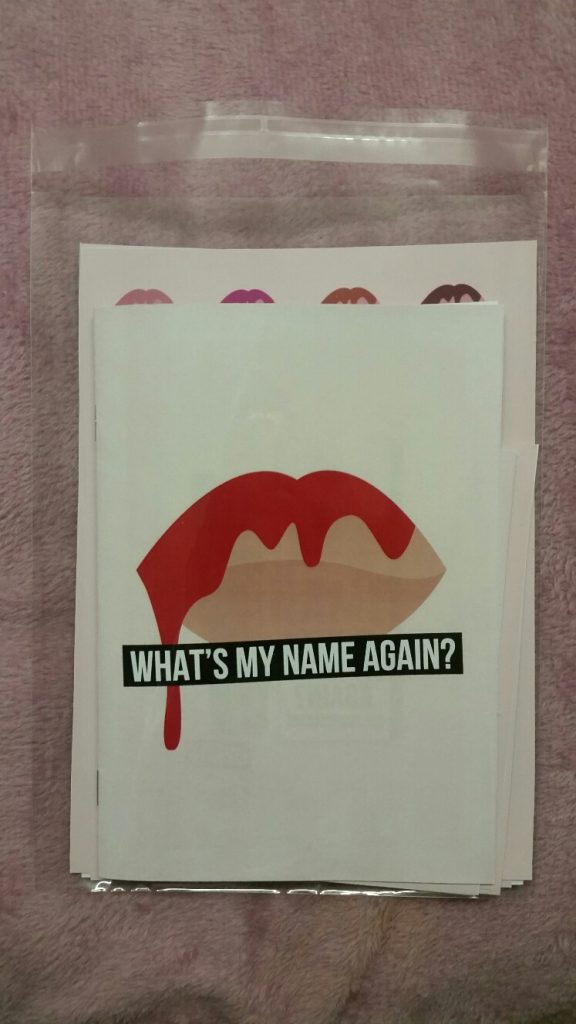
As shown above, the zine previously shown digitally, was printed incorrectly at first due to errors in exporting the PDF, which meant the front and back covers exported on portrait spreads, opposed to landscape spreads. However this was resolved through trial and error with printing, whilst also printing from InDesign directly, using the ‘print booklet’ tool, opposed to exporting a PDF.

The zines which were printed correctly are also shown below. These were then stapled, after previously experimenting with perfect binding but due to a only have 16 pages didn’t taken well to this method. Furthermore, stapling implies the traditional aesthetic of a low-cost zine, whilst perfect binding insinuates a more high-end lookbook aesthetic. These were then trimmed down accordingly. 2 zines of 4 printed, were used to form ‘Promo Packs’ including a range of printed collateral such as A6 Digital Prints and A5 Posters to share amongst friends. This is described on the back of the zine, as well as on the mountain-fold label designed in conjunction with the other labels designed to date for consistency. The other 2 zines will be submitted as 2 individual zines in their own right without taking the shape of a ‘pack’.

The A5 posters and A6 prints included in the pack have been taken from my previous post of ‘final print tests’, therefore are gloss in regards to stock, whilst the zine being low-cost and easily reproducible by nature, is printed on a 90gsm matte finish stock. This is also to again stay true to the aesthetic of traditional zines, whilst also again aiming to not look like a lookbook in design or aesthetic.

I had some spare A5 and A6 prints spare so created additional packs of these, and used stapling opposed to double sided tape, as once the label is taken off it can rip apart the card meaning it is unkeepable, and will leave both paper and glue residue on the plastic poly bag which may want to be kept by the end user to store prints/zines etc that are not in use. Initially I thought that this would cheapen the aesthetic however I actually prefer it due to being more ‘standard’ and also as it preserves the ‘inner’ and ‘external’ packaging opposed to ruining both once initially opened.

screen-shot-2016-11-08-at-01-34-09

20161108_011655_1478567965942_resized

20161108_011705_1478567963330_resized

20161108_011715_1478567960978_resized

20161108_011721_1478567958650_resized

20161108_011723_1478567956793_resized

20161108_011730_1478567954927_resized

20161108_011738_1478567952975_resized

20161108_011744_1478567950490_resized

20161108_011800_1478567948828_resized

20161118_230047_1479510201340_resized

20161118_230018_1479510203328_resized

20161118_230012_1479510205634_resized

Final Digital Gloss Print Tests

This is working towards objective 4.C.

Below shows final gloss prints tests of the “what’s my name again?” campaign developed and experimented without throughout this module to date. I realised however upon organising my work to date and reviewing it prior to photographing it in the studio ahead of submission, that the way the documents had exported with crop marks when printed on the A1 printer, had scaled down the dimensions of the print, and therefore, what I thought to be A3, A5 and A6 prints were intact slightly smaller. Therefore, these were chosen to reprint to scale on gloss stock, as noted through previous research and experimentation that the colours and depth of gradients came more to life whilst also being much more professional visually and aesthetically pleasing in forms of a poster print or a postcard, for example, staying true to their traditional print format, print choice and stock choices.

The prints with and without crop marks can be seen below.

These were then taken and re-packaged in poly-bags and re-labelled as seen previously, however using the mountain-fold label opposed to the sticker label, again for added aesthetics and value.

Looking ahead into next semester, any further collateral produced in regards to this particular project/brief will also been taken forward and applied as necessary.

20161107_225109_1478566038799_resized

20161107_225113_1478566043164_resized

20161107_225123_1478566047502_resized

20161107_225131_1478566045406_resized

20161107_225203_1478566049555_resized

20161107_225229_1478566051547_resized

20161107_231305_1478566055833_resized

Google Translate

googletranslate

Image Source

I was told my my supervisor Anne-Marie during my most recent tutorial about downloading Google Translate prior to my Japan visit in January as not much signage features English, and if so it is usually written in Roman format. Having used online translation tools in the past, I wasn’t aware that technology has so rapidly advanced to the point of taking a photograph of a sign, swiping your finger across the translatable text and the English translation will appear. This text can then be spoken in either English, or the desired translated language, in this case Japanese.

The app also also allows for me to speak directly in English for this to then be translated and spoken back in Japanese. The opposite is also available, i.e. Japanese spoken language to either a spoken, or written English translation to appear.

I feel whilst asking for the simplest of things such as directions this will be extremely beneficial, whilst also being beneficial if interviews are carried out for example whereby there are language barriers. I have discussed with my contact in Japan the idea of using a translator if need be, however this may be costly and depends on the situation at the time, and also depends on how much of a language barrier there is in Tokyo city with the people I will be hopefully talking to.


Well-being Campaigns: Visual Research

This is working towards objective 4.B.

Below shows a range of visual research carried out whilst building an initial picture for the well-being campaign project I have just began working on. Pinterest and Behance have been used heavily for visual research, allowing to see a wide range of aesthetics, ideas and the work and ideas of interdisciplinary artists broadly yet precisely in context and topic.

screen-shot-2016-11-06-at-22-50-21-copy


screen-shot-2016-11-06-at-22-50-32-copy

My ‘Well-being Campaign’ Pinterest Board can be found here.

I have included this in my references due to the concept and idea more so than execution, opposed to resonating with my work design aesthetic as many lay heavy with advertising-campaign style photography, however as a whole find this collection really inspiring in regards to execution and idea generation.

298aee11828207-562530786aafa

b9f83411828207-5625308ae7680

b5f4d311828207-5625308a2bc75

db84d711828207-562530b7a02f0

Source

“beYOUtiful is a social campaign program to sensitize young women that beauty in the media is not always true. Most women have a great attention to their physical appearance . Therefore, they often compare the physical appearance of their particular body shape with the actress or whoever they see in the media.  The results of that dissatisfaction can be a source of disappointment and ultimately can lead to the formation of body dissatisfaction.
 
Body dissatisfaction is not only experienced by women who are obese , but not a few teenagers who have a healthy weight , or even below average also experience body dissatisfaction.
 
So this social campaign aims to convey the message to girls who experience body dissatisfaction in order to know that the image of beauty they see in the media is not all good and true.
Based on the target, we use a girlie colour to reach out target.”

Above shows a Social Media campaign which I came across on Behance, targeting body image issues and body dissatisfaction as an outcome to over exposure to social media. As extremely relevant to my practice, I felt that the work of Jessica Jean should be included. Even though different to my aesthetic of work, I love the concept and find this work extremely inspiring for this particular Social Media Wellbeing project targeting similar issues of body image and self-perception due to over exposure to beauty and fashion-led images on social media.

More of Jessica’s work can be found here.

9408f716529787-562ad56c1cee8

960bb916529787-562ad5e2e282e

07dfd216529787-562ad43f24a37

d7ea7916529787-562ad4f0168b7

b5b18216529787-562ad4eef28d2

ab583416529787-562ad4ef9fe65

03b25d16529787-562ad4d2e9aee

0823ff16529787-562ad4ee8094c

e70dda16529787-562ad4eff36f6

6e37fe16529787-562ad56bb4b75

55f4c416529787-562ad5e0110eb

202e9116529787-562ad4d3a20e6

Source: Personal Archive of Work

Above shows a previous piece of my work from my BA(Hons) Graphic Design degree whereby I looked into how the public perceived themselves through anonymous research and expressive photography. I have included this due to the way in which this was a research-led project which informed a practical outcome, and also being different in terms of being a publication, or book, opposed to a digital campaign as mainly shown in the examples above. I am still considering options of a digital or printed campaign for this particular project at hand, however feel that this could be a good source of inspiration going forward, whilst also being a solid form of research in regards to useable quotes. In regards to this, all of which have all been agreed for use in regards to data protection, ethics and confidentiality prior to designing the book originally whilst carrying out research, with each participant agreeing on such terms of consent if used anonymously.

“Today’s society dictates how we should feel, look, act, walk, talk and speak. Not only being dictated to by new norms and conventions, we are told how we should shape ourselves to fit in and be the ‘ideal’. The media plays a major role in self-confidence and body related issues, more so now than ever before, which has contributed to the rise of ‘ideals’. On the contrary, we never get the chance to express how we feel about ourselves, and our conttibution to society.
As a result of conflicting interests surroundng the public, an anonymous survey was created and shared internationally allowing people to be honest, truthful and emotive. 
The survey was one question: How do you as an inidividual, pecieve your own body image? 
The Rules:
1. State Age
2. State Gender
3. Remain Anonymous
Over 100 responses were recieved from both males and females, ranging between the ages of 15-70.
The results were compiled with imagery associative of the issues within society, as well as showcasing two complimentary, yet contextual and critical essays developed for further academic reading.”
mental-health-booklet-v22
mental-health-booklet-v23
mental-health-booklet-v27
mental-health-booklet-v25
mental-health-booklet-v26
mental-health-booklet-v27
mental-health-booklet-v28
mental-health-booklet-v29
mental-health-booklet-v210
mental-health-booklet-v211
mental-health-booklet-v212
mental-health-booklet-v213
mental-health-booklet-v214
Source: Personal Archive of Work
Above shows another of my own works, however this was created off my own back for a previous employer, however was never finished, nor used. I have included this in my references due to the aesthetic being more inline with my style of work, opposed to the heavy advertising campaign aesthetic as seen often in examples shown in my Pinterest board, however they were selected for concept and idea more so than execution. Furthermore, the context is very relevant to this project, and was based around common mental health problems in the workplace, and was backed up by celebrity images and quotes, whom have experienced the same illness.