Danielle Muntyan
Working towards objective 2.
Whilst reading ‘The Magazines Handbook’ by Jenny McKay, I came across the below statements, and began to think about how these sorts of issues could come into play within my practice, and how I may want to question or consider social and ethical issues whilst working with different brands and clients.
I have noted the quotes below, along with a mind-map discussing my thoughts on this in context of my practice and research question as well as also looking at how this could be associated in context with my own practice.


–
“Advertorials can cause problems for journalists if the writer does not want to work on material that might compromise his integrity as an objective reporter. Some publishers always use freelances for advertorials while other pay their staff extra for working on them and bylines are not used. Either way the practice of pretending to readers that advertisements represent objective editorial recommendations is ultimately damaginger the magazine’s integrity and therefore to its value as a brand. The PPA does issue it’s members with a set of guidelines to cover the preparation and use of advertorials but these are not always observed (Morrish 2003: 105-107).”
“‘Relevant advertising is valued by readers, and is consumed with interest’, writes Consterdine in his report for the industry on how advertising works.”
“If you cut out the ads in a magazine before reading it then the chancestors are that you’ll be discarding almost half the pages in the average weekly or monthly magazine. This ratio of roughly 40:60 is known in the trade as the ad-ed ratio … a good example is Vogue, which is devoted largely to fashion coverage and has high production values for all its photography. It insists on the same from its advertisers and so a four-page advertising spread from Armani, say, brings to the reader yet more glamorous, high-quality fashion pictures that the editorial budget alone could not justify”.
–
In regards to the last quote shown above, I have noted a video below created by OscarTBrand regarding the very issue of the “ad-ed” issue as discussed by McKay.
I found this video very inspiring and I would like to carry out such forms of research in regards to the UK and Japan editions of Vogue.
In my previous post, ‘Initial Project Ideas’ I noted that each contained an element of Critical Design, especially the Instagram Posts and Posters which I am currently experimenting with. However, I was told about Dunne and Raby in a tutorial with Anne-Marie, and wanted to see how they carry out work as practitioners, and how this in return relates to my practice.
Critical Design is when “design as a medium to stimulate discussion and debate amongst designers, industry and the public about the social, cultural and ethical implications of existing and emerging technologies.”
Anthony and Fiona, commonly know as Dunne and Raby, are both Professors, Authors and Designers and have worked featured in galleries across the world, such as MoMA in NYC and The Design Museum in London.
What does Critical Design mean?
“Critical Design uses speculative design proposals to challenge narrow assumptions, preconceptions and givens about the role products play in everyday life. It is more of an attitude than anything else, a position rather than a method. There are many people doing this who have never heard of the term critical design and who have their own way of describing what they do. Naming it Critical Design is simply a useful way of making this activity more visible and subject to discussion and debate.” (Dunne and Raby, 2007)
Work Example:

The following extract is taken from: Weeds, Aliens and Other Stories, 1994-98
Dunne & Raby / Michael Anastassiades
“Weeds Aliens and Other Stories is a collection of psychological furniture for the home and garden. The project grew out of a deep dissatisfaction with the narrow range of psychological needs met by furniture. How many more chairs, tables and shelving units do we need in the world?
Weeds Aliens and Other Stories began as a sketchbook of drawings and ideas exploring the English obsession with the garden and seemingly irrational relationships between people and their plants. We wanted to encourage people to play out their eccentricities within their urban homes, homes with very little or no garden at all. These unacknowledged behaviours become legitimised through new types of furniture.
Fabrication: Ben Legg
Technical advice: Rick Thomas, Mark Bullimore, Jon Rogers
Sound design: Jayne Roderick
Photography: Salvatore Vinci
Thanks to: Andre Cooke, The British Council Window Gallery Prague, Mark Daniels, Northern Architecture, Northern Arts, Sophie Smallhorn, Robin Blackledge, and Claire Catterall
The project is in the permanent collection of the Victoria & Albert Museum in London.”
–
I chose to look at this example being drawn in by the use of photography as this still remains a dominant form of visual within both beauty and fashion industries, be on social media or in magazines and made me think how as well as illustrations and other forms of graphic design, how photography could somehow be used as a Critical Design-led research method in order to spark discussion around the research topic at hand.
It also allowed me to reflect on how even though I have used only illustrations to date, the same concept behind the form of research is prominent similarly to Dunne and Raby’s work in regards to gaining peoples attention in order to make them think, and ultimately engage in discussion or debate. However, I feel now knowing more about their background, their work and methods using forms such as video, photography, installation and sometimes illustration also, I feel I will be able to apply this knowledge going forward to further pieces of work. In addition, the benefit of collaborating with other interdisciplinary artists and creatives is evident allowing for various forms of work to be created including a wide range of conceptual projects and writings, sharing skill sets, ideas and knowledge. This is also something I would like to introduce into my practice in order to generate new ideas and informed conversation.
Sources:
http://www.dunneandraby.co.uk/content/projects/74/0 Last Accessed: 13th October 2016
http://www.dunneandraby.co.uk/content/bydandr/13/0 Last Accessed: 2nd December 2016
This is working towards objective 1.
Whilst researching technological advances within the Fashion Industry in regards to body image and self-perception, I came across one particular technology which I saw as a negative, but a possible positive in some respects, which I shall discuss below.
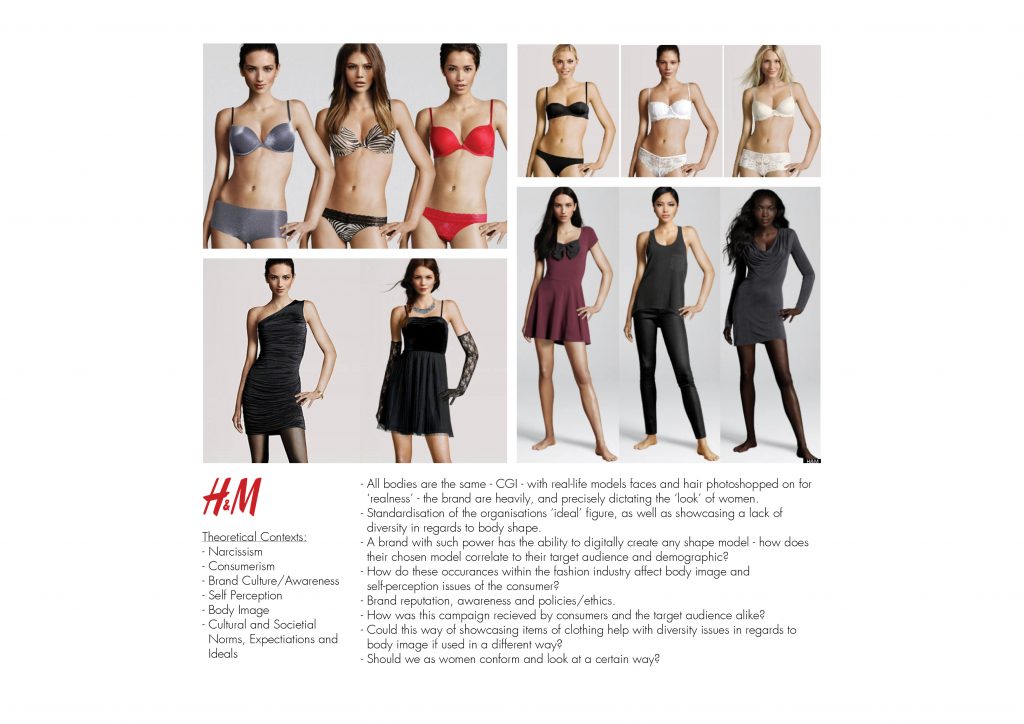
H&M in 2011 were found to be using computer generated models and photoshopping ‘real models’ heads on to the bodies, changing skin tones to create diversity and match accordingly. However, H&M may of gone unnoticed as a global organisation breaking the boundaries within the industry on what is ethically and socially right to do as a brand, if they had not only used one pose throughout the entirety of their website and catalogue at the time.
An H&M spokesman explained to Adweek that, “for our Shop Online we are using a combination of real-life models’ pictures, still-life pictures, and virtual mannequin pictures. For all other marketing and campaigns—outdoor, TV, print, and other media—H&M will continue to use real-life models.”
This can be seen visually below.


What I found most disturbing about this was how slim the models are. An International brand with huge amounts of influential power on the high-street chose to portray their ‘ideal’ women as a super skinny runway model-esk figure, opposed to seeing an opportunity to create perhaps a figure based on todays average woman, or a range of bodies showcasing different ‘normal’ figures if they feel the need to chose CGI over real-life models. Why did such a brand feel the need to go down this route to promote their clothing and accessory products? Perhaps this is for quicker turn around within the design and work involved in constantly updating an ecommerce site and a catalogue. Regardless of the reason, the impact can be damaging – especially if this was to catch on throughout the industry.
Adweek suggest that complaints have been made regarding these computer generated models, stating that the “stepford model ideal” promoted is not attainable nor correctly proportioned. Regardless of the ‘image which H&M have gone for with their new models, no two people look the same, and even if H&M used very slim real-life models, this would paint a better picture of the standardisation of women opposed to promoting the idea of ‘clones’ to women.
Furthermore, the online magazine site Jezebel, reported that H&M have also used computer generated models which upon close inspection actually have no faces. Whether this is a mistake a not, it proves that technologies cannot be relied on and that using real models would be more reliable in this respect.
This is evidenced in the photos shown below, whilst also being able to see quite clearly how poorly the CGIs have been put together in regards to photo manipulation, specifically shadows as shown below, enhancing the fact that this is in fact not a real person.


Sources:
http://www.adweek.com/adfreak/hm-under-fire-putting-models-heads-perfect-cgi-bodies-136974, Last Accessed: 13th October 2016
http://jezebel.com/5824561/new-hm-catalog-features-model-with-no-face, Last Accessed: 13th October 2016
This is working towards objective 1.
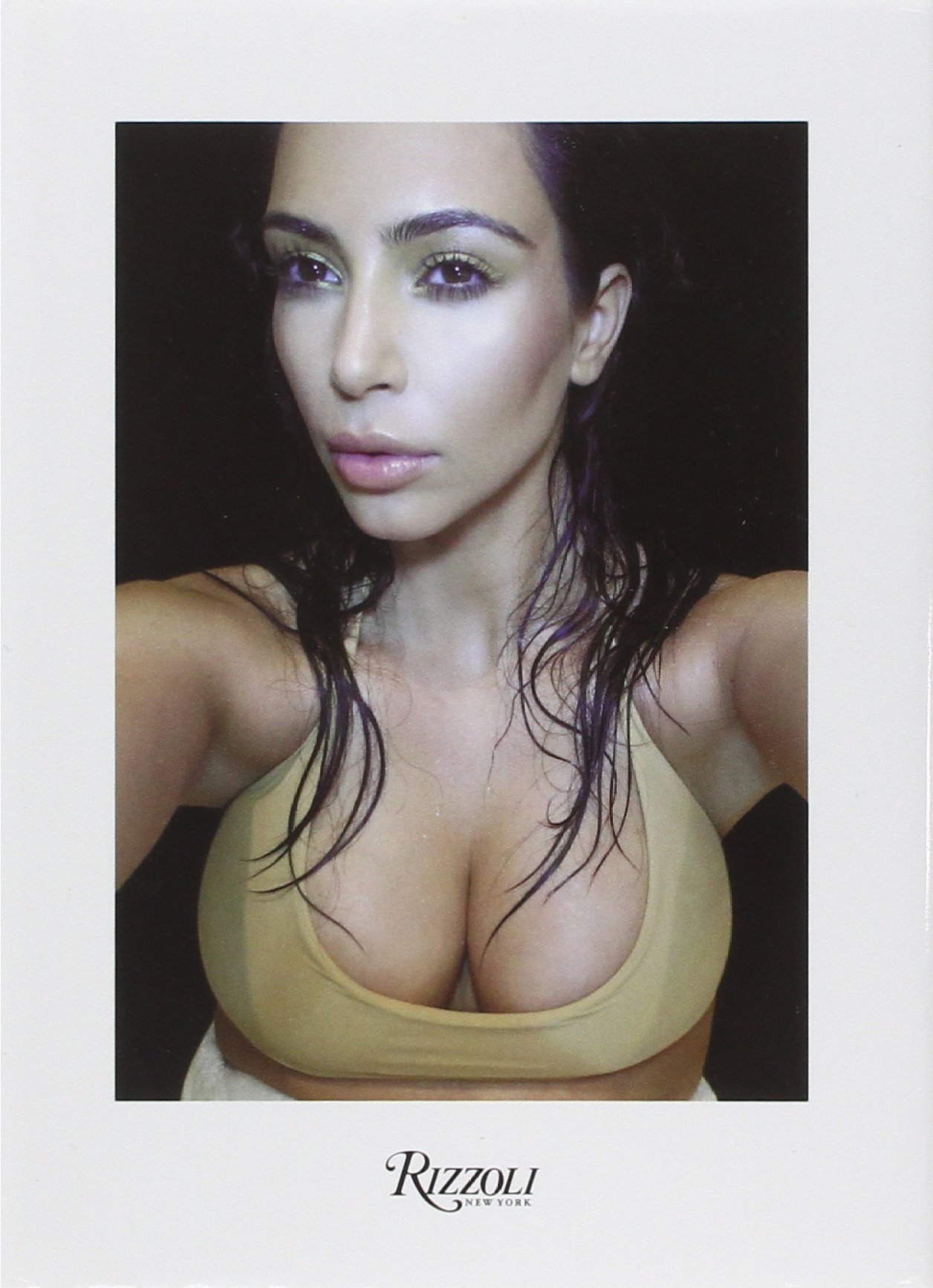
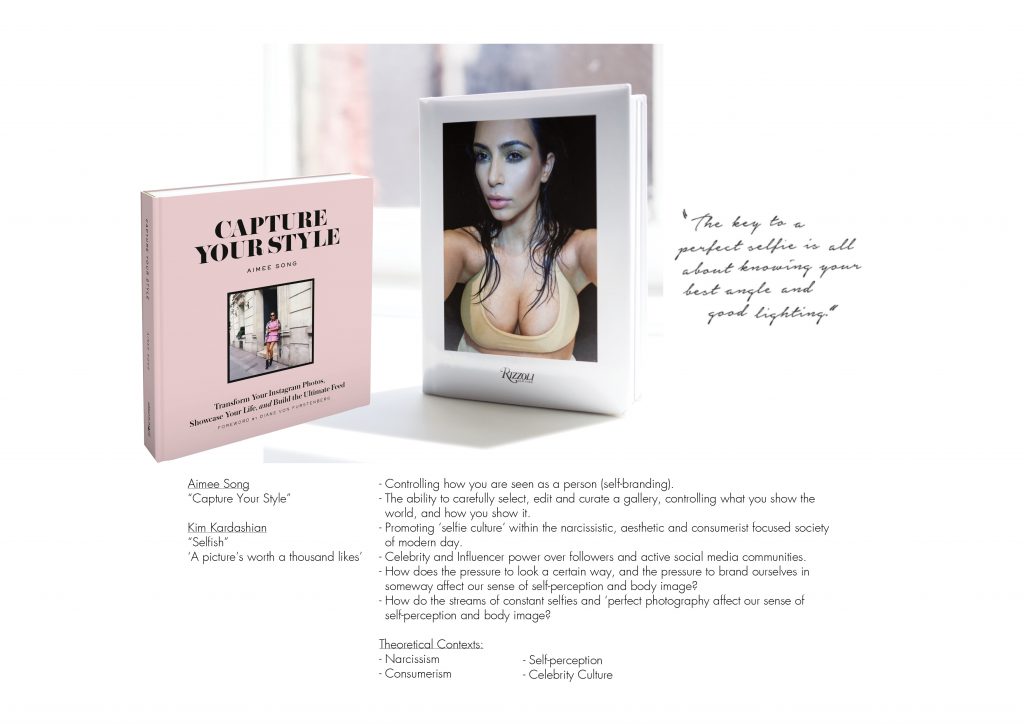
It is noted by some such as Rizzoli, that Kim Kardashian is the “trailblazer” and almost icon of the “selfie movement” which we are currently living within the rise of digital technologies and social media. Therefore, I have noted two books, ‘Selish’ by Kim Kardashian and ‘Capture Your Style’ by Fashion Blogger/Vlogger Aimee Song. Both represent this movement and the power of it, and therefore direct how to do it well in order to turn “an Instagram hobby into a successful business” as Song notes in a manner which would make any active and engaging Instagram users believe that it is also possible for them also with the right ‘look’ and image. Not only that but Song actively encourages her readers and followers to carefully edit their photographs to achieve the perfect addition to their carefully curated Instagram feed. This can also be seen in a video below. I found the video very interesting in the sense that Aimee is very controlling in the way others take photos of her, ensuring she is perceived in a particular, and controlled way therefore obviously being very aware of her body image and self-perception, especially in regards to what angles are used to take ‘the best photos’. This confirms how obsessive this form of photography, where by through taking our own photos – selfies – or directing the shoots of our own portraits, we are in full control in a narcissistic sense of what we are showing the public.
I have also noted these two books in my initial plan for my Professional Context presentation, looking at how these cultural, blogger and celebrity influences are impacting on our body image through their use of social media.

Selfish by Kim Kardashian
Image Source
“The selfie photography of Kim Kardashian West, featuring many never-before-seen personal images from one of the most recognizable and iconic celebrities in the world. From her early beginnings as a wardrobe stylist, Kim Kardashian West has catapulted herself into becoming one of the most recognizable celebrities in Hollywood. Hailed by many (including Givenchy designer Riccardo Tisci) as the modern-day personification of Marilyn Monroe, Kim has become a true American icon. With her curvaceous style, successful reality TV show Keeping Up with the Kardashians, DASH clothing store, makeup and perfume lines, she has acquired a massive fan following in the multi-millions. Through social media (Instagram, Twitter, and Facebook), Kim connects with her fans on a daily basis, sharing details of her life with her selfie photography. Widely regarded as a trailblazer of the “selfie movement”—a modern-day self-portrait of the digital age—Kim has mastered the art of taking flattering and highly personal photos of oneself. For the first time in print, this book presents some of Kim’s favorite selfies in one volume—from her favorite throwback images to current ultra-sexy glam shots—and provides readers with a behind-the-scenes look into this larger-than-life star.”
– Rizzoli
Noted Reviews:
“The first lady of #fame – the 100 Most Influential People” –Time Magazine
“Kim Kardashian already broke the internet. Now she’s poised to break the best-seller lists. . . . It’s easy to mock – indeed, the title almost does it for you – but this seemingly throw-away collection may end up being just as much a part of pop-art history as when Andy Warhol painted soup cans.” –Daily News
“Kim Kardashian is the queen of selfies, and she’s planning to make sure everyone knows it in her upcoming book, Selfish.” –MTV News
“Now there’s a book cover if we’ve ever seen one! . . . this book is obviously made for her biggest fans. Not to mention it includes previously unseen selfies!” –USA Today
“Kim Kardashian can take a selfie anywhere, and we mean anywhere!” –E! News
“In her new coffee-table book, Selfish, the reality star documents nine years of her life in selfies – some seen by millions, others revealed for the first time.” –Harper’s Bazaar
“Now you can get between the covers with her— hardcovers, that is. With more than 400 pages of intimate snaps (including bikini selfies, lingerie selfies and, yes, several nude selfies), flipping through her new photo book Selfish, published by art-house giant Rizzoli, feels like scrolling through a fabulously rich and beautiful friend’s well-curated smartphone.” –Playboy Magazine
“As they say, you have to love yourself first! After months of anticipation (and just a touch of eye-rolling), Kim Kardashian’s selfie-filled coffee table book, aptly entitled Kim Kardashian’s Selfish, [has] finally arrive[d].” –US Weekly
“Kim Kardashian has joined the ranks of Giacometti, da Vinci, Lichtenstein, O’Keeffe, and just about every other revered artist of any era: she, too, now has a Rizzoli-published book devoted to her work at the forefront of an artistic movement. Indeed, Rizolli notes that she’s ‘widely regarded as a trailblazer of the ‘selfie movement.’” –Flavorwire.com
“Treat your coffee table to a 300-page collection of Kim’s best selfies . . . ” –People Magazine
“[Kim K’s] the queen of the selfie. And her soon-to-be released hardcover book . . . should be all the evidence she’ll need to maintain that throne.” –CR Fashion Book
“Attention all Kim Kardashian fans – here’s the E! star as you’ve never seen her before! . . . aptly dubbed Selfish . . . [the images] definitely don’t disappoint.” –E! Online
“As it stands, Kim Kardashian West holds the title for most Instagram followers (at 30 million) just behind the platform’s own account (at 60 million). An average Kim K selfie garners upwards of 650,000 likes with her wedding photo receiving 2.5 million likes. With all that in mind, there’s no question that Kim’s controversial new book, Selfie, is going to fly off the shelves.” –V Magazine
“From her favorite throwback images to current ultra-sexy glam shots, Selfish will provide readers with a behind-the-scenes look into Kardashian’s life.” –In Style Magazine
http://www.rizzoliusa.com/book.php?isbn=9780789329202, Last accessed: 12th October 2016
–

Capture Your Style by Aimee Song
Image Source
“Oh. My. Gosh. You guys, I can’t believe it’s finally time to tell you this… I wrote a book! I’ve been blogging for about eight years now and in that time I’ve gotten to go all around the world to the most beautiful destinations and attend events I dreamed of when I was younger. A huge part of those experiences and my success as an influencer has been documenting them on Instagram. That’s what this book is all about–how to showcase your life through beautiful photos on Instagram.
Why should you want it? Instagram is so much more than a platform for pretty pictures. It’s the fastest-growing social media network with an engaged community, a major marketing tool for brands, a place where Beyoncé drops her albums, and a hub where products can be bought with a simple double tap. Including everything from fashion, travel, food, décor, and more, I’m giving you insider tips on curating a gorgeous feed and growing an audience.
Inside, you’ll learn ways to craft your voice and story on Instagram: all about how to edit your photos using the best apps and filters, how to prop and style food and fashion photos, how to gain more followers, and secrets behind building a top Instagram brand, transforming an Instagram hobby into a successful business.”
– Aimee Song, Song of Style
Below shows a list of questions which I have raised and noted whilst undertaking research, writing my project plans and mapping out my first Professional Context presentation in relation to my practice and my research question, “How do Magazines and Social Media within the Fashion and Beauty Industries, affect our sense of body image and self-perception?” I have realised that by logging these questions I am then able to assess which research methods can be used to try and find answers, whilst helping to direct topics of research going forward.
Questions raised:
How does this ever-lasting stream of so-called ‘ideals’, ‘perfection’, bloggers/vloggers and social media ‘famous’ affect our own ideas of our body image and self-perception?
Does this form of media affect us and influence us in a different way to magazines?
Is this due to content on social media in comparison to magazines?
Do people still read magazines and see them as a form of influence, or are we more enticed by social media for quick access and ease?
Who, or what within the Fashion and Beauty industries is the most influential in regards to our body image and self-perception?
What culture and history, for example are we missing out on as a society are we missing out on if we are forever taking photos of ourselves, rather than taking photos of our surroundings and those who we are with?
Is our self-indulgence taking away pleasure in our experiences?
Our we sourcing locations to take photographs for our social media accounts, or are we sourcing locations to take in what is there?
How do we feel if we cannot recreate or maintain that “flawless” look achieved through makeup apps?
How do these technologies add to the debates amongst body image and self-perception within a world which is becoming more narcissistic, controlling and standardised?
How does Western culture influence body image and self-perception in other countries due to the accessibility of celebrity culture, bloggers/vloggers, social media and the idea of the standardisation of beauty?
Do we have to look a certain way now to appeal to the opposite sex?
What do men think about the rise of beauty trends and fads?
What do they think of current ‘icons’ such as Kim Kardashian for example whom influence the looks and perceptions of women so much?
Do males and females feel differently about these issues?
How does the pressure to look a certain way, and the pressure to brand ourselves in someway affect our sense of self-perception and body image?
How do the streams of constant selfies and ‘perfect photography affect our sense of self-perception and body image?
How does instantly mimicking ‘the looks of others affect our sense of self-perception and beauty?
Are we more likely to try and change our appearance permanently through liking the results of edited photos more than what we see in the mirror?
Is this due to the over-exposure of Western models, magazines and social media platforms?
How does this affect the ‘everyday woman’ in Japan, her self-perception and purchases/activities?
Brands with power such as H&M, have the ability to digitally create any shape model – how does their chosen model correlate to their target audience and demographic?
How do these occurances within the fashion industry affect body image and
self-perception issues of the consumer?
Brand reputation, awareness and policies/ethics.
How was this campaign recieved by consumers and the target audience alike?
Could this way of showcasing items of clothing help with diversity issues in regards to body image if used in a different way?
Should we as women conform and look at a certain way?
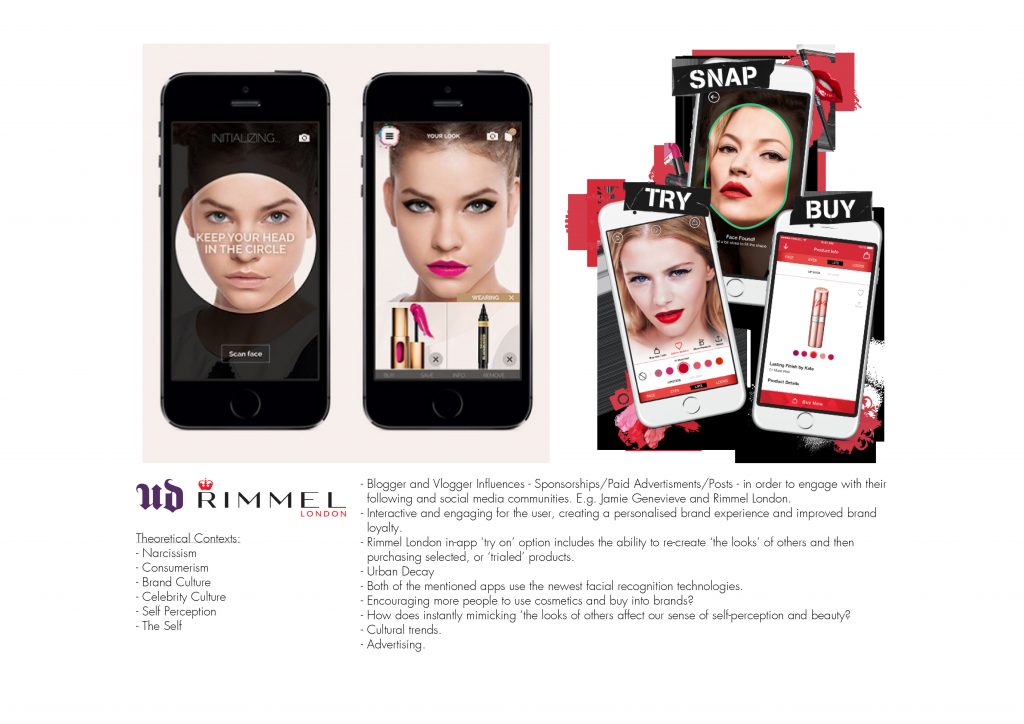
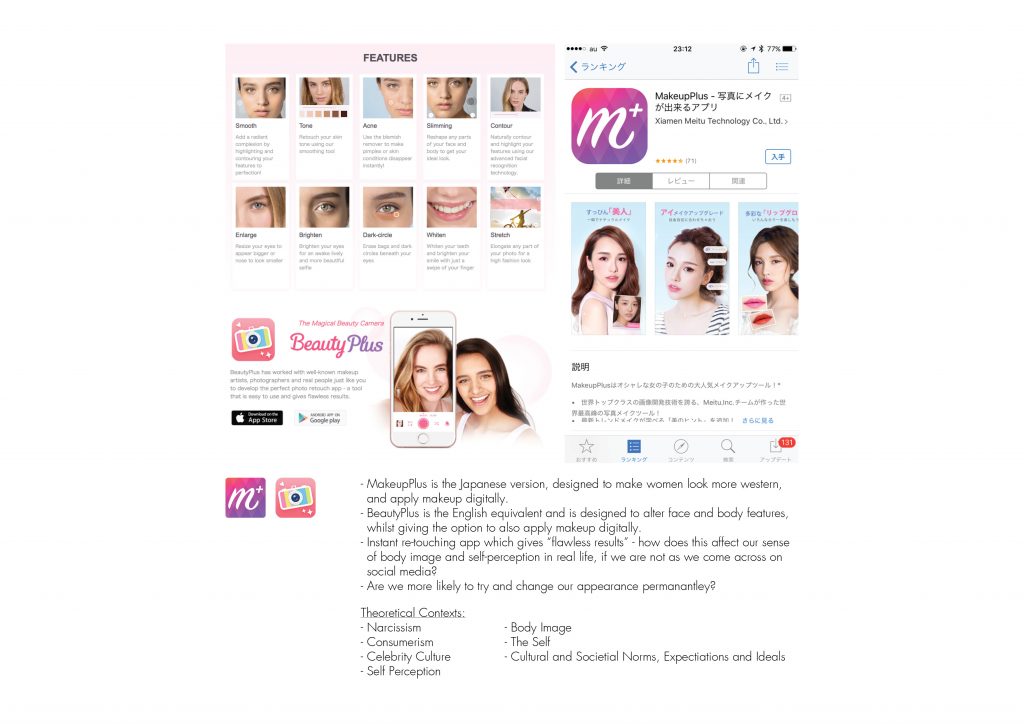
Below shows my initial Professional Context presentation plan, showcasing the surrounding professional contexts of my practice and how this relates in turn to my research question and project plans.
I am hoping to gain feedback from my personal supervisor in relation to moving this on forward. I am also planning on noting topics of discussion and removing the text from the presentation slides – these notes have been made as reference for my tutor and myself, as well as for future development, planning and research.
This is working towards objective 1.
Whilst initially planning and outlining the contents and structure for my Professional Context presentation, I decided that I would talk about recent developments in technologies within the Beauty Industries, and how this relates to my practice, self-development and research question. This particular blog post will cover the topic of ‘makeup’ apps.
–
I find that in today’s conformist and consumerist society, we are becoming much more influenced by beauty brands due to new innovative and instantly accessible social channels lending themselves to various forms of visual marketing and advertising. Adverts and campaigns are not only seen in magazines and store windows anymore models, bloggers/bloggers, influencers and associative brands are taking over and using social media, application design and UX/UI to their advantage, creating an engaging and empowering platform for end-users to work and engage with. Whilst the noted technologies are still quite new, and are constantly being trailed, tested and improved, organisations are still rapidly competing and are continually researching, learning and developing new digital processes and techniques, in order to create the best and most up-to date apps, with the most advanced features. This allows for brands and their associative applications to gain the best number of sales and active users, therefore gaining brand influence, engagement, loyalty and power within a world of consumer culture.
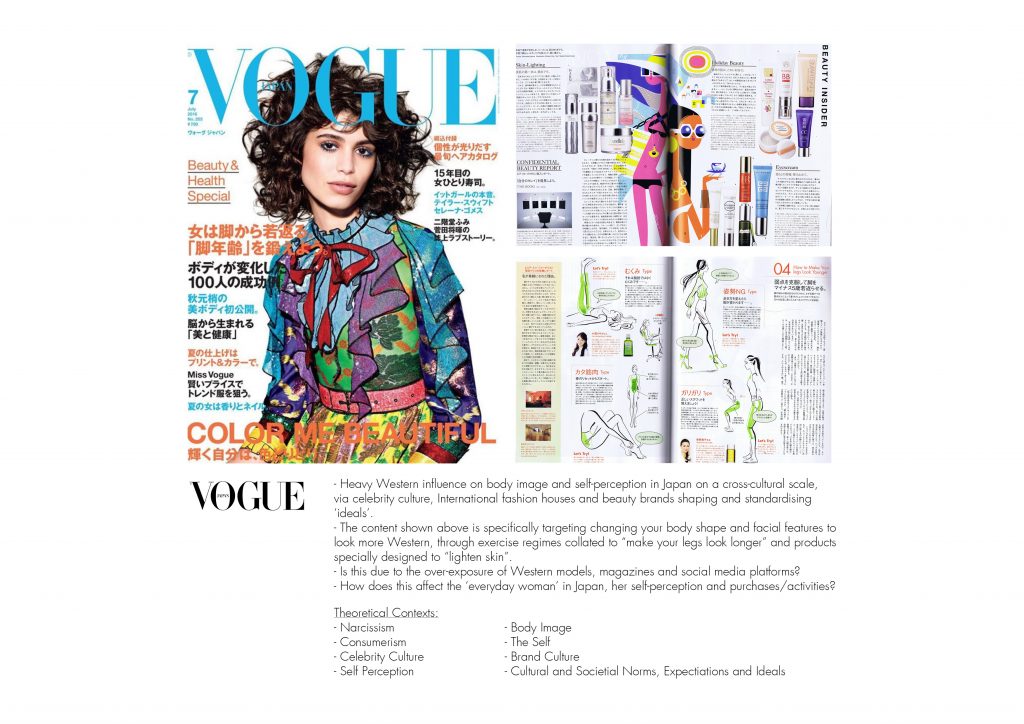
Researching further into this, I found several ‘beautifying’ apps which can transform, change or manipulate your appearance in different ways, each of which target different audiences and needs, and therefore use different technologies and use different ‘features’. However, I am also interested in how these applications and new technologies can be damaging to our self-perception, and in return, how we are perceived. I found this particularly relevant in regards to the Beauty Plus app and how this is used heavily by a Japanese and Chinese audience, in an aim to Westernising their looks through lightening their skin, widening their eyes and elongating their legs for example. These are all topics of discussion and promotion which were also found in the July 2016 edition of Vogue Japan ‘Health and Beauty Special’ – please see scanned in images below for reference of this. I was also surprised to see International brands such as Clarins conforming to such trends and releasing its own skin-lightening product – again please see scanned in images below for reference.
I feel these applications really show the advances in technology within this industry and how it is being used by brands around the world to their advantage whether to promote a product, increase consumer loyalty or make-up a digital element of a larger campaign, but again allows for a negative in retrospect in regards to the way we can edit our appearance digitally so easily and instantaneously, creating flawless looks which may not be so easily achievable in real-life and again promoting celebrity culture and the standardisation of what beauty should be on a cross-cultural scale. The beauty boom in Asia has also been noted through the popularity of the Chinese edition of the L’Oreal Makeup Genuis app, as evidenced in the article noted below. China have proved through their various user-interaction based marketing mediums that engaging with the consumer is a proven winner for promoting new products whilst promoting and exposing new found uses of technologies within a relevant context.


In a nut shell, the idea of these new technologies allows us to edit our pre-existing photographs or edit our appearance in real-time (depending on the chosen app) in order to look “flawless”. But regardless of technologies, the pressure to look like the ‘final look’ and take a “flawless” selfie, can really add to the pressure of looking a certain way and maintaining a certain ‘standard’ of image. What happens if we cannot maintain these ‘looks’? What if we cannot recreate that “flawless” look ourselves? How do these technologies add to the debates amongst body image and self-perception within a world which is becoming more narcissistic, controlling and standardised? How does Western culture influence body image and self-perception in other countries due to the accessibility of celebrity culture, bloggers/vloggers, social media and the idea of the standardisation of beauty?
Below shows four different examples of these new technologies in context of Celebrity Culture, Consumer Trends, Brand Engagement and User Interaction. Along with imagery are small articles or quotes further describing the technologies and formalities of each.

L’Oreal Makeup Genuis App
Image Source (Last accessed 2/12/16)
“There’s something scary about trying on makeup at the drugstore: what if you apply a new blush to your face, just to try it out, and then you walk out looking several shades too dark? That classifies as an actual beauty disaster, and is something none of us want to experience—and now, thanks to the makeup geniuses at L’Oreal, we don’t have to!
The beauty brand just launched an app that allows you to try on makeup without actually trying on makeup, right from the comfort of your home—or wherever you and your smart phone happen to be. The thing that separates the L’Oreal app from all the other makeover apps already on the market is that this is the first of its kind that actually allows you to apply lipstick, eye liner, eye shadow, and blush to yourself, as opposed to a mannequin-esque face that’s meant to resemble your own.
You scan your face using the front-facing camera on your iPhone—yes, the same way you take a #selfie—and the app’s technology reads everything from your face shape to your expressions. You then can begin applying L’Oreal makeup digitally to your own face in real time, watching the makeup you put on move as your face does.
The app took over 10 years to develop and uses the same technology that transformed Brad Pitt in The Curious Case of Benjamin Button, which won Oscars for both makeup and visual effects. It essentially turns your phone into a mirror, allowing you to see what you really look like with certain shades of (for instance) bronzer, eyeliner, and lipstick.
The app will also launch in select drugstores on tablets, where you can play around with makeup and then buy it right after.”
– Who What Wear (Last accessed 2/12/16)

L’Oreal Makeup Genuis – China Edition
Image Source (Last accessed 2/12/16)
“China has been a massive market for the app, bringing 4.7 million of its total 14 million downloads. That’s partly because of the size of the country’s internet population: 668 million people, with 594 million of those going online with mobile devices, according to official figures from the China Internet Network Information Center. And it’s also because it allows curious young women to try out heavier makeup, which is still uncommon in China.
“Girls in China can be shy to apply makeup if they are at the counter or if they are going out with friends — they don’t want to put on very dark lipstick, very dark eye shadow,” said Asmita Dubey, chief marketing officer for L’Oréal China.
“There’s no culture of makeup passed down from mom to daughter that has been there for years, so for a girl like that to get a virtual experience and try some new looks, that’s something she wants to do,” said Ms. Dubey, honored as one of Ad Age’s 2015 Women to Watch China for promoting innovations in mobile marketing for China’s No. 1 skin-care player and second-biggest advertiser.”
Further Digital Initiatives from L’Oreal:
Shake the smartphone: L’Oréal’s Maybelline brand sponsors a TV makeover show called “Cinderella.” It appears on traditional Chinese state television, CCTV, but it got a digital and mobile boost through a partnership with Tencent, the Chinese internet giant. During the show, people saw a message on the screen telling them to shake their smartphones. When they followed through, a page would pop up on their phones offering a tutorial video of the makeover looks people saw on the screen.
WeChat ads: Tencent’s ubiquitous mobile app WeChat had been mostly ad-free until this year, when sponsored messages started popping up on people’s newsfeeds. During the Cannes Film Festival in May, people who clicked on a picture of L’Oréal brand ambassador Fan Bing Bing opened a video with the Chinese megastar actress inviting them to virtually join her at Cannes. Many started following L’Oréal on WeChat, got updates on her looks at the festival and bought products via smartphone.
“Mobile social commerce apps is exactly where beauty is going,” Ms. Dubey said.
User-generated content: In China, online product reviews are a prevalent form of user-generated content – people devote a lot of energy to writing about products and taking pictures and videos of them. Tapping into that, L’Oréal’s Lancome has Rose Beauty, a social platform aggregating product reviews from users.
It offers tutorials, product info and samples so people can post their own videos of trying products out. “It becomes your product review platform, your community platform, your beauty platform,” Ms. Dubey said. And it links back to e-commerce, of course.
– AdAge (Last accessed 2/12/16)
 Rimmel Get The Look App
Image Source (Last accessed 2/12/16)
“The first beauty app that lets you snap any look and try it on live! SNAP – Take a picture of a makeup look in a magazine or from a real person, TRY – Try her look virtually live in the app, SHARE – Share your look with friends, BUY – Buy any product from the app”
– Rimmel (Last accessed 2/12/16)


BeautyPlus – Makeup Camera App
Image Source (Last accessed 2/12/16)
“BeautyPlus has worked with well-known makeup artists, photographers and real people just like you to develop the perfect photo retouch app – a tool that is easy to use and gives flawless results.”
– BeautyPlus (Last accessed 2/12/16)
“We have over 900 million users around the world, Meitu is a leading leading beauty and lifestyle app developer as well as a global innovator in mobile video and photography, including proprietary facial recognition and virtual “try-on” technologies for makeup, hair and fashion.”
– Meitu (Last accessed 2/12/16)
BeautyPlus is created by, Meitu whom are currently “seeking strategic partnerships with brands and influencers in the fashion, beauty and entertainment industries … At Meitu, we are obsessed with beauty, makeup and fashion. We are always looking for new ways to leverage our technology to help consumers discover new looks and shape their own styles. We are currently seeking strategic partnerships with brands and influencers in the fashion, beauty and entertainment industries. We can provide a unique, immersive and culturally relevant way for brands to connect with female consumers all around the world.”
– Meitu (Last accessed 2/12/16)
“Meitu’s photo and video apps have over 270 million monthly users1.”
– Meitu (Last accessed 2/12/16)

Image Source (Last accessed 2/12/16)

Image Source (Last accessed 2/12/16)

In regards to planning my upcoming projects both practical, oral and written, it was important to me to plan ahead so I can see when I have submissions, key dates, inductions, planned events, freelance work and personal events in order to effectively use my time moving forward.
I initially began doing this on my desktop calendar (see above), using a colour coding system to plan my time, and then realised that this is probably not the best way of planning my time as I cannot clearly see in advance when submissions are in relation to when key events are to plan research, development and practical/written work accordingly, whilst leaving enough time to account for any changes and feedback to be taken into account. Therefore, I felt using a GANTT chart to plan the next 10 weeks, would allow me to see each module together as well as resolving the problems recognised and noted above (see below).
 I found the GANTT chart system quite daunting initially, however through grouping presentations, submissions and learning objectives on the left hand side, I have been able to now work through any issues and populate the next 10 weeks of the semester accurately. I found this rather systematic approach difficult to work with when planning one module in isolation, as I found when I collated all 3, some weeks had an unachievable amount of work and objectives to attain, and found a more beneficial approach to planning doing so by project.
This can be seen on the draft shown below:

From this GANTT chart, I then went on to planning in-depth weeks, which I found much harder to work out accurately as are more likely to change as projects develop, new ideas arise, or problems arise, therefore I have not digitised these as I feel it would be wasting too much time revising them. Therefore, I have decided to keep these separate for on-going evaluation, reflection and revision each week to see if the work load is achievable to a high-standard, and if not, I will be looking to use the GANTT chart as a guide to see when there is time to reallocate. I am hoping that after using these methods of planning for several weeks any major problems can be addressed effectively to avoid any further issues. By planning to LO’s as well as projects, this chart will enable me to see what objectives I have and haven’t fulfilled as time moves on.
I have included an example of how my weekly plans look and work below:

It is interesting to think that social media is now overtaking publications in regards to ‘influence’, by having not only the capacity to feed the same content, but to also allow for brands and ‘influencers’ to engage directly and in real-time with their audience across a global range of platforms on a daily basis. Social media not only allows the audience to ‘follow’, view, watch and ‘like’, but to engage with others by commenting, encouraging re-posting and brand engagement, gaining feedback and analytical insights per video or photo, for example. On the other hand, publications can only be valued in this sense by the weekly, bi-monthy or monthly sales figures. This, unfortunately was clarified and confirmed by Alexander Shullman in the recent Vogue Documentary series aired on the BBC, whilst in discussion regarding which cover image would pull in more buyers to purchase the monthly read of the shelf. However, this sense of direct engagement within social media not only gives brands and ‘influencers’ immediate power over their following, but also gives a sense of direct interaction from the audience, making the end-user feel engaged and like an active part of the online community. Publications have always featured models, celebrities and ‘IT girls’, whilst now in present day, social media platforms have given us the ability to share our own photos with the same communities which we so religiously follow and strive to apart of. Like those, featured in the magazines.
As previously noted, most Fashion and Beauty-led publications are released weekly, bi-monthly or monthly, whilst social media is instantaneous and more importantly, constant. How does this ever-lasting stream of so-called ‘ideals’, ‘perfection’, bloggers/vloggers and social media ‘famous’ affect our own ideas of our body image and self-perception? Does this form of media affect us and influence us in a different way to magazines? Is this due to content on social media in comparison to magazines? Do people still read magazines and see them as a form of influence, or are we more enticed by social media for quick access and ease?
These are some of the questions and thoughts I want to explore through my research in regards to body image and self-perception issues with the beauty and fashion worlds.
Ultimately, with publications the Editors and Writers are responsible for choosing the stories, models and articles which we are exposed to and deem as modern day ‘ideals’, but with social media, it is us the public in a way whom collectively chose whom is deemed this limelight, wealth of influential powers and the ability to ultimately say what is ‘in’. Furthermore, the occurrence of ‘hashtags’ has allowed brands and ‘influencers’ to release content in accordance, following trends, fads and the ever-so important world of ‘pop-culture’. So who, or what within the Fashion and Beauty industries is the most influential in regards to our body image and self-perception?
Below shows a list of current forms of visual media which cross-over both platforms and are becoming more associative of each other as the Industries slowly convert their content to digital mediums. Throughout my studies and research, I hope to look into these further on a more contextual and theoretical level, as well as on a visual basis:
Following this, I wanted to further explore this within the context of my research question, in order to effectively plan my time and resources going forward for both research and practical based projects.
I have executed this in the form of a mind-map in order to contextualise and understand the links between the two main forms of mass media I have decided to explore within the fashion and beauty industries, allowing me to both pose research topics and questions as to how these collectively affect our sense of body image and self-perception.
From the first mind-map shown below, I started off looking at magazines and social media within the context of my research question and proposal, however realised at this point that my question at the moment is quite vast and could be interpreted in different ways, whereas the areas I have stated for research and have initially been researching are not specifically mentioned in the question itself, more so in the rationale. Therefore, I have chosen to change the question from “How and why the Fashion and Beauty Industries affect our sense of body image and self-perception?” to, “How do Magazines and Social Media within the Fashion and Beauty Industries, affect our sense of body image and self-perception?” Not only does this clarify my research topic for my peer group and visitors to the blog, but also helps streamline my research and project planning further.

A revised and more explosive, in-depth mind-map can also be seen below following changes noted as above. I am hoping to use this mind-map along with detailed plans for each of the three initial briefs to assess what research needs to be carried out and how I can do so effectively, objectives and aims for each module, as well as to assist with continual forward planning and initial reference points.