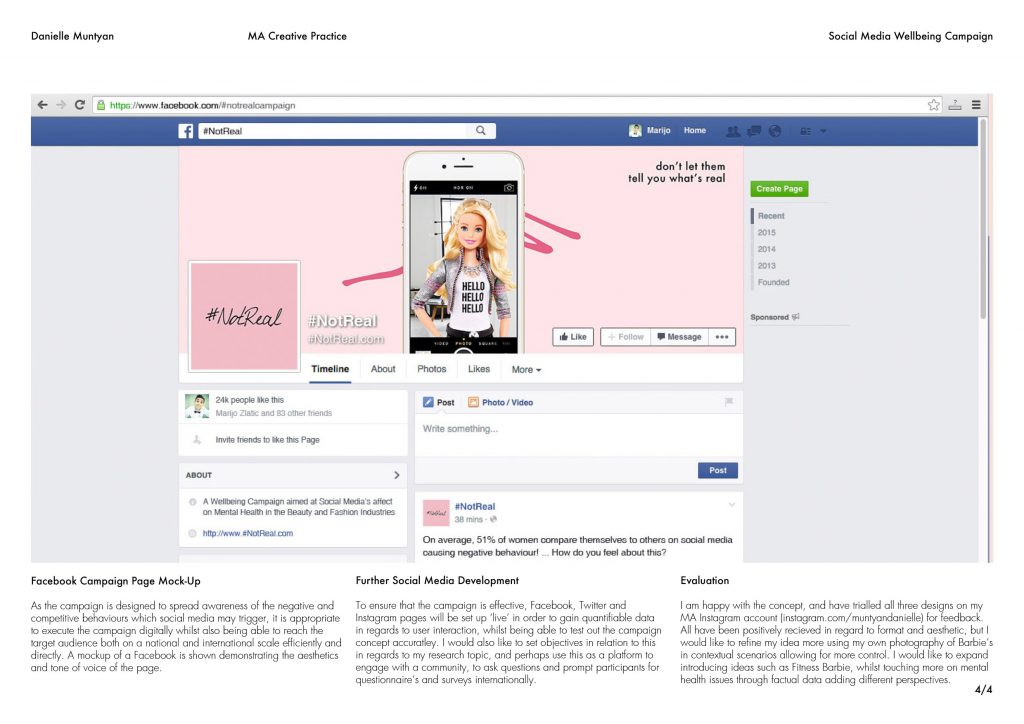
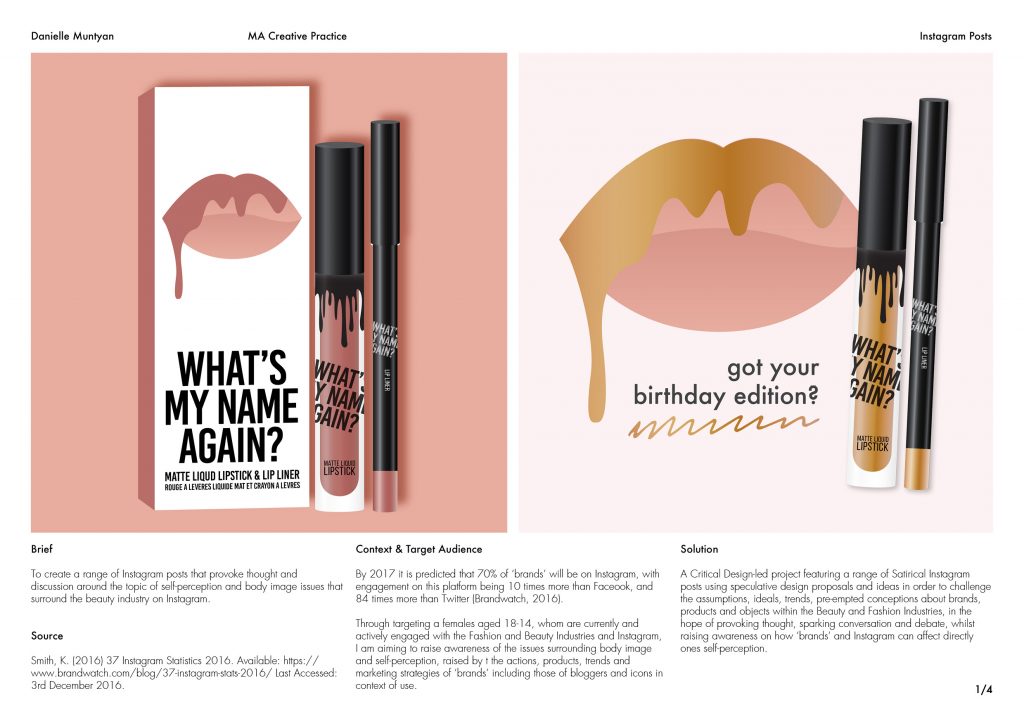
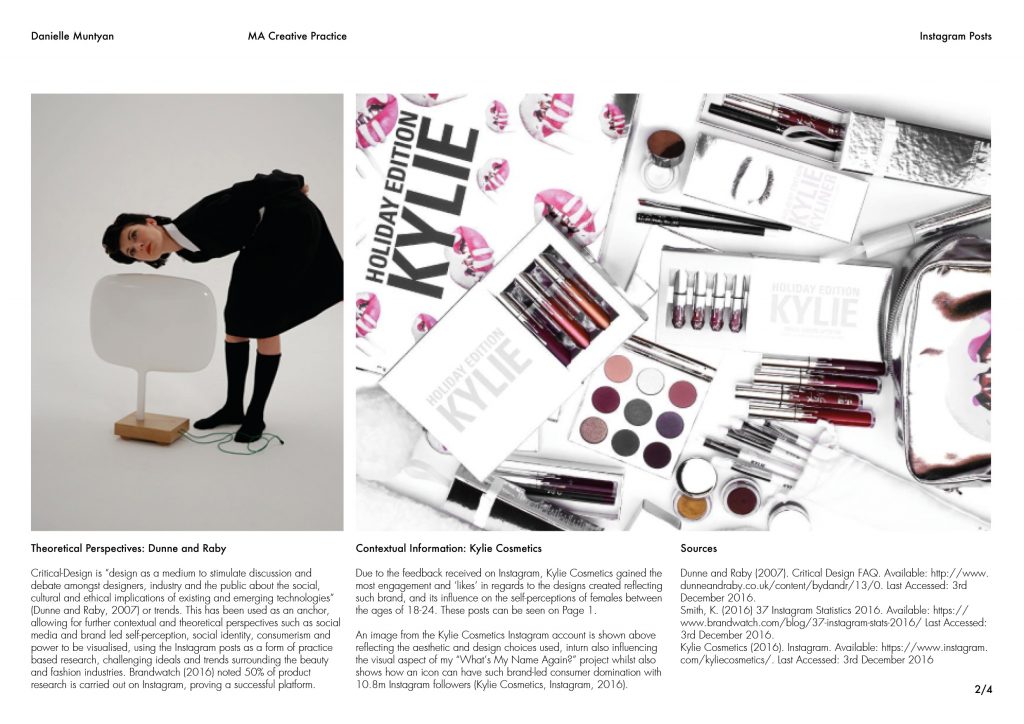
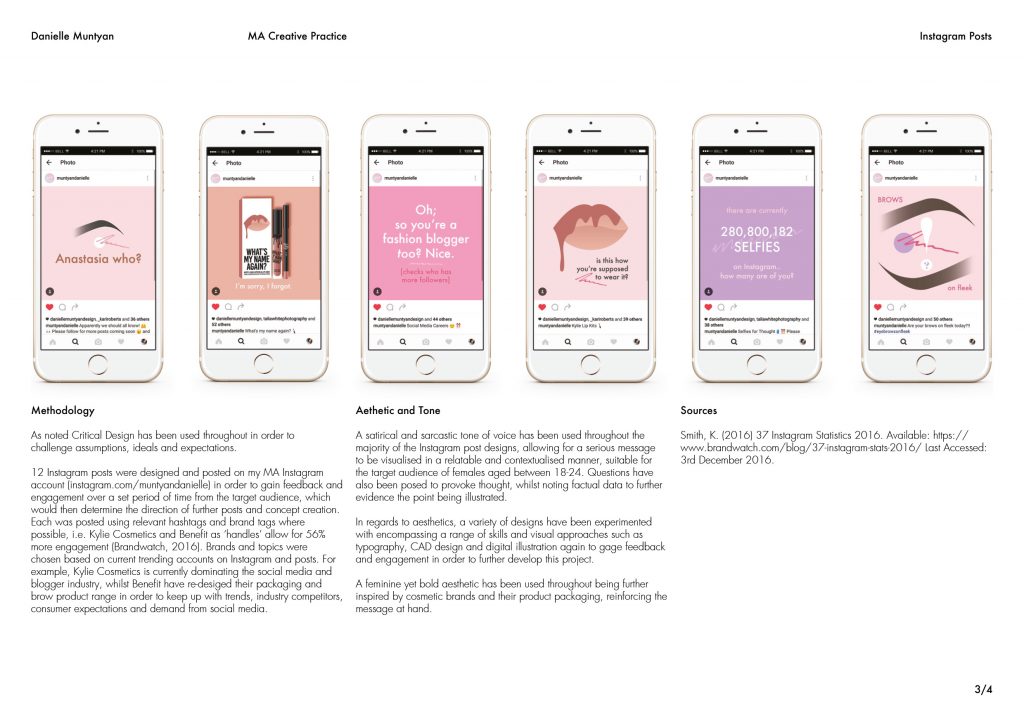
‘Cultivating Japanese Whiteness’ Ashikari, M (2005)

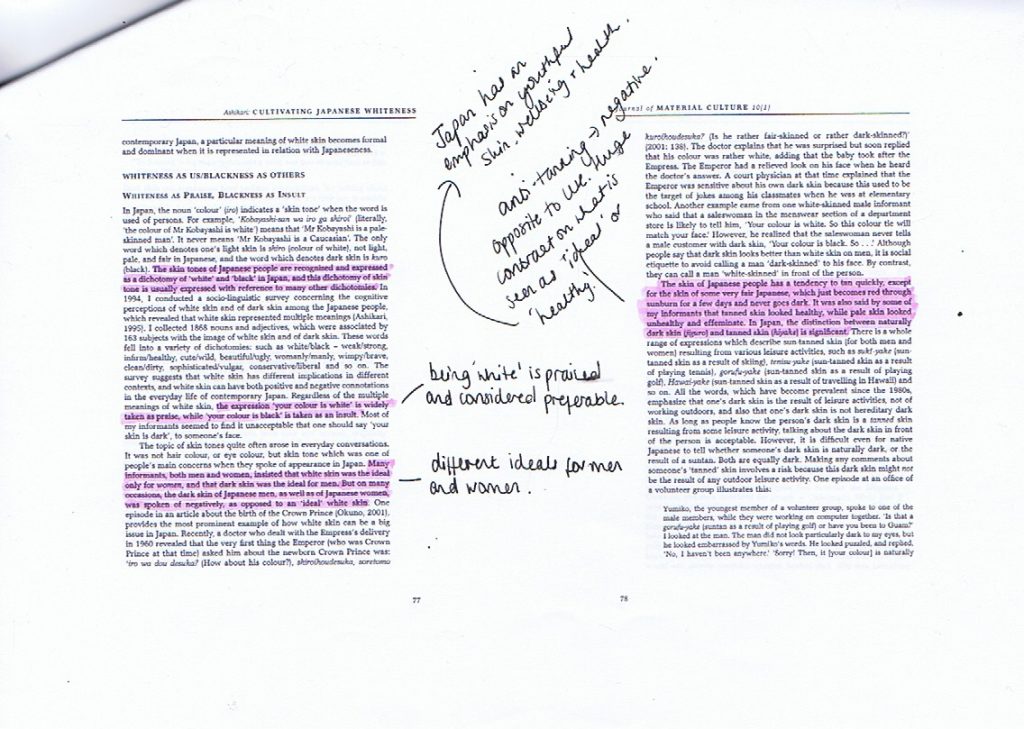
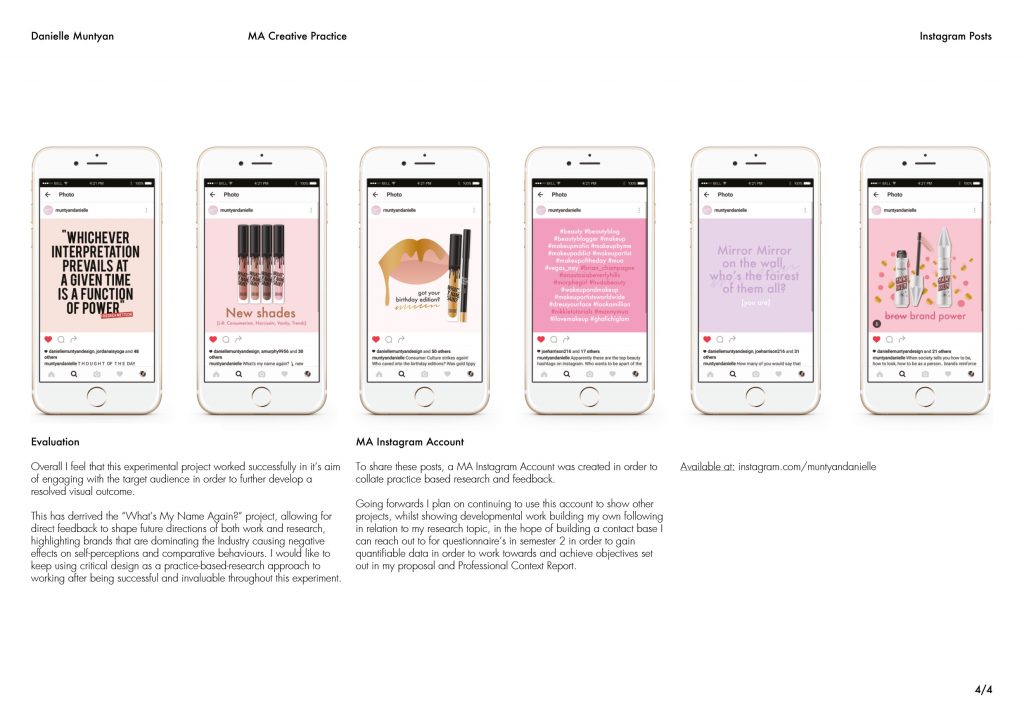
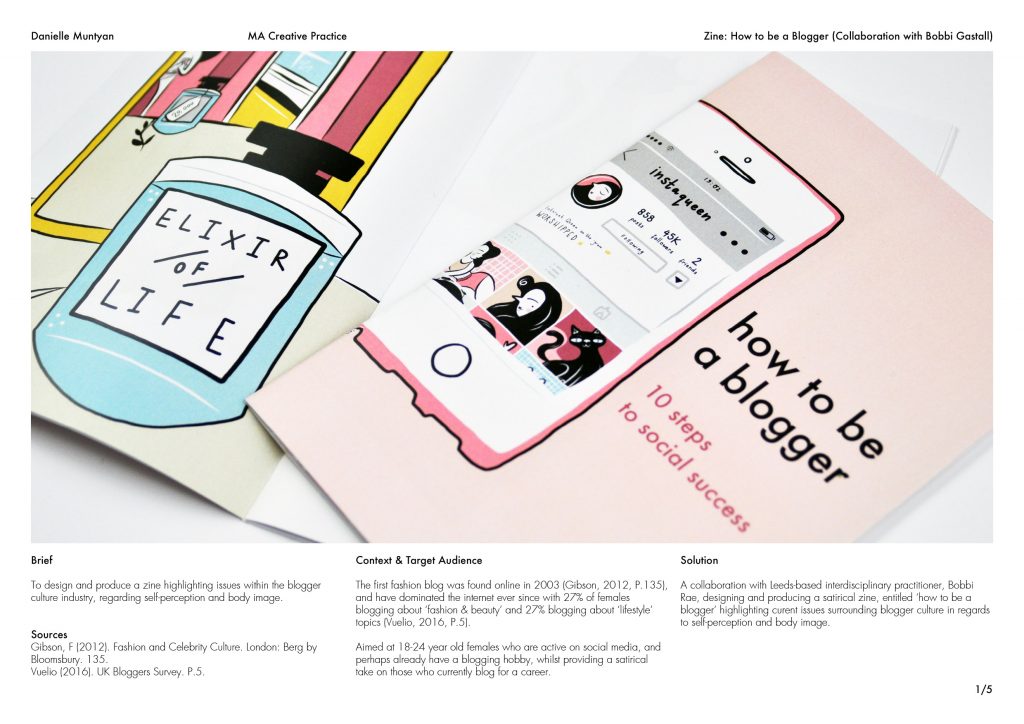
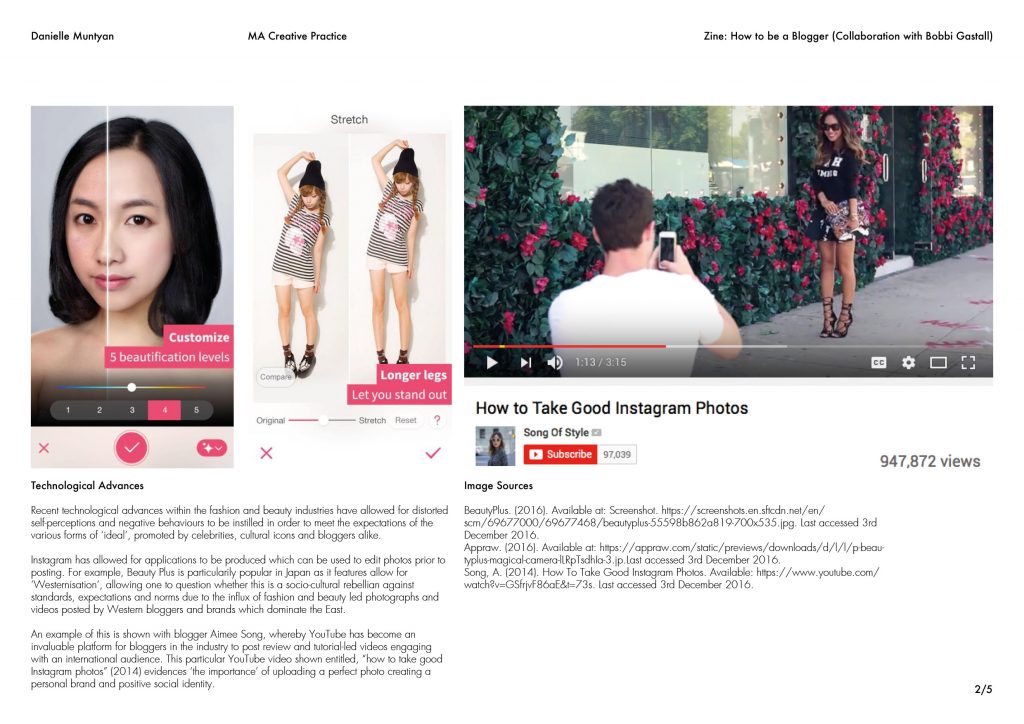
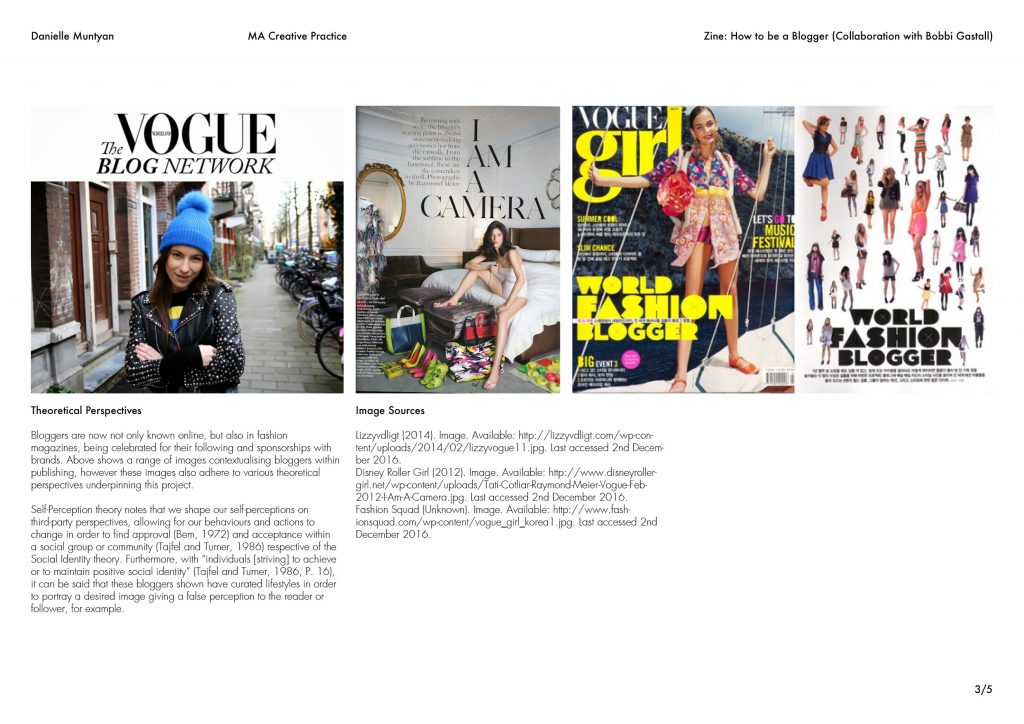
Below shows part of a journal written by Ashikari (2005), regarding the well-know Japanese beauty trend of ‘skin-lightening’. This journal in particular looks at this in a cultural, historical and social context. It also highlights how both Japanese and Western brands uses suggestive and clever copywriting and marketing within their ad campaigns. This is something which I will be looking out for during my research trip to Tokyo.

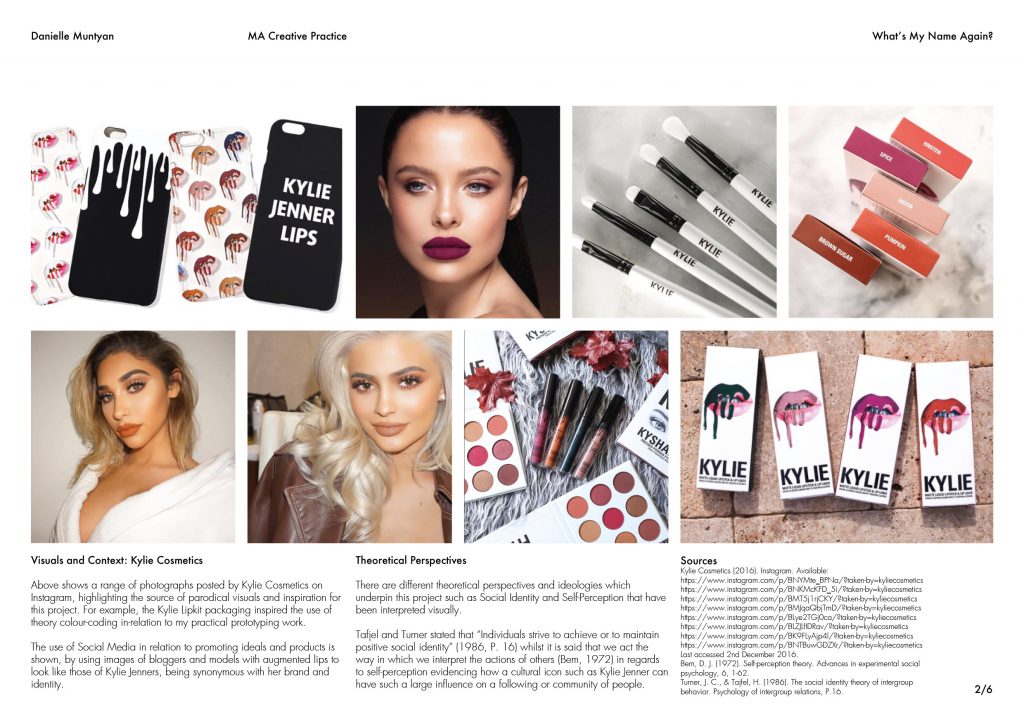
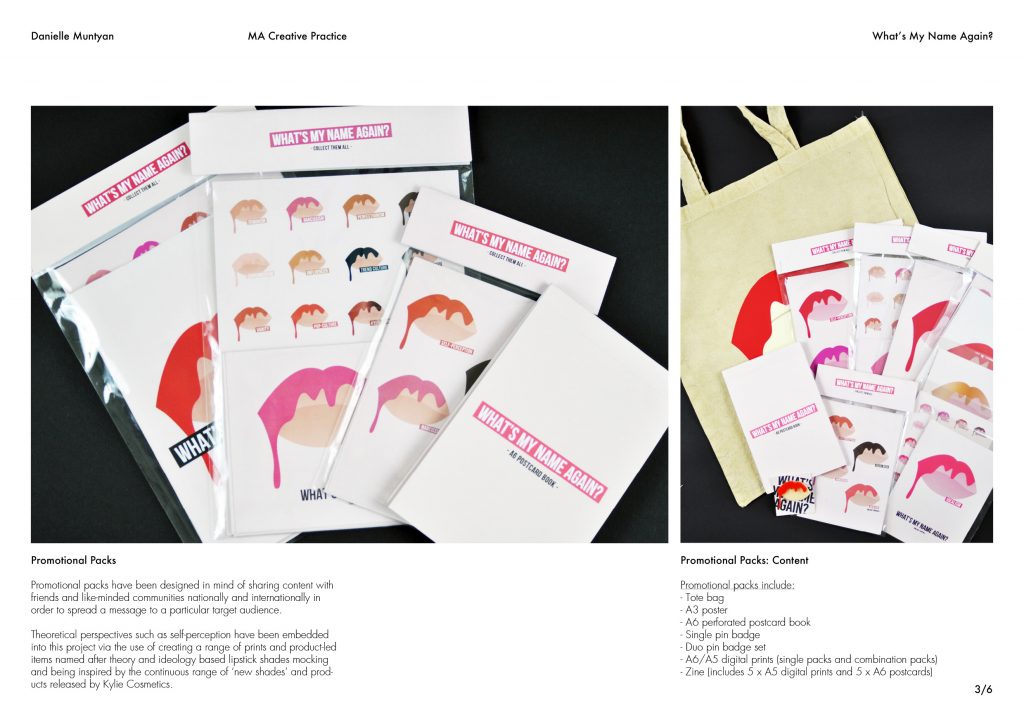
Main points raised throughout the journal:

  • Two perspectives on the ‘skin lightening’ trend, and where this has stemmed from – western influences and commercialisation, as well as traditional values and historical cultures in Japan (if you were a woman whom worked an outdoor labouring job, this seen as a ‘poor’ trade and meant you tanned naturally, whilst those in aristocracy or working inside, allowed for a more affluent lifestyle, and lighter skin).
  • Copywriting and marketing of consumer goods and magazines can be tactful and clever.
  • Opposite to the UK – tanning is popular in the UK and is seen as a sign of affluence and holiday-going.
  • Ties with traditional Japanese culture, symbols and identity – the Geisha.
  • ‘White’ skin is considered beautiful and more preferable.
  • Emphasis on ‘youthful and natural’ skin via anti-ageing and skin-lightening products, opposed to heavy makeup trends, as often seen in Western culture.
  • Allows for a feeling of inclusion and belonging.
  • Cannot escape the ‘ideal’ due to an influx of the above points.

The above points I would like to talk to about further whilst seeing Vogue Japan, and a Japanese Beauty Blogger I have made contact with in Tokyo, whilst on my trip in order to gain their insights and perspectives on this, whilst affirming the points made throughout this journal.

cvj-article cvj-article-1 cvj-article-2 cvj-article-3 cvj-article-4 cvj-article-5 cvj-article-6 cvj-article-7 cvj-article-8


Source:
Ashikari, M. (2005). Cultivating Japanese Whiteness. Journal of Material Culture. 10 (1), P. 73-90.

Shiseido: About, History and Context

Shiseido has arisen in research several times throughout my research to date:

Semester 1

  • Looking at Skin Lightening Creams.

Semester 2

  • Comp shopping for cross-cultural comparisons on product range and promotional materials.
  • Advertising materials discussed during conversation with Toni Hollowood.
  • Discussed in regards to informative tutorials on product and brand by Lisa Eldridge (see previous post).
  • In the journal, “Cultivating Japanese Whiteness” (2005) by Mikiko Ashikari in regards to influential copywriting within advertising, and brand-based collateral.

I therefore decided to research more into the Japanese brand before travelling to Tokyo, to carry out primary research. I wanted to look into their history, as through my reading and research to date, it has become apparent of late that Shiseido have been, and are still, extremely large influencers in Japanese ideals of beauty.

‘Shiseido Group’ now controls multiple brands in multiple countries across the world, opposed to being a Japanese company (i.e. NARS USA and Issy Mayake Fragrances). This is reflected through the imagery on the homepage of the group website below, however the copywriting, in my opinion reflects a somewhat indirect connection with a specific Japanese audience. I feel this is also highlighted, indirectly yet consciously, by the Japanese woman situated in the centre of the gridded images.

The copy reads;

“Beauty lies within… and every time we bring it to light, we make the world a little brighter”.

From my research, I found the use of the world “light” to signify ‘white’ – none of the 9 shown are of Black Caribbean or African decent, for example. The 9 people shown are of either caucasian or asian decent, hinting at racial prejudices and racial identity still being key factors for a Japanese brand. This is an idea discussed heavily in the writings of Mikiko Ashikari’s “Cultivating Japanese Whiteness” (2005), whereby it is stated that:

“Hiroshi Wagatsuma, a Japanese anthropologist who studied in the US, was probably the first to conduct anthropological research on skin colour in Japan. In his English article of 1967, he argued that a dichotomy observed in the 1960s in Japan, ‘white/beautiful versus black/ugly’, should be attributed to Japanese aesthetic values (Wagatsuma, 1967: 407)”

Ashikari (2005) also notes in regards to racial identity that:

“A lot of recent studies suggest that Japanese identity is largely based on a sense of racial identity (see Kondo, 1997; Oguma, 1995; Siddle, 1997; Weiner, 1997; Yoshino, 1992, 1997). Most studies conclude thus, by examining either historical documents or racial images distributed by the mass media in contemporary Japan.”

screen-shot-2017-01-11-at-21-16-30

Image Source

In relation to the copywriting below of the ‘brand message’, I found it staggering that the word, ‘beautifully’ is noted 5 times in the screenshot below, plus the use of the word, ‘beautiful’ once. The emphasis on living a beautiful life, essentially gives consumers the ideology and belief that through buying into their brand and products, they can also live “This life. Beautifully.” too.

screen-shot-2017-01-11-at-21-16-54

Image Source

Below covers Shiseido’s history as a brand which allows for understanding of present day the beauty cultures in Japan. Excerpts have been taken from the ‘History’ page on the Shiseido Group website, along with visual and written contextual support from Weisenfield’s Visualising Culture; Selling Shiseido (2009) visual essay. I found this extremely interesting to read, and found overlaps from recent conversation and other academic research regarding modern positioning of cosmetics and beauty in Japan, whilst being able to relate to theories such as ‘The Gaze” (Mulvey, L. 1999) and “The Self-Surveying Gaze” (Shields and Heineken. 2002), for example, which were analysed in Semester 1.

I have chosen to include key excerpts which I feel encompass the history as a brand and have perhaps furthermore shaped present day perceptions and ideologies of the Japanese, and ‘Japaneseness’, allowing a better understanding in relation to my research topic.

Overall the below reflects a range of key-topics such as; skin-lightening products, their use of theory-led advertising campaigns and western models, whilst also accounting for social and cultural history of ‘working class women’.

History of Shiseido in Conext:

  • Established in 1872 in Ginza, Tokyo
  • Releases “Seven Colours Face Powder” in 1917

This was a white powder which was made up of seven colours in order to match each skin tone – white, yellow, flesh, rose, peony, green and purple. The powder was very popular among Geishas as a means of “projecting an appealing image under the lights”.

  • Released the nine-color “Modern Colour Face Powder ” in 1932.
  • Released the 1st “Shiseido Geppo”, a cultural information magazine for their customers. This ran until 1931.
  • Designed Japanese logo in 1927.
  • Designed Western version of the logo in 1928.
  • ‘The Miss Shiseido’ Promotional Campaigns began in 1934.

In 1934, nine women (chosen from 240) debuted as ‘Miss Shiseido’ (a beauty consultant). Over the course of seven months of preparatory training, the women studied in such areas as beauty techniques, cosmetology, dermatology, physiology, publicity, dress, fashion, singing, Western painting and drawing, and etiquette, and they were expected to display a wide range of knowledge and sophistication. The first engagement for the Miss Shiseido women was the Theater of Modern Beauty, which opened throughout Japan beginning with Takashimaya in Osaka. Presented in a stage format, the five scenes were a unique way of introducing the latest beauty methods and techniques so that the audience could absorb beauty knowledge while enjoying the show.

After the performance, the women quickly changed into their uniforms and provided beauty counseling to each visitor one by one, and wrote down beauty prescriptions for them.

This was the start of the “counter activity” (storefront activity) to introduce beauty methods that suited the skin type and taste of each customer.

screen-shot-2017-01-11-at-22-19-29screen-shot-2017-01-11-at-22-19-42screen-shot-2017-01-11-at-22-19-51 (Above, P.34-36)

  • First makeup campaign in launched in 1961.

At the time the Japanese economy was stable, the age of mass production and mass consumption had begun, and people’s living standards had improved. Against this background, Shiseido put on its ’61 Candy Tone campaign to bring to the forefront the seven lipstick colors that were expected to be fashionable that spring. A good impression was made on consumers through cooperation between advertising and points of sale. Starting with this campaign, Shiseido would go on to expand each of its seasonal campaigns.

  • Launches “Beloved by the Sun” campaign in 1966, which was shot in Hawaii.

In 1966, Shiseido adopted the “sun” as the theme of its “Beloved by the Sun” summer campaign featuring the healthy beauty of tanned skin. The campaign was a big success, turning people towards the idea that tanned skin was part of a woman’s right to be beautiful.In addition, it was the first time in Japan that an overseas photo shoot had been done in Hawaii, making the posters so popular for a time that they were being stolen from stores throughout Japan, and the formerly unknown model, Bibari Maeda, became a star overnight. This summer campaign was the start of promotions glorifying summer under the shining sun.

  • “The Art of Beauty” Exhibition launched in 1985, celebrating 113 of Advertising from Shiseido.

In 1985, at the request of the New York Fashion Institute of Technology (FIT), “The Art of Beauty” exhibition of Shiseido advertising was held as part of the twentieth anniversary commemorative event for Shiseido Cosmetics America. Ad designs and posters, as well as product packaging and more were shown in contemporary settings. High praise was showered on the original artistic qualities of Shiseido’s advertising materials.The following year, the collection was further enriched with the Shiseido Advertising Art Exhibition organized by a Paris advertising art gallery. Shiseido’s design work was a unique visual expression of a hybrid between traditional Japanese culture, and French art nouveau and art deco, receiving praise from many French people.

Company cultural exhibitions were held thereafter such as “Paris-Tokyo-Paris Shiseido 1897-1997 La Beaute,” organized in 1997 by the Musée des Arts Décoratifs in Paris, and “Face to Face: Shiseido and the Manufacture of Beauty, 1900-2000,” organized in 2000 by New York University’s Grey Art Gallery.

These activities have made Shiseido’s originality stand out and have contributed to the company’s prestige.

  • 1997: Corporate and Social Responsibilities introduced.

Announced ‘The Shiseido Way’ (corporate behavior) and announces ‘The Shiseido Code’ (corporate ethics and behavior standards). This has now been reintroduced in 2011 as the Shiseido Group Corporate Philosophy under the banner “Our Mission, Values and Way.”

  • Lisa Eldridge teamed up with Shiseido in 1998, working on a brand new make-up line, targeted specifically at the Asian market.
  • 2000: Holds Face to Face: Shiseido and the Manufacture of Beauty 1900-2000 Exhibition (Grey Art Gallery, New York University)
  • Online Archive of Shiseido Advertising

Sources:
Shiseido. (2016). History. Available: http://www.shiseidogroup.com/company/past/history/. Last accessed 11th January 2017.
Shiseido. (2016). History. Available: http://www.shiseidogroup.com/company/message/?rt_bt=menu-company-main_004. Last accessed 11th January 2017.
Weisenfield, G (2009). Visualising Culture; Selling Shiseido. Massachusetts: Massachusetts Institute of Technology. P.34-36.
Ashikari, M. (2005). Cultivating Japanese Whiteness. Journal of Material Culture. 10 (1), P. 75-6.

Japanese Beauty: “Japanese Makeup Look, Haul and Chat” with Lisa Eldridge

I came across this video whilst researching Japanese Beauty Culture and views towards Makeup more in depth. I feel it is important to know as much as possible surrounding this subject area, before visiting Japan, and liaising with professionals and bloggers alike. I also want to be aware so I can compare cross-culturally in regards to the UK, for example, allowing to truly respond to my research topic.
I found this tutorial extremely informative in regards to the following:

  1. It is a makeup tutorial – a relatively new concept which has allowed bloggers in particular to engage socially on digital platforms, interacting with niche communities – however it is very informative and contextually sits perfectly within my research topic.
  2. Explores Japanese beauty trends and one of the ‘ideal’ makeup looks shaping Japaneseness and Japanese Identity for many.
  3. Lisa’s experience and knowledge on Japanese culture in relation to the beauty industry, leading to further research surrounding Shiseido in particular.
  4. Lisa was part of the team that helped create a new line for an Asian market, therefore being knowledgable on contrasts and similarities cross-culturally.

About Lisa:

  • “In 1998, Eldridge teamed up with Japanese make-up and skincare company Shiseido, who asked her to create a brand new make-up line for the Asian market.”
  • Eldridge is now Global Creative Director at Lancôme.

Key Points taken regarding Japanese Beauty, Culture, Tradition and Products:

  • Ideal base to makeup is ‘perfect’ pale skin, with no blemishes visible. Perfectly polished.
  • Foundation is worn that doesn’t leave too much shine on the skin.
  • Different sub-cultures will have different make-up trends, i.e. Harajuku.
  • Big eyes are popular – Anime influences, photo booths and apps available to achieve this when photographed. Also achieved with makeup; opening up the eyes with brush strokes, eyeshadow and eyeliner to rounded the eye.
  • False eyelashes are also huge in the consumer market, again allowing for eyes to be ‘larger’.
  • Brows are not so emphasised in Japan in contrast to the UK or more Western cultures, where there is a large emphasis on this trend, including, brow shape, brow routine and brow products/brands, for example.
  • Blusher has become more popular in the past 10 years.
  • ‘Contouring’ is not a huge trend in Japan, like Brows, opposed to in the UK/Western Countries currently.
  • Nudes, apricots and pale pink shades are favoured, or more often seen in Japan with many ‘looks’ and is seen as quite ‘glamourous’. Red lipstick is not seen as ‘glamourous’ in Japan, it is seen more as a traditional colour, and is said may only be worn with a Kimono for example, giving an example of cross-cultural differences. Red lipstick in the West can often be seen as provocative, for example.
  • Packaging is often ‘Kawaii’ (cute), reflecting again a different culture, whilst also reflecting the known Japanese trends of being youthful (many anti-ageing products on offer from both Japanese and Western brands).

Source:
Eldridge, L. (2015). Japanese Makeup Look, Haul and Chat – (and some BIG NEWS!). Available: https://www.youtube.com/watch?v=Yj792rF713w. Last accessed 11th January 2017.
Unknown. (2017). Lisa Eldridge. Available: https://en.wikipedia.org/wiki/Lisa_Eldridge. Last accessed 11th January 2017.

Japan Itinerary: 16th-23rd January 2017

I have compiled an itinerary for my research trip to Tokyo to ensure that I utilise my time and gain all of the necessary information required to write my dissertation and understand my research topic. I have found this to be a crucial to plan in such detail to ensure that travel runs smoothly, all places of interest (i.e. galleries) are covered, and that all meetings are attended. Forming a plan also allowed for me to see by ‘area’ what is ‘near by’, allowing to free up time on somedays and reconsolidate my initial itinerary to be more efficient.

I have another version of this itinerary with flight details, times, locations, meeting/interview information, and inner Tokyo travel routes which I will be using whilst in Tokyo, and will submit as a printed copy.

This is also working toward the following objectives:

1. To understand the ways in which Social Media and Magazines can affect self-perceptions and issues:

A) With body image (Females, 18-24)

B) With body image on a cross-cultural scale (Females, 18-24; Tokyo, Japan).

2. To understand policies and guidelines within the Fashion and Beauty Industries currently encouraging positive body image.

3. To work with and interview those both actively working in the Fashion and Beauty Industries, and those on a consumer/follower/user basis, to compare behaviours and perspectives in relation to body image and self-perceptions.

4. To prototype a range of design work targeted at 18-24 year old women, highlighting impacts of cross-cultural beauty/fashion trends on self-perceptions and body image.

MONDAY 16th

Travel to Japan (Full Day)

Train to Aiport
Fly to Tokyo
TUESDAY 17th
Arrive in Japan
Travel to Accommodation
Travel to Tokyo City
  • Travel and City Orientation
  • Food/Coffee Stop
  • Explore Local Area/Shops
  • Locate Local Galleries/Areas of Interest
  • Temple
Travel to Accommodation
WEDNESDAY 18th
Travel to Harajuku:
  • Meet a renowned Beauty Blogger for Beauty Shopping and Talk regarding Blogger Culture and Beauty in Harajuku
  • Walk through Omotesando on route to Harajuku
  • Explore Harajuku (LaForet Shopping Centre & LaForet Fashion Museum – Top Floor)
Travel to Accommodation
THURSDAY 19th
 
Travel to Ginza (Morning):
  • Travel from Ginza Station to Advertising Museum/Library Tokyo (Opens 11am)
  • Explore Ginza Shopping Area (Vivienne Westwood Red Label, Shiseido, Uniqlo – Open until 8pm)
  • Ginza Graphic Gallery (Time Permitting)
  • Matsuya Ginza (Shopping Centre)
Travel to Shinjuku (Afternoon):
  • Walk to Bunka Gaukuen Costume Musum (opens 10am)
  • Explore Local Area/Shops/Food (Vivienne Westwood Red Label)
Travel to Accommodation:
 
FRIDAY 20th
 
Travel to Shibuya
  • Walk to Vivienne Westwood Japan (and other ‘Designer stores’)
  • Travel to Meeting
  • Explore Shibuya Area
Travel to Accommodation
 
SATURDAY 21st
Disney Sea
SUNDAY 22nd
 
TBC
 
MONDAY 23rd
Travel to UK

London Research Trip: Findings Mindmap

Below shows an overview of my research findings from my London research trip. In-depth notes have been made regarding the meeting with Toni Hollowood (separate blog post and included in appendices with audio recording), however the interview and findings with my model contact due to confidentiality agreements, will only be included in my appendices (with audio recording also).

In regards to the ‘Burberry’ and ‘Visual Research’ headings, these findings will be explored in Tokyo, Japan, off the back of this research trip in more detail, and will be discussed in conversation with Vogue, for example, whilst gaining comparative research (both contextual and visual).

This is also working toward the following objectives:

1. To understand the ways in which Social Media and Magazines can affect self-perceptions and issues:

A) With body image (Females, 18-24)

B) With body image on a cross-cultural scale (Females, 18-24; Tokyo, Japan).

2. To understand policies and guidelines within the Fashion and Beauty Industries currently encouraging positive body image.

3. To work with and interview those both actively working in the Fashion and Beauty Industries, and those on a consumer/follower/user basis, to compare behaviours and perspectives in relation to body image and self-perceptions.

london-mindmap

Manny Gutierrez for Maybelline Campaign/Reactions to Beauty and Fashion Male Market

I came across this ‘beauty news’ this morning whilst browsing through the new articles of Glamour online. I found it to be an interesting perspective in regard to my active research topic, particularly in relation to the power of social media in regards to influence and digital presence.

Maybelline announced its new ad campaign for its best selling “Big Shot Mascara by Colossal” with a twist – this is the first time that Maybelline has collaborated with beauty influencers, whilst also including a male influencer. To me this is a huge step forward in the world of beauty and social media relations, showing how influential platforms and influencers can be, not only influencing consumers (heavily discussed and researched in Semester 1) but now also brands to re-think their strategy and approach to a rapidly and drastically changing market, and industry. The male star, Manny Gutierrez, is more commonly known as Manny MUA (@MannyMUA733) and has almost 3 million followers on Instagram, showing a snapshot of his huge digital platform and presence, excluding his YouTube followers. By using Manny for this campaign, Maybelline are sending out a message that regardless of gender, makeup can be for you if you want it to be, reacting to the rise of male social media users, bloggers, makeup artists and makeup users. In addition, the Maybelline Campaign also features beauty influencer Shayla Mitchell (@MakeupShayla) as Manny’s female-counterpart. In the months to come I believe that we will see response continue with more major international brands jumping on the bandwagon to claim a share of this new, expanding and exciting market.

The popularity of male cosmetics and beauty regimes is something I predicted back in 2015 whilst employed with a cosmetics supplier, and slowly overtime this has become a reality. Brands over the past year have begun to include more males within their advertising campaigns and social media strategies, and furthermore have also began to include more gender-neutral product lines. I feel that this is another reaction to social media and male influencers such as Manny, whom have had a major impact on the industry through instant and increased accessibility to digital content.

I also believe that this is an indirect reaction to the growing awareness in mens fashions due to raised awareness at events such as LFW, whilst also taking into account the rise of male bloggers and male celebrity focused campaigns such as, David Beckham for H&M, allowing for males to also feel of the same identity and have a sense of connection. In addition, ASOS recently released a range of ‘mens choker necklaces’ driving the sense of equality in the fashion industry. This received extreme negative reactions online, with ‘tweets’ such as the following going viral:

“If I ever see a boy wearing a asos choker I will buy a gun and shoot myself,” user @tumber_10 wrote.

“ASOS have started selling men’s chokers,” wrote @aaronlxd. “Can already tell 2017 is gonna be a shite year.” (This tweet has more than 13,000 likes.)

“If my boyfriend wore them I’d leave him” wrote @courtneysoz.

In response to this David Yi, from Allure Magazine noted that negative response is “[promoting] the dangerous sentiment that men are supposed to adhere to hyper masculine culture. This ultimately fuels the so-called men’s rights movement, one that mitigates women’s—along with their allies’—fight toward equal rights. It allows chauvinism and homophobia to fester in small crevices and thrive across the country”, keeping gender-boundaries in-check and promoting oppressiveness of self-awareness.

By taking away these boundaries, more people are being able to become who they feel they truly are, opposed to what societies stereotyping has told them to be, which in turn is a positive reaction to self perception and awareness within social media.

This is reflected by the following examples, showing how brands are starting to become more inclusive for all. CoverGirl (an American Cosmetics brand) released a campaign with James Charles, whom became the first ‘CoverGuy’ and in addition, Giorgio Armani have recently released a lip balm titled, “Him/Her Lipcare” again taking away gender-boundaries.

Sources:
Yi, D. (2017). Chokers for Men: The Internet Is Freaking Out, and Here’s Why That’s Not OK. Available: http://www.allure.com/story/chokers-for-men-controversy. Last accessed 8th Jan 2017.
Reimel, E. (2017). Manny Gutierrez Is the First Man to Star in a Maybelline Campaign, and It’s a Huge Deal. Available: http://www.glamour.com/story/manny-gutierrez-maybelline-campaign. Last accessed 8th Jan 2017.


Semester 2: Objectives, Goals and POA

The below objectives and goals have been carried over from Semester 1, and will remain the same objectives which I am going to work towards throughout Semester 2.

Due to the types of research I plan on carrying out this semester, I believe that Objective 4 will change in regards to practical work, as I feel my research will inform this, and therefore have removed any specifics to allow for a clean slate to build from post-research and analysis of all work, and research to date. After looking quite broadly last semester, by narrowing and deepening my research this semester, I hope to have a very refined and direct final outcome which is relevant and in response to my research topic.

I also aim to work on Objective 5 post-research and post-interviews/meetings with Industry Professionals in both the UK and in Japan, to assess it’s viability before being produced/designed.

I have noted below each objective/goal research methodologies which will allow for these to be achieved.

Objectives and goals:

  1. To understand the ways in which Social Media and Magazines can affect self-perceptions and issues:

A) With body image (Females, 18-24)

B) With body image on a cross-cultural scale (Females, 18-24; Tokyo, Japan).

Questionnaire allowing for 18-24 year olds to complete the survey online, regardless of location (UK/Japan). I found this to be a good way of collating quantifiable data and analysing it, after finding it hard to connect with Japanese students in Japan (lack of contact information) and having little response back from HE Institutions in the UK. By having the questionnaire online also, it is possible to gain the trust of participants whilst also gaining a larger range of responses from a larger range of people, which may of been restricted via targeting Universities, for example.

I plan to keep this open to both males and females to gain different perspectives and comparative results, taking into account feedback from Semester. In addition to this, I plan on using my time in Japan (16th-23rd January 2017) to speak with Beauty Bloggers and Vogue, in order to understand this on a cross-cultural scale.

I plan on speaking with various other professionals to gain different perspectives, i.e. models and bodybuilders, whilst also speaking with like-minded creative practitioner, Toni Hollowood from CSM about her MA, similar research and practice.

  1. To understand policies and guidelines within the Fashion and Beauty Industries currently encouraging positive body image.

I plan on speaking with ASOS to understand an Industry perspective on this topic, in relation to their Model Welfare Policy and Corporate/Social Responsibilities.  

I plan on speaking with Vogue in Japan, and hopefully in the UK also regarding other positive strategies which are promoted/used throughout their publications and digital content.

  1.  To work with and interview those both actively working in the Fashion and Beauty Industries, and those on a consumer/follower/user basis, to compare behaviours and perspectives in relation to body image and self-perceptions.

See actions for Objective/Goal 1.

I also plan on speaking with professional international and national models, whilst speaking with beauty and/or fashion bloggers both in the UK and Japan. I have made contact already with bloggers in Japan ahead of my trip, and will now actively look for bloggers in the UK to contact also for comparable research.

  1. To prototype a range of design work targeted at 18-24 year old women, highlighting impacts of Social Media and Magazines on self-perceptions and body image.

I plan to carry out the main body of research for semester 2 prior to working on my practical work, as I believe that this semester will allow for the cross-cultural side of my research topic to be truly highlighted, and therefore visually used in context. I also feel I need to go to Japan and seek inspirations from their culture, galleries, products, advertising, etc, whilst taking into account research to date and upcoming interviews/meetings.

I do however have ideas which I would like to push and develop, however feel the key aim has to be to highlight the cross-cultural differences between the UK and Japan in relation to my research topic.

  1. To derive a National or International Policy for use within the Fashion and Beauty Industries, based on collated research, interviews and experiences throughout this project.

See actions for Objective/Goal 2.

In addition, I plan on carrying out all research prior to embarking on working soley towards this objective/goal. I have also recently been thinking critically whilst reflecting on the research/practical work done to date, that perhaps this is not the focus of my practice, but an interest which still needs to be explored and research in context. This leads me to note that, perhaps the practical-led work for this outcome should be as stated above, in Objective/Goal 4, opposed to a Policy Proposal. However, this will be discussed and considered further as my research unfolds, meetings are carried out and as interviews take place.

Semester 2: Research to-do

Before resuming research during Semester 2, I wanted to draw up a list of research-led actions which need to be taken to answer my research question, and meet my set objectives and goals going forwards.

  • London Research Trip – UK/Japan Comparisons (products, advertising, copywriting, models, etc), Interview with International Model and Meeting with CSM MA Fashion Communication Student/Art Director (Objective 3)
  • London Research Trip 2 – Meeting with ASOS (Objective 2, 3 and 5)
  • In-depth research on culture, makeup history and beauty in Japan in comparison to the UK
  • Japan Research Trip – UK/Japan Comparisons (products, advertising, copywriting, models, etc), Meeting with Beauty Bloggers and an International Publisher to gain different perspectives on my research topic
  • Interview analysis from Semester 1 & 2 (Objective 3)
  • Questionnaire for Public completion (UK & Japan) (Objective 1A/1B)
  • Policy – viability post-research analysis/meetings/interviews
  • Alternate Perspectives
  • Journals, Articles, Books
  • Visual/practice-led research (Objective 4)

Further Research for Semester 2

The below in particular is working towards objectives, 1, 2 and 3.

I have been unable to cover all of the research which I had intended to cover throughout this semester. I do not feel that this has been down to poor time management however, I feel it has been more to do with the amount of contextual research and theoretical perspectives that I have needed to be aware of, along with a wealth of practical exploratory work. I do not feel at this stage I have enough time to finish these elements of research competently, and to the highest standard, and therefore feel it is best to wait to work on these until post-semester 1 hand in. I will begin to work on these post-hand in and going into semester 2, alongside itinerary planning for my field-research trip to Tokyo. Again with this, I have had to contact organisations to enable to secure meetings to work around in relation to itinerary. The below will help also with my research trip and in particular when speaking with Beauty Editors at Vogue Japan.

I have also noted people I would still like to contact prior to my research trip, and again will begin to work on this immediately after hand-in to ensure enough time is allowed for in regards to international communication and contingency plans regarding this.

  • Vogue December UK and Vogue Japan October article analysis in the aim of understanding how the articles, models, products and copywriting may influence perceptions of women in a certain way
  • Vogue Japan analysis on articles related to social media/fashion and beauty bloggers/associated culture
  • Content comparison – brands, designers, products, trends (the same monthly issue will be used to do this)
  • Amount of Japanese models featured on average per Vogue Japan issue, opposed to Western
  • Vogue Japan and UK Media Pack analysis
  • Male Perception issues in relation to my research topic (feedback from professional context presentation 2)
  • Japanese beauty and culture in comparison to western cultures and ideals
  • Japanese averages and ideas in comparison to UK (elaboration on previous analysis work featured on blog in relation to this)
  • Japanese bloggers whom may be available for an interview in Tokyo, or via a digital questionnaire
  • B-EAT and APPG in relation to policies and guidelines supporting positive body image in the noted industries, as well as how policies are created and passed, working towards objectives 3 and 5.
  • I would also like to go through my original bibliography included with my proposal, in order to visit texts not covered due to new topics and research arising.

In relation to the above, points noted with ‘Vogue’ will also be carried out on my field-research trip on comp shops, looking at what products are for sale in the UK and in Japan, i.e. skin lightening products – are these also available in the UK from the same brands as in Japan (often Western) or simply only from Japanese brands due to changes in culture? These are the sort of investigations I plan on carrying out to work towards answering my research topic and objectives.