Selfie Culture: The Importance of Selfies within Social Media Cultures

This is working towards objective 1.

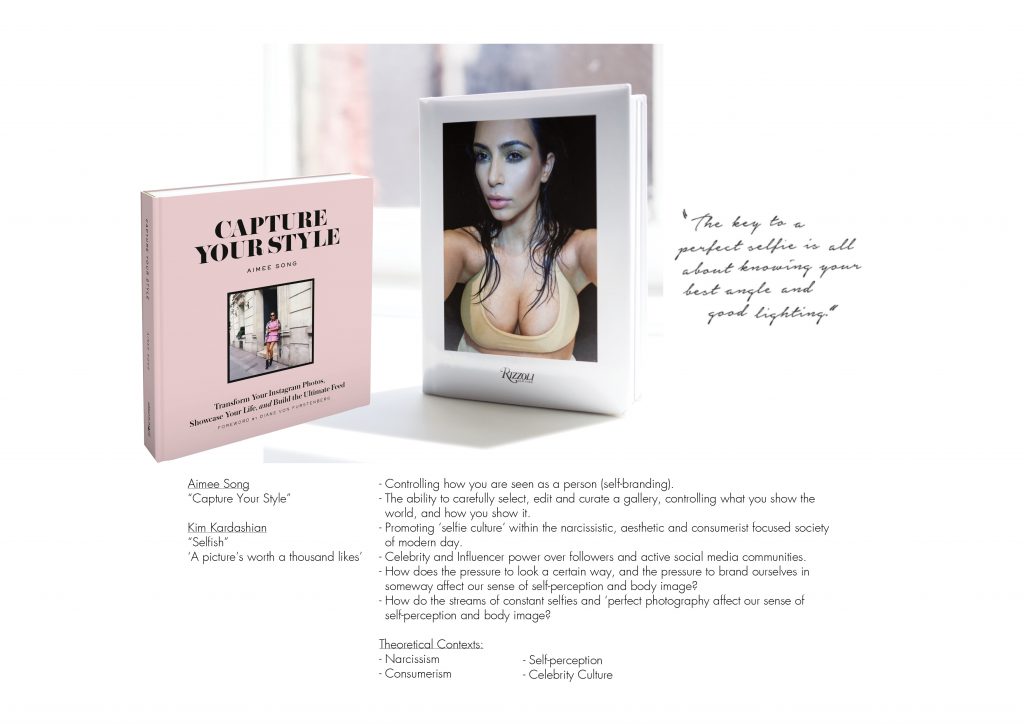
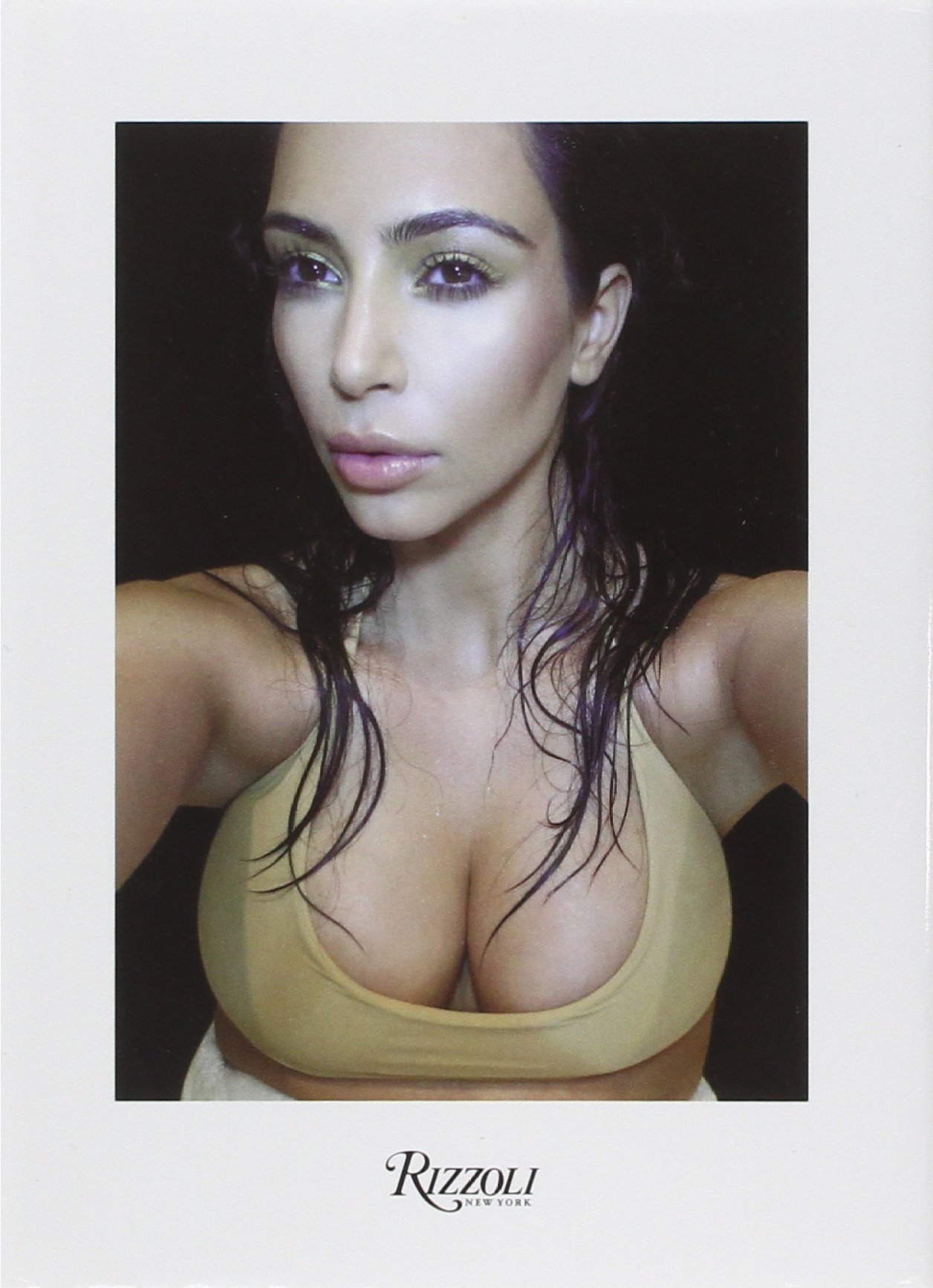
It is noted by some such as Rizzoli, that Kim Kardashian is the “trailblazer” and almost icon of the “selfie movement” which we are currently living within the rise of digital technologies and social media. Therefore, I have noted two books, ‘Selish’ by Kim Kardashian and ‘Capture Your Style’ by Fashion Blogger/Vlogger Aimee Song. Both represent this movement and the power of it, and therefore direct how to do it well in order to turn “an Instagram hobby into a successful business” as Song notes in a manner which would make any active and engaging Instagram users believe that it is also possible for them also with the right ‘look’ and image. Not only that but Song actively encourages her readers and followers to carefully edit their photographs to achieve the perfect addition to their carefully curated Instagram feed. This can also be seen in a video below. I found the video very interesting in the sense that Aimee is very controlling in the way others take photos of her, ensuring she is perceived in a particular, and controlled way therefore obviously being very aware of her body image and self-perception, especially in regards to what angles are used to take ‘the best photos’. This confirms how obsessive this form of photography, where by through taking our own photos – selfies – or directing the shoots of our own portraits, we are in full control in a narcissistic sense of what we are showing the public.

I have also noted these two books in my initial plan for my Professional Context presentation, looking at how these cultural, blogger and celebrity influences are impacting on our body image through their use of social media.

71zvyjzwc8l

Selfish by Kim Kardashian
Image Source

“The selfie photography of Kim Kardashian West, featuring many never-before-seen personal images from one of the most recognizable and iconic celebrities in the world. From her early beginnings as a wardrobe stylist, Kim Kardashian West has catapulted herself into becoming one of the most recognizable celebrities in Hollywood. Hailed by many (including Givenchy designer Riccardo Tisci) as the modern-day personification of Marilyn Monroe, Kim has become a true American icon. With her curvaceous style, successful reality TV show Keeping Up with the Kardashians, DASH clothing store, makeup and perfume lines, she has acquired a massive fan following in the multi-millions. Through social media (Instagram, Twitter, and Facebook), Kim connects with her fans on a daily basis, sharing details of her life with her selfie photography. Widely regarded as a trailblazer of the “selfie movement”—a modern-day self-portrait of the digital age—Kim has mastered the art of taking flattering and highly personal photos of oneself. For the first time in print, this book presents some of Kim’s favorite selfies in one volume—from her favorite throwback images to current ultra-sexy glam shots—and provides readers with a behind-the-scenes look into this larger-than-life star.”
– Rizzoli

Noted Reviews:
“The first lady of #fame – the 100 Most Influential People” –Time Magazine

“Kim Kardashian already broke the internet. Now she’s poised to break the best-seller lists. . . . It’s easy to mock – indeed, the title almost does it for you – but this seemingly throw-away collection may end up being just as much a part of pop-art history as when Andy Warhol painted soup cans.” –Daily News

“Kim Kardashian is the queen of selfies, and she’s planning to make sure everyone knows it in her upcoming book, Selfish.” –MTV News

“Now there’s a book cover if we’ve ever seen one! . . . this book is obviously made for her biggest fans. Not to mention it includes previously unseen selfies!” –USA Today

“Kim Kardashian can take a selfie anywhere, and we mean anywhere!” –E! News

“In her new coffee-table book, Selfish, the reality star documents nine years of her life in selfies – some seen by millions, others revealed for the first time.” –Harper’s Bazaar

“Now you can get between the covers with her— hardcovers, that is. With more than 400 pages of intimate snaps (including bikini selfies, lingerie selfies and, yes, several nude selfies), flipping through her new photo book Selfish, published by art-house giant Rizzoli, feels like scrolling through a fabulously rich and beautiful friend’s well-curated smartphone.” –Playboy Magazine

“As they say, you have to love yourself first! After months of anticipation (and just a touch of eye-rolling), Kim Kardashian’s selfie-filled coffee table book, aptly entitled Kim Kardashian’s Selfish, [has] finally arrive[d].” –US Weekly

“Kim Kardashian has joined the ranks of Giacometti, da Vinci, Lichtenstein, O’Keeffe, and just about every other revered artist of any era: she, too, now has a Rizzoli-published book devoted to her work at the forefront of an artistic movement. Indeed, Rizolli notes that she’s ‘widely regarded as a trailblazer of the ‘selfie movement.’” –Flavorwire.com

“Treat your coffee table to a 300-page collection of Kim’s best selfies . . . ” –People Magazine

“[Kim K’s] the queen of the selfie. And her soon-to-be released hardcover book . . . should be all the evidence she’ll need to maintain that throne.” –CR Fashion Book

“Attention all Kim Kardashian fans – here’s the E! star as you’ve never seen her before! . . . aptly dubbed Selfish . . . [the images] definitely don’t disappoint.” –E! Online 

“As it stands, Kim Kardashian West holds the title for most Instagram followers (at 30 million) just behind the platform’s own account (at 60 million). An average Kim K selfie garners upwards of 650,000 likes with her wedding photo receiving 2.5 million likes. With all that in mind, there’s no question that Kim’s controversial new book, Selfie, is going to fly off the shelves.” –V Magazine

“From her favorite throwback images to current ultra-sexy glam shots, Selfish will provide readers with a behind-the-scenes look into Kardashian’s life.” –In Style Magazine

http://www.rizzoliusa.com/book.php?isbn=9780789329202, Last accessed: 12th October 2016

captureyourstyle_book-1530x1905

Capture Your Style by Aimee Song
Image Source

“Oh. My. Gosh. You guys, I can’t believe it’s finally time to tell you this… I wrote a book! I’ve been blogging for about eight years now and in that time I’ve gotten to go all around the world to the most beautiful destinations and attend events I dreamed of when I was younger. A huge part of those experiences and my success as an influencer has been documenting them on Instagram. That’s what this book is all about–how to showcase your life through beautiful photos on Instagram.

Why should you want it? Instagram is so much more than a platform for pretty pictures. It’s the fastest-growing social media network with an engaged community, a major marketing tool for brands, a place where Beyoncé drops her albums, and a hub where products can be bought with a simple double tap. Including everything from fashion, travel, food, décor, and more, I’m giving you insider tips on curating a gorgeous feed and growing an audience.

Inside, you’ll learn ways to craft your voice and story on Instagram: all about how to edit your photos using the best apps and filters, how to prop and style food and fashion photos, how to gain more followers, and secrets behind building a top Instagram brand, transforming an Instagram hobby into a successful business.”
– Aimee Song, Song of Style

http://www.songofstyle.com/2016/05/wrote-book-called-capture-style.html

Questions raised through Research

Below shows a list of questions which I have raised and noted whilst undertaking research, writing my project plans and mapping out my first Professional Context presentation in relation to my practice and my research question, “How do Magazines and Social Media within the Fashion and Beauty Industries, affect our sense of body image and self-perception?” I have realised that by logging these questions I am then able to assess which research methods can be used to try and find answers, whilst helping to direct topics of research going forward.

Questions raised:

How does this ever-lasting stream of so-called ‘ideals’, ‘perfection’, bloggers/vloggers and social media ‘famous’ affect our own ideas of our body image and self-perception?

Does this form of media affect us and influence us in a different way to magazines?

Is this due to content on social media in comparison to magazines?

Do people still read magazines and see them as a form of influence, or are we more enticed by social media for quick access and ease?

Who, or what within the Fashion and Beauty industries is the most influential in regards to our body image and self-perception?

What culture and history, for example are we missing out on as a society are we missing out on if we are forever taking photos of ourselves, rather than taking photos of our surroundings and those who we are with?

Is our self-indulgence taking away pleasure in our experiences?

Our we sourcing locations to take photographs for our social media accounts, or are we sourcing locations to take in what is there?

How do we feel if we cannot recreate or maintain that “flawless” look achieved through makeup apps?

How do these technologies add to the debates amongst body image and self-perception within a world which is becoming more narcissistic, controlling and standardised?

How does Western culture influence body image and self-perception in other countries due to the accessibility of celebrity culture, bloggers/vloggers, social media and the idea of the standardisation of beauty?

Do we have to look a certain way now to appeal to the opposite sex?

What do men think about the rise of beauty trends and fads?

What do they think of current ‘icons’ such as Kim Kardashian for example whom influence the looks and perceptions of women so much?

Do males and females feel differently about these issues?

How does the pressure to look a certain way, and the pressure to brand ourselves in someway affect our sense of self-perception and body image?

How do the streams of constant selfies and ‘perfect photography affect our sense of self-perception and body image?

How does instantly mimicking ‘the looks of others affect our sense of self-perception and beauty?

Are we more likely to try and change our appearance permanently through liking the results of edited photos more than what we see in the mirror?

Is this due to the over-exposure of Western models, magazines and social media platforms?

How does this affect the ‘everyday woman’ in Japan, her self-perception and purchases/activities?

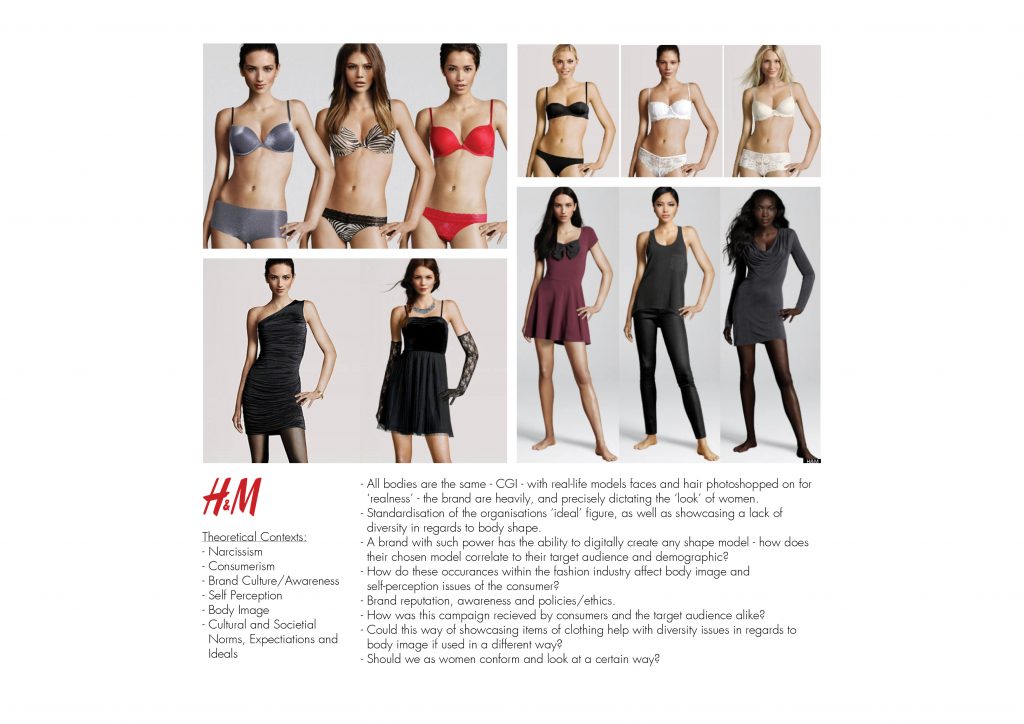
Brands with power such as H&M, have the ability to digitally create any shape model – how does their chosen model correlate to their target audience and demographic?

How do these occurances within the fashion industry affect body image and
self-perception issues of the consumer?

Brand reputation, awareness and policies/ethics.

How was this campaign recieved by consumers and the target audience alike?

Could this way of showcasing items of clothing help with diversity issues in regards to body image if used in a different way?

Should we as women conform and look at a certain way?

Initial Screen-Printing Experiments

This is working towards objective 4.C.

For my initial screen-printing experiments which make up part of my “Social Media Posts and Poster” Project as noted below, I chose to select this particular post to experiment with.

I wanted to test different colours and inks to see what the best method of print (digital or traditional) is in regards to outcome and commerciality, in order to take a selected few further for development whilst acting as pieces of critical-design led research via engaging with the active target audience mocking preconceived assumptions, expectations and ideas.

instagram-04

“This post is essentially a satirical, mocking and sarcastic response to the instantly recognisable drippy lip icon which Kylie Jenner uses to symbolise her ‘Lip Kits’. The concept of this was perceiving the packaging design and iconography as how we should use the product without prior knowledge of cosmetics, responding to a world and community where individuals are so guided and influenced by visuals, therefore assuming that everyone is aware of these products, brands and uses.”

Below shows a range of photographs documenting the screen-printing process. The colours chosen initially to work with were Flesh Colour for the Lips, Metallic Gold, Gloss Red and Black. For this, red acrylic paint was mixed with Spot Varnish in order to contrast with the matte lips and typography. The same thought process was behind this with the gold – not only to add a different dimension to the print in regards to the effects produced digitally, but to associate with the “Kylie Cosmetics” and target audience also.

20161011_141011_1476274108118_resized

20161011_141230_1476274102243_resized

20161011_151935_1476274094011_resized

20161011_151930_1476274097981_resized

20161011_163144_1476274114374_resized

Whilst printing the Red Lips as shown above, I realised that I had not accounted for leakage around the edges of the screen leaving bleed marks as shown above. I also found it quite difficult to align the lipstick drips to the lips as I set-up the print bed with the main print to the back of the screen. I found that I was wasting quite a lot of time and prints trying to sort out the slight miss alignments – also shown above. When I began to set the screen up for the gold prints, I sealed the edges to avoid leakage and bleed, and also set up the print-bed backwards to ensure the print I was working on first was closest to the front. I hoped after spending so much time to resolve the issues printing initially that the gold versions would work out better.

I found by having the print closer to me, I was able to align the remainder of the prints correctly, however the metallic gold ink came out quite transparent allowing for a gold sheen to be applied, opposed to a block of colour. I wasn’t overly keen on how this looks as didn’t feel it was as strong visually as the digital versions. I also felt that the prints as a whole looked very flat due to a lack of background colour or tone within the colours used for the lips for example.

20161012_102836_1476274090111_resized

A3 Poster Prints and A6 Postcards were produced as shown below.

I do feel though however that even though the screen-printing process was enjoyable, it may not be the best form of print to take forward throughout my practice and development due to be so time consuming and limiting in regards to the amount of experiments I’d like to carry out surrounding this particular Social Media Post and Poster project.

In comparison to the breadth and amount of work, effects and variety which can be achieved digitally in the same time, I found with my ideas for on-going posts it makes more sense visually and logically to continue producing digital varieties. I also feel that I can produce more impactful results digitally, and furthermore I can target the ‘digital age’ of active social media users, via digital posts, which I feel will be very beneficial in regards to targeting the right audience and receiving the right feedback through my critical-design led posts.

In addition, the variety of posts which I have ‘posted’ on Instagram over the past week would not all allow for easy translatable designs which could be screen printed to the same ‘glossy’ effect, as I have included and shown to date through variety of CAD designs.

20161012_103910_1476274085673_resized

20161012_111845_1476274082670_resized

img_20161012_001043_1476269683445

img_20161012_105141_1476269683278
img_20161012_115117_1476269682964

Taking this onwards, I am hoping to work digitally producing a further range of experimental prints and posts which can feed into both the Poster Project and also the zine, which again I feel by working digitally will be more in tune with the chosen target audience for such projects. I would also like to continue working with a critical-design approach.

Article: “Be Realistic! How Technology Affects Your Perception of Beauty”, By Dr. Robert Tornambe

This is working towards objective 1.

“How can women, young or not, aspire to look like modern-day role models when the role models themselves don’t even look like their photos?”

Whilst researching the surrounding contexts of the recent technological developments within the Beauty industry and how this can in turn effect our self-perception, I came across the article shown below on Oprah.com, written by Dr. Robert Tornambe, whom is a “New York City plastic surgeon, a fellow of the American College of Surgeons (F.A.C.S.) and diplomate of the American Board of Plastic Surgery (board certified). Dr. Tornambe has lectured in the United States and Europe and is considered an expert in cosmetic facial and breast surgery. He was listed in New York Magazine’s “The Best Doctors in New York.” Dr. Tornambe has appeared on Dateline, NBC’s Today and The Charlie Rose Show, and he was the only New York City–based plastic surgeon to appear on the ABC series Extreme Makeover. His latest book is The Beauty Quotient Formula (Hay House)” and was struck by the question he posed mid-article, which I have noted at the top of this post for reference also.

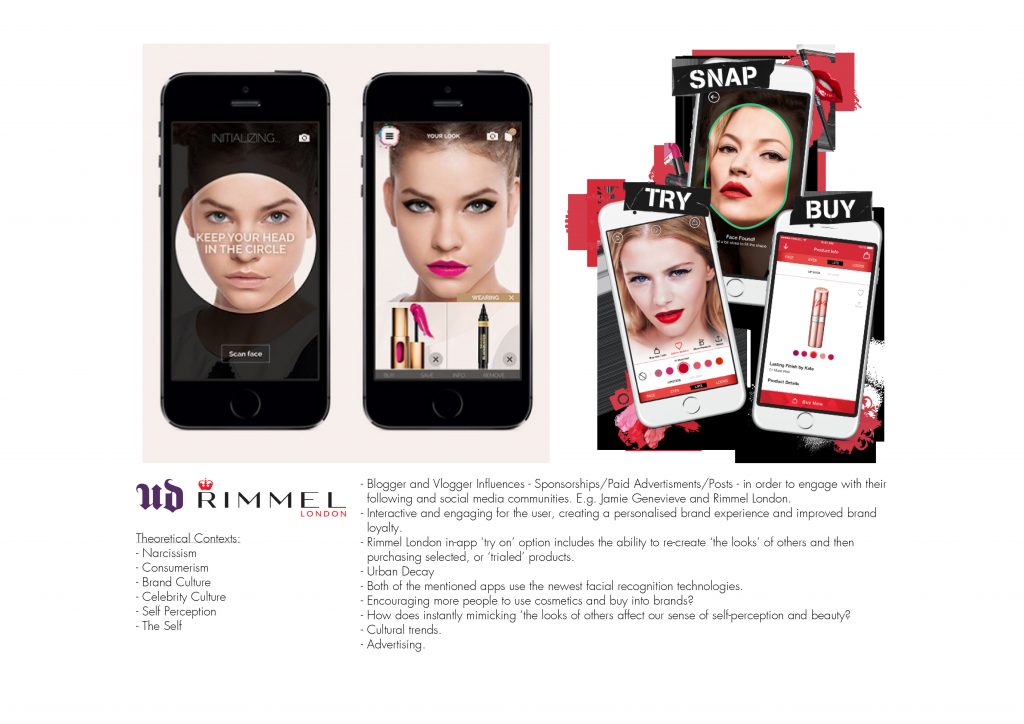
This question posed, brought to life the idea that technology does change how we see ourselves, and also other people, especially with individuals whom go to extreme lengths to fulfil their ‘ideal’ vision of themselves based on those they follow, admire and look up to whether this be through cosmetic surgery or photo-editing platforms/tools. In turn, this made me think about my own research question and how the idea of ‘role modes’ relates to self-perception and body image issues in this particular context of beauty, surrounding the new phenomenon of brands using celebrities, bloggers and vloggers as marketing and communications tools. For example, the Rimmel “Get the Look App” (noted in a previous post – ‘Recent Technological Advances and Developments within the Beauty Industry’) which allows the user to take a photo of themselves and apply pre-set makeup looks inspired by their models and campaigns. Kate Moss in this instance is used as the main anchor for the campaign, enticing app downloads through the promise of quite literally getting her look – however, the photo of Kate Moss itself is edited – a prime example of the posed question.

virtual-makeover-v2

Rimmel Get The Look App
Image Source

We currently live in a society whereby access to celebrity information and photographs for example is instant via digital platforms. We know every beauty product they use thanks to hashtags and brand endorsements, allowing followers to engage with small, but key parts of their lifestyles, replicating it hoping to achieve the same results. Furthermore, along with the Instagram streams for example, recent advanced technologies and releases of ‘beautifying’ apps also now allow this change to happen instantaneously if desired. As Dr. Tornambe notes that “the touch-up technician has become an essential part of every photo project” hinting at the idea that whether we ‘edit’ ourselves through permanent changes or not, many people feel the need to look perfect and flawless to be perceived a certain way and will use one or more mediums to do so.

I found the article below particularly interesting in the sense that these “stars” were almost unreachable in a sense that at one point in time, they would only be featured in high-end fashion magazines such as Vogue, and on billboard campaigns. However at present day, as discussed in my ‘Initial Thoughts on Social Media and Publications’ post, these platforms are becoming much more interlinked and allow for the end-user to contribute their own photographs and instantly engage with content and the surrounding online communities on a personal level. Furthermore, by using various digital and print based outlets to showcase brand campaigns, collections, sponsorships and products for example, more people are being targeted, and more people are contributing therefore as a whole resulting in a constant stream of faces, selfies, outfits and lifestyles being showcased inadvertently on our smartphones influencing changes in body image and self-perception overtime.

“The digital age has brought with it wonderful advantages in all aspects of people’s lives, but it has also created certain unexpected troubles—one of which is a detrimental change in society’s perception of beauty.”

Full Article:
I have highlighted key points which I believe will help in the understanding and unpicking of my research question, whilst there also being several points of which back up points I have already mentioned in this post, or in previous posts prior to finding and reading this article.
“Years ago, actresses were glamorous, larger-than-life movie icons and role models that women looked up to and wanted to be like. But, now that you can follow celebrities on Twitter, read about their makeups and breakups on their blogs and in the tabloids, movie stars are becoming more like…you. Find out how technology has influenced your perception of how you look at yourself and modern-day Hollywood.

The digital age has brought with it wonderful advantages in all aspects of people’s lives, but it has also created certain unexpected troubles—one of which is a detrimental change in society’s perception of beauty.

Prior to computers, magazines and cinema were the sole outlets influencing your perception of beauty. Movie icons—larger than life—were admired on the silver screen, and their more notable adventures were followed in magazines. Carefully orchestrated photo shoots with perfect lighting, makeup and hair styling enhanced the stars’ already beautiful faces. These stars were idolized for their beauty and style. And the general public placed the lucky, well-known celebrities on pedestals, crowning them as royalty. They were role models—adored, but not copied, because it was understood that they lived a life far different from the average person. Stars were admired…from afar.

Fast-forward to the present, ever-changing computer age where you are bombarded by images of all forms and gossip about those celebrities who used to be so glamorized—so distant and different than you. Their lives are chronicled on a daily basis thanks to Twitter, blogs, online magazines and other easily attainable media, creating an almost intimate relationship between the public and the stars. And this change in society’s relationship has changed its view of beauty. Since these celebrities are now on your level, doesn’t that also mean you can be more like them?

The bar for women has been set unrealistically high by the role models people have today. The deck has been stacked against the modern woman. It was bad enough women used to see 17-year-old fashion models wearing $25,000 haute couture gowns in women’s magazines. Now, thanks to Photoshop and other photo-editing software, photos may be manipulated to make their subjects look thinner or heavier, taller or shorter, bustier or flatter chested. Wrinkles can be magically erased and prized features, such as pronounced cheekbones, can be enhanced. The touch-up technician has become an essential part of every photo project.

So the inevitable question arises: How can women, young or not, aspire to look like modern-day role models when the role models themselves don’t even look like their photos?

The answer should be evident, but with people’s new relationship to the stars and new beauty technologies like Botox, facial fillers and cosmetic surgery, this goal seems to be practically doable. But self-esteem can plummet when women compare themselves to these unrealistic iconic images. They are chasing an illusion and place themselves in a no-win situation.

Take Heidi Montag as an example. Recently, this very pretty 23-year-old, up-and-coming actress underwent 10 different surgical procedures so she could look “more glamorous” and hopefully stand out in the highly competitive Hollywood arena. She stands out now, but for all the wrong reasons! So, how does an intelligent, attractive woman in today’s society adjust to all these unrealistic messages around her?

First, women must stop this star worship and gain back a bit of separation between the woman on the screen and the woman in the mirror. Realize that what you see in the media is not reality. These faces should not be the faces you aspire to have. Choose realistic role models for various stages of life. And remember that as wonderful as plastic surgery is, if you are 60 years old, you are never going to look like Heidi Klum. Look for women who are beautiful and vivacious, yet who are aging gracefully, like Helen Mirren or Meryl Streep—or your boss or neighbor. Use these as your role models, and your life will become much simpler and your goals more attainable.

Also, women need to discard their one-dimensional definition of beauty. Beauty does not lie in physical features alone. It’s about the whole package: physical beauty, mental strength, warm personality and personal presentation. So stop looking in the mirror and seeing the glass as half empty. Instead of looking for flaws, embrace your positive characteristics and figure out ways to enhance them. Stop wishing for someone else’s nose or hair and fall in love with your own. A face can be structurally imperfect but still beautiful. Intangibles make a woman beautiful, and you must recognize those wonderful quirks that you possess and be proud of them. Develop a beauty arsenal consisting of clothing that fits well and enhances your attributes. Create a solid hair-and-makeup routine, and exercise to stay healthy and build your confidence. Confidence is the real secret here! A confident woman is a beautiful woman. Learn how to feel great on the inside as well as the outside.”

Source:
Dr Robert Tornabe (2010) Your Perception of Beauty in the Digital Age http://www.oprah.com/spirit/your-perception-of-beauty-in-the-digital-age#ixzz4MoUl5FzX, Last Accessed: 11th Oct 2017

Instagram Blogging Posts using Critical-Design

This is working towards objective 4.A and 1.

I would like to experiment with the idea of a Critical Design-led project using methods founded by Dunne and Raby (2007), which features a range of digital blogging posts using speculative design proposals and ideas in order to challenge the assumptions, ideals, trends, pre-empted conceptions about brands, products and objects within the Beauty and Fashion Industries, whilst provoking thought, sparking conversation and debate.

Furthermore, I would like to then develop these posts based on received feedback to further to achieve a realised outcome, which would be made up of a carefully selected and curated range of printed posters, which could either be sold or exhibited. The final outcome would aim to reflect the findings of my research question which explores the responsibilities of the Fashion and Beauty Industries, understanding how Social Media and Magazines influence and affect our sense of self-perception and body image” whilst utilising the collated research based on this critical-design led project.

To coincide with this blog and my journey on the MA Creative Practice course, I have decided to also open an Instagram account which will serve as a social media platform to share the work I am creating and developing, whilst engaging with an active consumer market in the hope of sparking thoughts and interest on the noted issues around the Fashion and Beauty Industries.

The Instagram account can be found here, and the account itself promotes this blog and encourages followers and viewers to stop, look, visit, read, question and think in a different way.

I have already posted several times this week on Instagram to get the ball rolling and to assess what works/doesn’t work for the target audience in regards to content, whilst exploring different digital processes and techniques. The posts which have ‘gone live’ this week can be seen below, and have so far received a positive reception from the Instagram community.

I plan on collating a list of ideas for posts which can be produced in advance, to then be uploaded everyday day or two in order to continually engage with the targeted communities and audience whilst building up a series of illustrations and typographic design work which can be used and further developed going forward. By planning posts in advance I can ensure that these then relate to research topics and projects at hand as previously noted, whilst ensuring any problems or issues are illeviated in advance. Furthermore my allocating set blocks of time to plan and create these posts on a regular basis I am hoping for this to be a smooth running, on-going process.

A variation of approaches in regards to aesthetic has been used in order to gain ideas of which has the best reception in regard to target audience (female, 16-24 years old), those whom are active on social within fashion and beauty communities, whilst using critical-design through use of typographic statements informing satirical vector and CAD based illustrations, relaying serious messages with parodical undertones.

I decided to start off by creating posts relevant to my proposal and the ‘Initial Thoughts’ blog post.

Further Context:

Social Media, has become notorious for ‘influencing’ what we wear through the boom of bloggers and vloggers as well as through the rise of brand engagement, digital magazine publishing and promotion as well as celebrity accounts. These “influencers” as they choose to be called, collectively ‘influence’ how we look, promote ‘ideals’ and almost tell us what and wear to buy our products from, however, many ‘consumers’ seem unaware of the affects these daily streams of content can have on us in regards to body image and self-perception issues, let alone our purses.

The posts which I have been creating and posting this week aim to reflect this in a tounge-in-chic manner, using bold graphics, feminine colours and copy which has been written to not only raise the point of influence and scale within these industries, but to show this visually. I hope to collate a range of posts which can then be experimented with through hands-on print processes such as screen-printing, in order to see what gives the most effective results, engagement and insight with the target audience, whilst delivering the message in the most appropriate visual manner.

instagram-05

This first post is targeted at noting the rise of “fashion bloggers”, the readiness and easiness of this as a career path and the competitiveness which surrounds it. With the right platform, anyone can try to make it as a fashion blogger, or even beauty blogger making the industry overwhelmingly competitive. The more followers you have, the more brand kudos and sponsorship you shall receive, similarly to celebrities and ‘face time’ on campaigns, tv and magazines, etc. This competitiveness can spark self-perception issues and generate ideas around a rise of narcissists, allowing for a career which is very self-consuming and all about ‘the self’.

instagram-04

This post is essentially a satirical, mocking and sarcastic response to the instantly recognisable drippy lip icon which Kylie Jenner uses to symbolise her ‘Lip Kits’. The concept of this was perceiving the packaging design and iconography as how we should use the product without prior knowledge of cosmetics, responding to a world and community where individuals are so guided and influenced by visuals, therefore assuming that everyone is aware of these products, brands and uses.

instagram-3-rgb-03

This was created in response to how many Selfies were currently on Instagram at the time of creating this post, whilst addressing the question of how as individuals we have contributed to this overtime. Some selfies may also be Instagram without even being aware – friend or group selfies which one may not have tagged you in for example, or possibly old accounts you had forgotten about or thought you may of deleted. Either way, photos of you are live in circulation under the # system, and are reasonably accessible to most people around the world whether you know them or not. I wanted people to think about these sorts of questions and even possibly question whether that is okay or not ethically? Should our photographs be so public? Or do we by using social media, consent ourselves to be seen, judged and viewed by others? What harm does this do to us? Or do some see it as a positive?

instagram-rgb-01

This post questions the current growing trend of ‘perfect brows’ in a dominant, loud and illustrative manner, highlighting the ‘growing importance’ of such facial feature with the beauty industry and social media communities. By using language relative to the target audience and trend alike, this post aims to engage with such audience and spark thoughts about how they think and feel about their own features.

Below shows the posts in situ on Instagram, whilst showing engagement from the Instagram community in regards to ‘likes’. ‘Insights’ becomes available for the most recent post only after 24 hours of being posted which shows how many people have seen the posts, and how many actually engage with it through ‘likes’ or comments. This is something I plan on noting for each overtime to assess what has the best reach. I also plan to do this as noted above to see which aesthetic and topic of choice appeals to the target most also in order to curate my further exploratory work to this demographic:

screenshot_2016-10-11-20-47-34_1476215331923

screenshot_2016-10-11-20-47-26_1476215331760

screenshot_2016-10-11-20-47-17_1476215331617

screenshot_2016-10-11-20-47-07_1476215331384

It is apparent from the above 4 screenshots that ‘Kylie Jenner’ references and ‘Brow’ were best received, highlighting how trends and cultural icons have power over such users, therefore potentially affecting ones self-perception.

Research Methods

I have collated a list of various forms of research I would like to carry out across the academic year in order to improve the quality of my research methodologies and findings, as weĺl as contributing to the understanding and visual realisations of my research question. In addition using a variety of primary and secondary research methods to collect data, I feel as though this will strenghten my conclusions and allow for indepth analysis and reflection across a range of resources.

In addition, due to the vast scale of topics which can be look at and analysed regarding my research question and the time available on the course to carry out such work, I feel as though I have had to target females specifically being ultimately the main end user and audience within the Beauty and Fashion industries. However, I would like to use some of these research methods to find out how men perceive women via magazines and social media, again changing perceptions within these industries so see how this affects their ideas of ‘ideal’ women. Do we have to look a certain way now to appeal to the opposite sex? What do men think about the rise of beauty trends and fads? What do they think of current ‘icons’ such as Kim Kardashian for example whom influence the looks and perceptions of women so much? Do males and females feel differently about these issues?

I would also like to find out what people think generally about the rise of beauty and fashion trends, the rise of bloggers, Vloggers and social media outlets, as well as the traditional magazine and how these visual outlets affect our body image and self-perception issues.

Noted forms of research may include:

  • Qualitative Data
  • Quantitative Data
  • Interviews
  • Questionnaires and/or Surveys
  • Focus Groups – male and/or female?
  • Visual Research
  • Critical Design-led Research 
  • Visual Questionnaires for ‘ranking’ of looks and reflection – could possibly be targeted at a male audience.
  • Debates and discussions following lectures and presentations, for example. 
  • Field research – International Research trip booked to Japan.

Professional Context Presentation 1 – Initial Plan

Below shows my initial Professional Context presentation plan, showcasing the surrounding professional contexts of my practice and how this relates in turn to my research question and project plans.

I am hoping to gain feedback from my personal supervisor in relation to moving this on forward. I am also planning on noting topics of discussion and removing the text from the presentation slides – these notes have been made as reference for my tutor and myself, as well as for future development, planning and research.

professional-context-presentation-draft-2professional-context-presentation-draft-22
professional-context-presentation-draft-23professional-context-presentation-draft-24professional-context-presentation-draft-25


Recent Technological Advances and Developments within the Beauty Industry

This is working towards objective 1.

Whilst initially planning and outlining the contents and structure for my Professional Context presentation, I decided that I would talk about recent developments in technologies within the Beauty Industries, and how this relates to my practice, self-development and research question. This particular blog post will cover the topic of ‘makeup’ apps.

I find that in today’s conformist and consumerist society, we are becoming much more influenced by beauty brands due to new innovative and instantly accessible social channels lending themselves to various forms of visual marketing and advertising. Adverts and campaigns are not only seen in magazines and store windows anymore models, bloggers/bloggers, influencers and associative brands are taking over and using social media, application design and UX/UI to their advantage, creating an engaging and empowering platform for end-users to work and engage with. Whilst the noted technologies are still quite new, and are constantly being trailed, tested and improved, organisations are still rapidly competing and are continually researching, learning and developing new digital processes and techniques, in order to create the best and most up-to date apps, with the most advanced features. This allows for brands and their associative applications to gain the best number of sales and active users, therefore gaining brand influence, engagement, loyalty and power within a world of consumer culture.

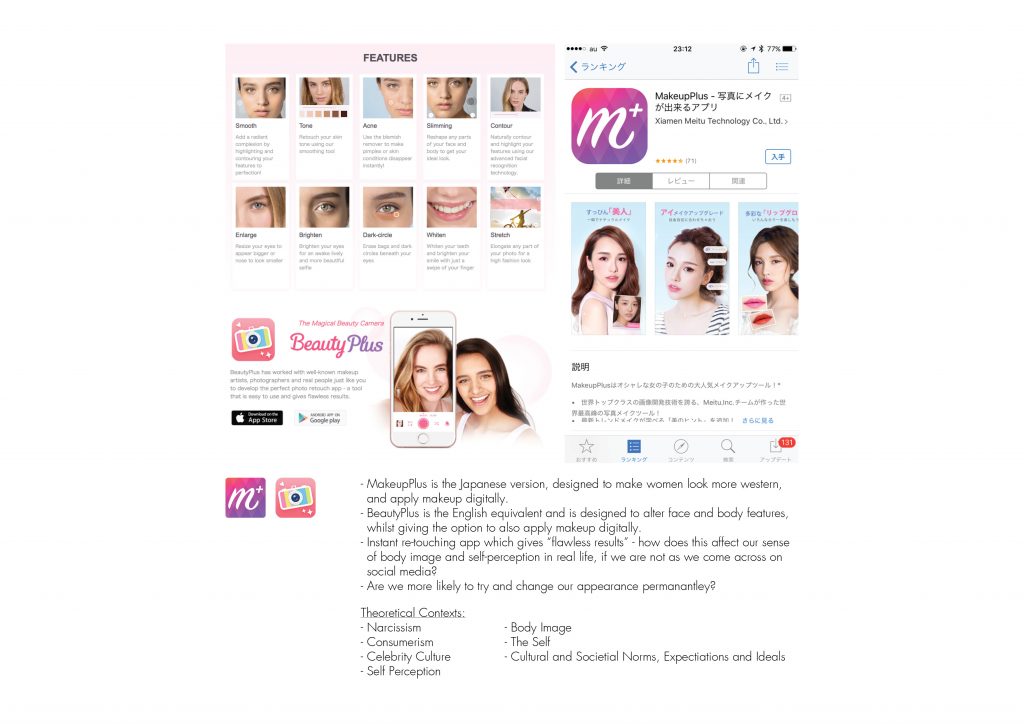
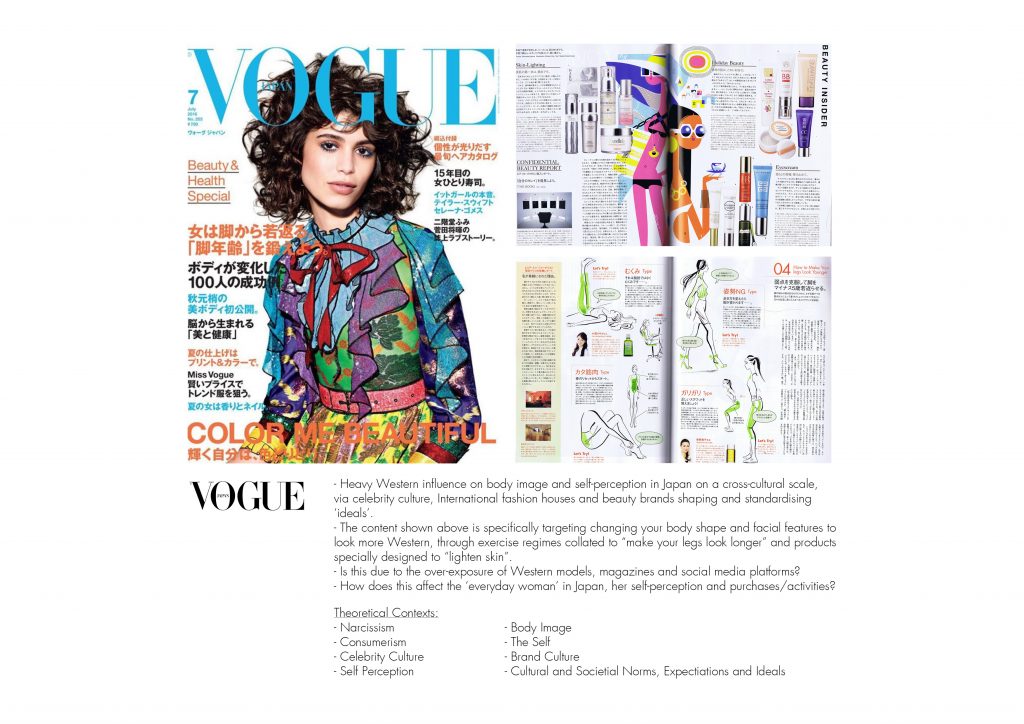
Researching further into this, I found several ‘beautifying’ apps which can transform, change or manipulate your appearance in different ways, each of which target different audiences and needs, and therefore use different technologies and use different ‘features’. However, I am also interested in how these applications and new technologies can be damaging to our self-perception, and in return, how we are perceived. I found this particularly relevant in regards to the Beauty Plus app and how this is used heavily by a Japanese and Chinese audience, in an aim to Westernising their looks through lightening their skin, widening their eyes and elongating their legs for example. These are all topics of discussion and promotion which were also found in the July 2016 edition of Vogue Japan ‘Health and Beauty Special’ – please see scanned in images below for reference of this. I was also surprised to see International brands such as Clarins conforming to such trends and releasing its own skin-lightening product – again please see scanned in images below for reference.

I feel these applications really show the advances in technology within this industry and how it is being used by brands around the world to their advantage whether to promote a product, increase consumer loyalty or make-up a digital element of a larger campaign, but again allows for a negative in retrospect in regards to the way we can edit our appearance digitally so easily and instantaneously, creating flawless looks which may not be so easily achievable in real-life and again promoting celebrity culture and the standardisation of what beauty should be on a cross-cultural scale. The beauty boom in Asia has also been noted through the popularity of the Chinese edition of the L’Oreal Makeup Genuis app, as evidenced in the article noted below. China have proved through their various user-interaction based marketing mediums that engaging with the consumer is a proven winner for promoting new products whilst promoting and exposing new found uses of technologies within a relevant context.

vogue-japan-3

vogue-japan-1

vogue-japan-2

In a nut shell, the idea of these new technologies allows us to edit our pre-existing photographs or edit our appearance in real-time (depending on the chosen app) in order to look “flawless”. But regardless of technologies, the pressure to look like the ‘final look’ and take a “flawless” selfie, can really add to the pressure of looking a certain way and maintaining a certain ‘standard’ of image. What happens if we cannot maintain these ‘looks’? What if we cannot recreate that “flawless” look ourselves? How do these technologies add to the debates amongst body image and self-perception within a world which is becoming more narcissistic, controlling and standardised? How does Western culture influence body image and self-perception in other countries due to the accessibility of celebrity culture, bloggers/vloggers, social media and the idea of the standardisation of beauty?

Below shows four different examples of these new technologies in context of Celebrity Culture, Consumer Trends, Brand Engagement and User Interaction. Along with imagery are small articles or quotes further describing the technologies and formalities of each.

main-original-640x0c

L’Oreal Makeup Genuis App
Image Source (Last accessed 2/12/16)

“There’s something scary about trying on makeup at the drugstore: what if you apply a new blush to your face, just to try it out, and then you walk out looking several shades too dark? That classifies as an actual beauty disaster, and is something none of us want to experience—and now, thanks to the makeup geniuses at L’Oreal, we don’t have to!

The beauty brand just launched an app that allows you to try on makeup without actually trying on makeup, right from the comfort of your home—or wherever you and your smart phone happen to be. The thing that separates the L’Oreal app from all the other makeover apps already on the market is that this is the first of its kind that actually allows you to apply lipstick, eye liner, eye shadow, and blush to yourself, as opposed to a mannequin-esque face that’s meant to resemble your own.

You scan your face using the front-facing camera on your iPhone—yes, the same way you take a #selfie—and the app’s technology reads everything from your face shape to your expressions. You then can begin applying L’Oreal makeup digitally to your own face in real time, watching the makeup you put on move as your face does.

The app took over 10 years to develop and uses the same technology that transformed Brad Pitt in The Curious Case of Benjamin Button, which won Oscars for both makeup and visual effects. It essentially turns your phone into a mirror, allowing you to see what you really look like with certain shades of (for instance) bronzer, eyeliner, and lipstick.

The app will also launch in select drugstores on tablets, where you can play around with makeup and then buy it right after.”
Who What Wear (Last accessed 2/12/16)

makeup_geniu_3x2_20150807

L’Oreal Makeup Genuis – China Edition
Image Source (Last accessed 2/12/16)

“China has been a massive market for the app, bringing 4.7 million of its total 14 million downloads. That’s partly because of the size of the country’s internet population: 668 million people, with 594 million of those going online with mobile devices, according to official figures from the China Internet Network Information Center. And it’s also because it allows curious young women to try out heavier makeup, which is still uncommon in China.

“Girls in China can be shy to apply makeup if they are at the counter or if they are going out with friends — they don’t want to put on very dark lipstick, very dark eye shadow,” said Asmita Dubey, chief marketing officer for L’Oréal China.

“There’s no culture of makeup passed down from mom to daughter that has been there for years, so for a girl like that to get a virtual experience and try some new looks, that’s something she wants to do,” said Ms. Dubey, honored as one of Ad Age’s 2015 Women to Watch China for promoting innovations in mobile marketing for China’s No. 1 skin-care player and second-biggest advertiser.”

Further Digital Initiatives from L’Oreal:

Shake the smartphone: L’Oréal’s Maybelline brand sponsors a TV makeover show called “Cinderella.” It appears on traditional Chinese state television, CCTV, but it got a digital and mobile boost through a partnership with Tencent, the Chinese internet giant. During the show, people saw a message on the screen telling them to shake their smartphones. When they followed through, a page would pop up on their phones offering a tutorial video of the makeover looks people saw on the screen.

WeChat ads: Tencent’s ubiquitous mobile app WeChat had been mostly ad-free until this year, when sponsored messages started popping up on people’s newsfeeds. During the Cannes Film Festival in May, people who clicked on a picture of L’Oréal brand ambassador Fan Bing Bing opened a video with the Chinese megastar actress inviting them to virtually join her at Cannes. Many started following L’Oréal on WeChat, got updates on her looks at the festival and bought products via smartphone.
“Mobile social commerce apps is exactly where beauty is going,” Ms. Dubey said.

User-generated content: In China, online product reviews are a prevalent form of user-generated content – people devote a lot of energy to writing about products and taking pictures and videos of them. Tapping into that, L’Oréal’s Lancome has Rose Beauty, a social platform aggregating product reviews from users.

It offers tutorials, product info and samples so people can post their own videos of trying products out. “It becomes your product review platform, your community platform, your beauty platform,” Ms. Dubey said. And it links back to e-commerce, of course.
AdAge (Last accessed 2/12/16)

virtual-makeover-v2Rimmel Get The Look App
Image Source (Last accessed 2/12/16)

“The first beauty app that lets you snap any look and try it on live! SNAP – Take a picture of a makeup look in a magazine or from a real person, TRY – Try her look virtually live in the app, SHARE – Share your look with friends, BUY – Buy any product from the app”
Rimmel (Last accessed 2/12/16)

screen-shot-2016-10-08-at-20-27-12 screen-shot-2016-10-08-at-20-26-41
BeautyPlus – Makeup Camera App
Image Source (Last accessed 2/12/16)

“BeautyPlus has worked with well-known makeup artists, photographers and real people just like you to develop the perfect photo retouch app – a tool that is easy to use and gives flawless results.”
– BeautyPlus (Last accessed 2/12/16)

“We have over 900 million users around the world, Meitu is a leading leading beauty and lifestyle app developer as well as a global innovator in mobile video and photography, including proprietary facial recognition and virtual “try-on” technologies for makeup, hair and fashion.”
– Meitu (Last accessed 2/12/16)

BeautyPlus is created by, Meitu whom are currently “seeking strategic partnerships with brands and influencers in the fashion, beauty and entertainment industries … At Meitu, we are obsessed with beauty, makeup and fashion. We are always looking for new ways to leverage our technology to help consumers discover new looks and shape their own styles. We are currently seeking strategic partnerships with brands and influencers in the fashion, beauty and entertainment industries. We can provide a unique, immersive and culturally relevant way for brands to connect with female consumers all around the world.”
– Meitu (Last accessed 2/12/16)

“Meitu’s photo and video apps have over 270 million monthly users1.”
– Meitu (Last accessed 2/12/16)

beautyplus-55598b862a819-700x535-2

Image Source (Last accessed 2/12/16)

beauty-plus

Image Source (Last accessed 2/12/16)

Using Archives as a Method of Research

Today Sharon delivered a lecture discussing the importance of archives as a source inspiration, information and narrative in her current practice, which she discussed through her newest project, ‘The Radical Decade” exhibition which is currently open to visitors at Leeds College of Art.

With this exhibition, it was explained how research stemmed organically from a material object and a box of ‘memories’ belonging to Gerald McCann, a Fashion Designer, which when curated by Caroline Riches translated into a narrative, tell a previously untold yet important story. I also found the story captivating in regards to the importance of collaboration and good will, and what can be achieved with passion and a dedicated team.

20161007_104249_1475950270381_resized

20161007_104650_1475950256681_resized

20161007_104654_1475950253611_resized

As a class, we were asked to visit the exhibition and then discuss our thoughts afterwards. I found this very interesting as points were made either from the language, context, theories, connotations or visuals used, and various opinions and thoughts related to my practice.

Topics Discussed:

  • Post 1950s – Cultural and Social changes of Femininity and the role of Women.
  • Body Image change in relation to above and the move away from feminine physiques – this made me think about my previous use of Vogue archives in my practice and academic writing (see below).
  • The early commercialisation of Fashion – women may of lost a sense of identity through mass-produced clothing opposed to home-made patterns.

radial-decade-1 radial-decade-2

I found the lecture and debate particularly interesting, and was surprised by how much I could take away as initial starting points for research on body image and self perception within this era itself. I was later able to reflect on this further thinking about how I have used archives in the past as a source of quantitative and visual information, and how I may again use them across this year to help investigate and answer my research question.

I haven’t used any archives as an initial starting point of research for a long time, as my professional practice is very commercial and heavily based upon current trends, however throughout my A Level studies and BA(Hons) studies, I used archives throughout projects as a source of information, inspiration and visual evidence to support theoretical contexts. The types of archives I delved into throughout my BA(Hons) studies were the large range of Vogue Magazine archives, which are stored in the LCA library, and my own archive of over 300 International Vogue magazines which I have been collecting for around 14 years. Using these archives as a visual form of research, allowed me to understand the different female ‘ideals’ which have influenced our self-perception and body image overtime, whilst understanding and contextualising bodily changes overtime due to societal, cultural, commercial and political changes, to name a few. This enabled me to create studio-based briefs based on this collated research, whilst furthering my knowledge for critical and academic writing.

Below shows two of projects from my BA(Hons) Graphic Design course, whereby the archive based research informed the project, content, design and execution, and therefore my practice. I hope to revisit the Vogue archives which I have n0ted again over the course of the year for visual and contextual research.

screen-shot-2016-10-08-at-18-58-07

“80s Fashion”
Designed in mind for fashion students and fashionista’s, it contains everything needed to know about the influential decade; history, social issues, cultural changes, trends and influential icons who shaped the fashion industry and ‘look’ at the time.
96 pages / Perfect Bound / Matte Cover / Gloss Inners

screen-shot-2016-10-08-at-18-49-02

screen-shot-2016-10-08-at-18-48-53

– – –

screen-shot-2016-10-08-at-18-54-32

“How has the commercialisation of women, affected the ‘ideal’ body shape?”
A physical companion to my University Dissertation. This book looks into the changes and evolution of the female body image over time, specifically how the ‘ideal’ has changed due to social, economic and cultural issues, including fashion, media and advertising.
These changes have been captured through illustrations, paintings, drawings and photography for centuries, forming a bank of commerical images of women.
This book looks at in particular 1900 – 2014, highlighting the ‘ideal’ of each year, elaborating with an analysis of the image, context, tone, background and physical change, producing a seamless timeline of how the female body has changed, showing the corruption of the media and image manipualtion.Furthermore, through the analysis, the analysis’ aim to prove a correlation between the media and the rise in eating disorders.
248 Pages, 116 Images.

screen-shot-2016-10-08-at-18-50-44

screen-shot-2016-10-08-at-18-50-52

screen-shot-2016-10-08-at-18-51-00

screen-shot-2016-10-08-at-18-51-08

screen-shot-2016-10-08-at-18-51-16

screen-shot-2016-10-08-at-18-51-26

screen-shot-2016-10-08-at-18-51-32

screen-shot-2016-10-08-at-18-51-39

screen-shot-2016-10-08-at-18-51-47

In addition, whilst undertaking my A Level studies in Fine Art, I became very interested in researching my family background, and began researching by looking through my Grandmother’s photo box. I have a very culturally diverse background, with all four of my grandparents immigrating to the UK post-war from Spain, Italy, Hungary and Poland, however my Spanish Grandmother, Carmen, was the only one to keep all of her photographs as evidence of her past life. This past life in Spain intrigued me, and led me on to specifically research the era, the town, the fashions, the culture, but most importantly her as a woman. More recently however, along with my father I have digitised over 3000 new photographs which were found upon her death, re-archiving photographs in a new way, whilst exploring, questioning and recording new narratives.

In regards to this specific archive, something which Sharon noted yesterday in her lecture really made me think about how personal some archives can be, and how we choose to display, store or curate those archives can often paint a narrative to the viewer in a different way.

This itself made me think about my current practice and how personal it is. I think in the past my practice has been very personal in regards to final, realised, visual outcomes, allowing me to contextualise and directly portray an emotive narrative. However, I feel that currently my practice has become even more personal and is heavily interlinked with my proposal and research question also. I believe my current practice is heavily influenced by my personal experiences with Anorexia Nervosa, working with Fashion Designers, Brands, Cosmetics and Designers whilst analysing and recognising the rise of self-perception, societal and consumerist issues which are currently flooding the market I work within. I suppose in a way, my mind is an archive, and by revisiting those thoughts, emotions and feelings, I can re-engage with my past in a reflective and proactive manner, channelling this into my current practice and research methodologies.

I have noted a list of additional archives below which I plan on researching further to see if any could be of use for my current practice and research question:

  • Discovery Collections
  • National Media Museum
  • Teeside Visual
  • Manchester Art Gallery
  • V&A Archive
  • TATE Gallery Archive
  • Online Archives
  • Vogue Magazine Archives

Penguin Posse

14572356_10157557390765427_7789215796333023469_n

Penguin Posse is a creative group of writers, illustrators and designers who meet up two-monthly, in order to share their recent, work, inspirations and share ideas. It is organised by Zeppo and More Please Dennis, and takes place at Heart in Headingley, Leeds.

Tonight I spoke for 10 minutes at the most recent Penguin Posse event about my new journey on the MA Creative Practice course, and gave a brief insight into my proposal and the exploratory social media work I have just began undertaking, whilst discussing the ideas of feminism, narcissism, self-perception, consumerism, brand culture, sociology, psychology and identity which underpin and contextualise my research question.

I found that talking through and outlining my practice sparked relative interests in other interdisciplinary artists, writers and designers leading onto a published Leeds based poet Jaimes Lewis Moran, to deliver a passage titled, ‘Rachel’ regarding identity in today’s society, where culture almost fuels noise and confusion as to who we are as people, what we stand for and believe in. I also found that I resonated with Stéphanie Vendryes’ work, a Fine Artist whom talked about her new project whereby she is interested in the idea of how a photograph can reflect someone in a very different way in contrast to traditional portraiture, due to changing perceptions, technologies and lifestyles. I related with this instantly, and contextualised this reflecting on identity, the self and photography within my own practice, thinking about how again we project ourselves through our own photographs, or ‘selfies’ on social media, in contrast to the photographs which are seen in magazines and brand advertisements and campaigns, or again different to those seen 50 years ago in the same context. Upon further reflection, the idea and theory of narcissism also comes into play looking at both practices – portraits are becoming much more rare over time, due to changing lifestyles, consumerism and trends, but furthermore because we enjoy being able to edit, and selectively choose what we put out in the world for others to see, influencing how others perceive oneself, as often seen within the beauty and fashion industries.

I will continue to attend the Penguin Posse events, and hope to continue sharing ideas and pushing my own thoughts within my practice, whilst bettering my verbal presentation skills. I really found tonight beneficial and would recommend it to any creative practitioner wanting to share their work and engage with other interdisciplinary artists, designers and writers in a relaxed atmosphere.