Social Media Wellbeing Campaign: Photo Editing

This is working towards objective 4.C and 1.

The below quotes/facts/figures has been taken from an article written by Daily Mail, leasing with a Clinical Psychologist, Dr Vivienne Lewis in regards to body-dissatisfaction and self-perception issues, in relation to social media specifically. As this campaign is aimed particularly at young women, whom actively use social media, I thought that the below are key pieces of information which can be relayed back through the campaign materials.

Furthermore, I also found this article interesting in relation to topics previously discussed and researched, such as photo-editing apps and the impact that this can have on one how one perceives themselves due to being faced with “the expectation to use them”, as noted below by Dr. Lewis.

I also found interesting that Carli Alman noted that through the research of BeautyHeaven, it is apparent that there are “double standards when it comes to photo editing” noting often the criticism of celebrities doing so, however 57% of the women spoken to admitted to doing so themselves.

In addition to this, I also found that 18% of women noted that their social media profile pictures are not genuine representations of themselves in regards to being edited to enhance their appearances, whilst 2/3 of women would also need to ask approval from a friend before actually sharing such images online. This shows alone, that social media has a huge role to play in our changing perceptions of not only ourselves but of others. As noted earlier in this semester, with the Fashion and Beauty Industries going more digital in regards to publications and advertising alike, it is important to remember that social media is becoming a magazine such as magazines are turning into social media, therefore to me, it is important to notice how the impact of new technologies is altering and shaping our perceptions and ideals more, and more over time, and therefore why I am working on this project. I do not think that this has been helped by bloggers and vloggers also, whom like celebrities are all for the photo editing ways of life, and only post ‘perfect’ photographs throughout the day, again tainting ideas, norms and unrealistic nor unattainable expectations of women.

New research has shown that over two thirds of women interviewed “believe it’s wrong for magazines to edit photos before they go to print. However 57 per cent of these ladies also admitted to altering their own pictures before posting them on various social media sites.”

“18 per cent of the ladies surveyed admitted that the profile picture on their social media page is so heavily edited it’s a not a realistic representation of them. Further to this almost two thirds of women surveyed force friends to show them photos for approval before they’re posted online, and 60 per cent untag themselves from images they aren’t happy with.”

“‘It seems there are double standards when it comes to photo editing,’ Carli Alman, Editor of beautyheaven said of the research. ‘They’ve seen celebs like Beyoncé and Miranda Kerr looking perfect in their social media snaps, knowing many of these images have been edited and now there is a copycat effect.’ Carli added.”

“Dr Vivienne Lewis, a Clinical Pyshcologist at University of Canberra, who specialises in body image issues, said body image dissatisfaction is ‘becoming more and more of a problem for women. The thing is they’re constantly having to meet unrealistic standers of beauty, women in particular who are very concerned about their bodies can spend hours editing photos. Social media is certainly putting us under more and more pressure to look our very best, and that often falls in line with the sort of ideals we see elsewhere.'”

Dr Vivienne Lewis added that, “because there is access to photo editing apps, there is an expectation to use them. But she said women need to embrace the way they – and those around them – look. It’s the judgement of others that women get concerned about and comparisons to other women. It’s all about celebrating body diversity and embracing your own uniqueness. The more and more people who are able to accept others for what they look like.. the more likely we are to do it to ourselves”

Sources:
Noble, F. (2015). Double standards? More than half of women admit to editing their social media photos before posting despite over two thirds thinking it’s wrong for magazines to do it. Available: http://www.dailymail.co.uk/news/article-2948410/More-half-women-admit-editing-social-media-photos-posting-despite-two-thirds-thinking-s-wrong-magazines-it.html#ixzz4PZ3krcW6. Last accessed 10th November 2016.

‘The Male Gaze’ Theory and Feminism

This is working towards objective 1.

After looking into the new Barbie Doll line-up for 2016, this resonated with theories of Feminism and the Male Gaze theory which were slightly touched upon, and are extremely relevant to my current practice and research question, therefore wanted to look into these more intently.

The Male Gaze:

“The male gaze is the way in which the visual arts and literature depict the world and women from a masculine point of view, presenting women as objects of male pleasure. The phrase male gaze was coined by feminist film critic Laura Mulvey in 1975.”

screen-shot-2016-11-09-at-22-27-54

In addition to this, John Berger in ‘The Ways of Seeing’ stated that, “according to usage and conventions which are at last being questioned but have by no means been overcome — men act and women appear. Men look at women. Women watch themselves being looked at.”

Furthermore, theories by Lacan surrounding the idea of “seeing oneself and seeing the ideal” can be noted in related to both theories of Mulvey and Berger in the sense that each relays back to ones self-perception as an impact of external influences and triggers, such as the Male Gaze for instance, in addition to the pressures of the media in the 21st century. Perhaps that this can be said especially in relation to Lacan is the difference between looking at a still photograph and that of a ‘real’ person allowing for a comparative nature to take over. In addition in regards to the Male Gaze, this is evident across the media with magazines such as Vogue to those such as Playboy, for example, amongst many other forms of print and digital based media.

Furthermore, as times have changed and women have become more conscious of how one and another perceive themselves, be it in real life, or on social media for example, Mulvey also notes that the ‘Female Gaze’ is the same as the ‘Male Gaze’ stating that women see themselves through the eyes of men, therefore influencing our choices on what is perceived and deemed attractive by the opposite sex, or the ‘male gaze’. Again, this is reflected though the likes of Playboy models whom tailor their appearance purposely to obtain such roles and careers.

Feminist Perspectives on The Male Gaze:

“A good deal of feminist criticism has been focused on eighteenth-century philosophy because of the many influential works on beauty, pleasure, and taste that were written at that time and that became foundational texts for contemporary theories. “Taste” refers to the facility that permits good judgments about art and the beauties of nature. While the metaphor for perception is taken from the gustatory sense, these theories are actually about visual, auditory, and imaginative pleasure, since it is widely assumed that literal taste experience is too bodily and subjective to yield interesting philosophical problems. Judgments of taste take the form of a particular kind of pleasure—one that eventually became known as “aesthetic” pleasure (a term that entered English only in the early nineteenth-century).”

“The phrase “male gaze” refers to the frequent framing of objects of visual art so that the viewer is situated in a “masculine” position of appreciation. By interpreting objects of art as diverse as paintings of the nude and Hollywood films, these theorists have concluded that females depicted in art are standardly placed as objects of attraction (much as Burke had lined up women as the original aesthetic object); and that the more active role of looking assumes a counterpart masculine position. As Laura Mulvey puts it, women are assigned the passive status of being looked-at, whereas men are the active subjects who look (Mulvey 1989).”

“Theories of the gaze reject the idea that perception is ever merely passive reception. [The approach] assume that vision possesses power: power to objectify—to subject the object of vision to scrutiny and possession. The male gaze has been a theoretical tool of inestimable value in calling attention to the fact that looking is rarely a neutral operation of the visual sense.”

Naomi Scheman states: “Vision is the sense best adapted to express this dehumanization: it works at a distance and need not be reciprocal, it provides a great deal of easily categorized information, it enables the perceiver accurately to locate (pin down) the object, and it provides the gaze, a way of making the visual object aware that she is a visual object. Vision is political, as is visual art, whatever (else) it may be about (Scheman 1993: 159).”

“Since the turn of the last millennium there has been a veritable explosion of interest in beauty among philosophers, artists, critics, and cultural theorists–feminists among them (Brand 2013: 4-6). While some of this work continues to consider the general traits of beauty in art and nature, quite a lot of it focuses on the norms of appearance of the human body, and the “violation” of “standard” norms according to race, disability, age, history, and variant sexual morphologies. Such standards govern not only artistic depictions, but also the way that real people shape and reshape their own bodies to conform to reigning standards of attractiveness (Devereaux 2013; Wegenstein 2012, 2006). Feminists and critical race theorists have been especially mindful of diversity and suspicious of general norms and the harms that they can occasion.”

Sources:

Mulvey, L. (1999). Woman as Image, Man as Bearer of the Look. In: Leo Braudy and Marshall Cohen “Visual Pleasure and Narrative Cinema.” Film Theory and Criticism : Introductory Readings.. New York: Oxford UP. p.837.
Unknown. (2016). Male Gaze. Available: https://en.wikipedia.org/wiki/Male_gaze. Last accessed 9th November 2016.
Berger, John (1973), “Section 3”, in Berger, John, Ways of seeing, London: BBC Penguin Books. p.45.
Sturken, Marita; Cartwright, Lisa (2001), “Spectatorship, power, and knowledge”, in Sturken, Marita; Cartwright, Lisa, Practices of looking: an introduction to visual culture, Oxford New York: Oxford University Press, p.81
Sassatelli, Roberta (September 2011). “Interview with Laura Mulvey: gender, gaze and technology in film culture”. Theory, Culture & Society. Sage. 28 (5): p. 123–143.
Korsmeyer, C. (2012). Feminist Aesthetics. Available: http://plato.stanford.edu/entries/feminism-aesthetics/. Last accessed 10th November 2016.

HE Institutions: Tokyo, Japan

This is working towards objective 1 and 3.

I have been researching HE Institutions in Tokyo, Japan, prior to my visit in January 2017, in regards to locating large groups of people whom sit within my target demographic audience to conduct research with if possible.

I have targeted Fashion and Beauty-led institutions, resonating highly with both my practice, and my working research question.

I have found that there are 3 main HE Institutions which cover a range of Design-led programmes such as Fashion Design, Graphic Design and Beauty Therapy. I feel by targeting these Institutions I will be targeting young females, whom are interested in the topic of my study, whilst also being with a relevant age bracket of around 17-22 years old, which also again resonates with the target audience of focus in the UK, for example, especially in relation to my recently developed project, “what’s my name again?!” I would aim to either carry out interviews with a group of students, or perhaps even a focus group which may help with time-restraints, however again this may be harder to organise especially with the language-barrier, however this is something I plan on looking at in the next 2 or so weeks, allowing for me to review my ethical policies and consent forms with my supervisor, Anne-Marie prior to contacting Institutions overseas.

During the next semester, I am hoping to begin carrying out interviews and focus groups in the UK with groups of the public, in addition to looking at this in Japan, as I would like to be able to compare and contrast the results from the same, or similar bank of questions, which would be tailored to the audience and topic of research intently. However, I feel by researching into these HE Institutions now, and planning whom I will contact and why, I feel that the process of arranging and conducting interviews/focus groups will be easier.

Furthermore, if unable to book a meeting with the Institutions, I would perhaps like to consider the option of sending a digital questionnaire which could be filled in remotely and digitally, and emailed back to myself, or processed through an official data collection website such as Survey Monkey. Again, I also want to look further into which forms of questionnaire’s, survey’s and interview styles may be used to assess my options and also allow for contingency plans if I am unable to meet with students in Japan, or collect the desired data whilst overseas.

The HE Institutions I have come across can be found listed below, and in due course over the next 2 weeks will evidence any further planning and communication in regards to this particular element of my field-research trip. Contact details and addresses can also be seen below in preparation for contacting the Institutions.

As a back up I also plan to contact the following HE Institutions in the UK due to having such a wealth of international students on their fashion courses. I have began contacting the below institutions by both phone and email to attain contact information for course leaders.

  • CSM
  • Manchester Met
  • Leeds Beckett
  • Leeds Uni

Tokyo:

screen-shot-2016-11-08-at-13-31-32

screen-shot-2016-11-09-at-00-12-28

Image/Contact Details Source

screen-shot-2016-11-08-at-13-32-05

screen-shot-2016-11-08-at-13-32-14

Location:

screen-shot-2016-11-08-at-23-54-22

Google Maps

Google Translate

googletranslate

Image Source

I was told my my supervisor Anne-Marie during my most recent tutorial about downloading Google Translate prior to my Japan visit in January as not much signage features English, and if so it is usually written in Roman format. Having used online translation tools in the past, I wasn’t aware that technology has so rapidly advanced to the point of taking a photograph of a sign, swiping your finger across the translatable text and the English translation will appear. This text can then be spoken in either English, or the desired translated language, in this case Japanese.

The app also also allows for me to speak directly in English for this to then be translated and spoken back in Japanese. The opposite is also available, i.e. Japanese spoken language to either a spoken, or written English translation to appear.

I feel whilst asking for the simplest of things such as directions this will be extremely beneficial, whilst also being beneficial if interviews are carried out for example whereby there are language barriers. I have discussed with my contact in Japan the idea of using a translator if need be, however this may be costly and depends on the situation at the time, and also depends on how much of a language barrier there is in Tokyo city with the people I will be hopefully talking to.


Communication Theory: AIDA Model

This is working towards objective 1.

Whilst researching the Shannon-Weaver Communication Model, I came across the AIDA Model which I feel may be more relevant contextually to my working research question and practice.

“The phrase AIDA, in marketing communication was coined by American advertising and sales pioneer Elias. St. Elmo Lewis in the late 1800s. The model talks about the different phases through which a consumer goes before going to buy a product or service.” This can be seen in present day through the use of marketing and design-led strategies within the consumer industry, such as the fashion and beauty industries in relation to my practice, especially in regards to social media and magazine advertising.

AIDA, an acronym, stands for the following: Attention, Interest, Desire and Action. It is said that these are the four stages which a consumer will pass through whilst engaging with a piece of communication. Lewis notes that the primary purpose of advertising is to capture the consumers attention, spark interest on the product at hand building up a desire to own such product, leading to action in the way of a purchase. However, this is also applicable to magazines for instance and the ad campaigns filling the pages, or the cover alone for example, attracting the consumer through a headline or cover model, gaining interest through the copywriting and content leading for a desirable product to purchase leading to further content and advertisements inside triggering the same process, allowing for more actions to be taken, and more products to be purchased. This can also be looked at from the point of social media as recently researched and worked on throughly Instagram project. By uploading images this can cause attention and interest from followers or communities, leading to a desire to buy into a new product, or change ones appearance for example, leading to an end-action as a result of the initial ‘image’ or ‘advert’.

The AIDA Model is something which I would like to consider for my Social Media Wellbeing Campaign project which I am hoping to begin experimenting with this week, in order to create effective ideas for an advertising campaign.

This process has been summarised below (source):

  • Attention: Attention is usually grabbed by the use of image, color, layout, typography, size, celebrity, model etc
  • Interest: Once attention is grabbed, it’s necessary to create interest in the viewers mind so that they will read more about the brand being advertised. By the use of an attractive sub head, interest can be invoked
  • Desire: The element of desire is usually created by the use of body copy where you write in detail about the necessity of buying the brand, thereby explaining the features of the brand, facts and figures
  • Action: Towards the end, the contact information of the brand will be given where they expect the viewers to take action. It can be in the form of shop address or website address for example.

An example has also been taken from the Communication Theory website to show how this often works in direct relation to a visual in an advertising campaign context, opposed to in a social media context as also discussed above.


The acronym AIDA stands for Attention, Interest, Desire and Action. These are the four stages that a consumer goes through when watching or viewing an advertisement.


This can also be seen in a campaign spread taken from Vogue Magazine (source):

  • Attention: Photograph
  • Interest: Headline
  • Desire: Subhead
  • Action: Product Names, Prices and Contact (store/website)

212395_980

Source:
Unknown. (2014). AIDA Model. Available: http://communicationtheory.org/aida-model/. Last accessed 6th November 2016.
Vogue Magazine. (2011). Image. Available: https://aidasview.files.wordpress.com/2011/10/212395_980.jpg. Last accessed 6th November 2016.
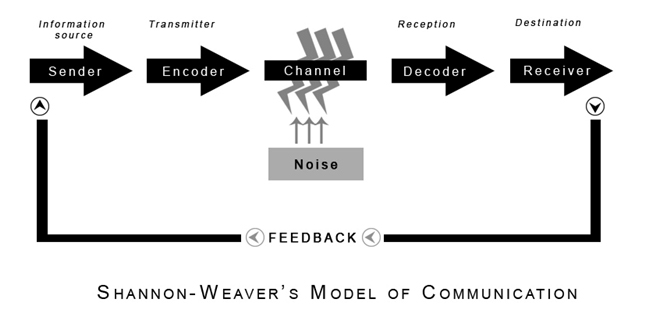
Communication Theory: Shannon-Weaver Model and Wilburr Schramm

This is working towards objective 1.

As a Graphic Designer, I feel researching into Shannon and Weavers Communication Theory model, will allow for myself to understand my practice better, in regards to how the end-user receives the message which I, the sender, am putting out there for public engagement, feedback and communication of a message or idea.

The Shannon-Weaver model suggests that the Communication Theory has (taken from source):

  • “Sender :  The originator of message or the information source selects desire message
  • Encoder : The transmitter which converts the message into signals
  • Note: The sender’s messages converted into signals like waves or Binary data which is compactable to transmit the messages through cables or satellites. For example: In telephone the voice is converted into wave signals and it transmits through cables
  • Decoder : The reception place of the signal which converts signals into message. A reverse process of encode
  • Note : The receiver converts those binary data or waves into message which is comfortable and understandable for receiver. Otherwise receiver can’t receive the exact message and it will affect the effective communication between sender and receiver
  • Receiver : The destination of the message from sender
  • Note : Based on the decoded message the receiver gives their feed back to sender. If the message distracted by noise it will affect the communication flow between sender and receiver
  • Noise:  The messages are transferred from encoder to decoder through channel. During this process the messages may distracted or affected by physical noise like horn sounds, thunder and crowd noise or encoded signals may distract in the channel during the transmission process which affect the communication flow or the receiver may not receive the correct message
  • Note : The model is clearly deals with external noises only which affect the messages or signals from external sources. For example: If there is any problems occur in network which directly affect the mobile phone communication or distract the messages”

However, even though this model accounts for ‘noise, or interference’ this can often represent a confused or distorted message which the receiver may not understand, therefore missing a key step of ‘feedback’. This was accounted for by theorist, Wilbur Schramm, whom focused on this additional stage in regards to allowing for overcoming barriers of effective communication. Schramm noted that “to understand human communication process, one must understand how people relate to each other” through communicating a message.

The modifications to this theory developed as shown below:

  1. “Added to the model the context of the relationship, and how that relationship will affect Communicator A and Communicator B.”
  2. “Included the social environment in the model, noting that it will influence the frame of reference of both Communicator A and B.”

Thoughts:

I do feel that this theory is relevant in regards to my practice and the work carried out recently for my Instagram post project, in sense of having a sender, encoding a message, decoding and receiving a message, however feel that this theory applies more to verbal channels of communication, opposed to visual in the sense that this model allows for a continuous loop of discourse to take place between two people. I would like to look further into other communication theories which may apply to my practice more on a visual level.

Sources:
Unknown. (2015). Shannon and Weaver Model. Available: http://communicationtheory.org/wp-content/uploads/2011/06/shannon_weaver_model.jpg. Last Accessed: 6th November 2016.
Praccreditation. (Unknown.). Communication Models. Available: http://www.praccreditation.org/resources/documents/APRSG-Comm-Models.pdf. Last Accessed: 6th November 2016.

Self-Perception Theory: Daryl Bem

This is working towards objective 1.
 
“©Dove conducts a social experiment exploring women’s view of their own beauty in contrast to what others’ see in them. A promotional piece for Dove, it exemplifies how we are, indeed, more beautiful than we think.”
“Men are not their own worst beauty critics. Only 4% of men around the world consider themselves average looking. At New Feelings Time, we are committed to creating a world where illegitimate beauty is not a source of confidence. So, we decided to conduct a compelling social experiment that explores how men view their own beauty in contrast to what others see.”
I came across these videos whilst researching the theory of Self-Perception as profoundly noted by Daryl Bem in 1972. Both are social experiments, the first being by Dove, a brand owned by Unilever, and the second by New Feelings Time, and both aim to showcase how Women, and Men perceive themselves in relation to others.

I found the first one interesting in how honest the women were in stating how they truly felt about their facial appearance, especially in relation to when they analysed each others faces for portraits, whereby they seemed shocked by how beautiful they were actually seen as.

The second video, showcases men whom describe themselves again honestly. Half used references from other peoples opinions of themselves, for example their Mothers, whilst others stated how they themselves feel. I was however surprised by the brutally honestly of the women describing the women at the end of the video describing a man. This seem to raise opinion with the men on how they were portrayed in and how they feel, with one claiming, “that does not look like me, and I refuse to believe it” giving the impression that in contrast to the female experiment whereby all were pleased with their portraits, men perhaps are not as aware of their self-perception.

As my research question focuses on the idea of self-perception within the fashion and beauty industries, I feel looking into this theory is key to successful practical projects, as well as academic research.

The below extracts summarise the theory whilst proving relevance to my research question and recent research topics of social media for example, whereby this can socially influence our behaviours and beliefs. Furthermore, I also found the statement, “we are what we do” resonant with the idea of ‘cultural icons’ and beauty bloggers, for example, in the sense that how they portray themselves through digitally curated galleries on Instagram, shapes that person, builds an image and a persona, being fully aware of their self-perception and self-awareness. But how does this affect the followers and their self-perception? Does this allow for us to change our identities in order to fit in and therefore become aware of our own self-perception once again?

I feel that this is heavily resonant with the Instagram/poster/zine project which has recently been experimented with, exploring this idea in relation with the theory of Identity for example, and changing to conform with an ideal such as Kylie Jenner. This form of marketing strategy, shapes our identity and perception due to being counterintuitive feeding off the actions of others in our individual ways to conform with this built sense of ideal.

Summary

“Self-perception theory describes the process in which people, lacking initial attitudes or emotional responses, develop them by observing their own behavior and coming to conclusions as to what attitudes must have driven that behaviour.”

Self-Perception Theory

“Self-perception theory is counterintuitive. Common knowledge would have us assume that a person’s personality and attitudes drive their actions; however, self-perception theory shows that this is not always the case. In simple terms, it illustrates that “we are what we do.” According to self-perception theory, we interpret our own actions the way we interpret others’ actions, and our actions are often socially influenced and not produced out of our own free will, as we might expect[1].”

screen-shot-2016-11-13-at-15-26-08

Image Source

screen-shot-2016-11-13-at-15-26-18

Image Source

Furthermore, since whilst researching for my 2nd Professional Context presentation, came across these two images, one of Kim Kardashian, and one of Makeup Artist/Instagram Icon, Amreezy, whom are practically holding the same pose – has social media affected our self-perception into allowing us to feel it is okay to perceive ourselves or see ourselves in a similar way to others to attain followers and likes?

Sources:

Unknown. (2016). Self-Perception Theory (Bem). Available: https://www.learning-theories.com/self-perception-theory-bem.html. Last Accessed: 5th November 2016.
[1] Bem, D. J. (1972). Self-perception theory. Advances in experimental social psychology6, 1-62.
Dove. (2013).
Forensic Artist Capture’s Women’s Self-Perception. Available: https://www.youtube.com/watch?v=sPZ0N4HdYYA. Last Accessed: 5th November 2016.
Dove. (2013). Dove Real Beauty SketchesAvailable: https://www.youtube.com/watch?v=YBoyf9HWiDQ. Last Accessed: 5th November 2016.

Collaboration with Scarlett Carson: Commercial Photography

I have confirmed this week a collaboration with a fellow MA student Scarlett Carson, a Commercial Photographer. I feel this collaboration is very important to my practice, with Graphic Design, Fashion and Commercial Photography being extremely relative, whilst the topic of my studies resonates with Scarletts interests and practice also.

Our idea is around Identity and Standardisation within the Fashion and Beauty Industries. Specifically for this photoshoot and project, we are wanting to use shop mannequins, masks and props to represent the concept of plastic surgery and the strive for perfection, and then showcase this as an editorial or campaign led project.

We are both currently in the process of sourcing props for the shoot, and plan on booking a Photography studio in next few weeks to start experimenting with this idea in the studio. Scarlett has been sourcing mannequins, whilst I have been looking for smaller props such as False Nails to complement the idea, enhance the concept and sharpen the boundaries between ‘real’ and ‘fake’ ‘perfect’ bodies.

London Trip Booked: 7th – 8th January 2017

This is working towards objective 1, 2, 3 and 5.

As noted in previous posts, I have been speaking with a well-known model, whom I cannot name for confidentiality reasons, regarding an interview, whilst also speaking with my connection at It’s Milk and Honey (a recent freelance project of mine) regarding an interview.

I have already noted that with my ‘model’ contact, I wish to discuss how working in industry, both fashion and beauty, affect ones self-perception. I am interested to see how this compares to those whom view such models in the media on a daily basis.

In regards to It’s Milk and Honey, I wish to speak with my contact regarding their work as an online group of female bloggers, how they feel they are targeting the issues of fashion, beauty, body image and self-perception, and how in turn they are empowering women.

Prior to carrying out this trip, I plan on sending out consent/confidentiality forms and a full introduction clarifying what questions will be asked to alleviate any problems prior to interview. I will also note that pseudonyms will be used if desired to protect their identities and confirm with the Ethics Policy provided by the College. This will ensure that the interviewee is aware of what the research is being carried out for, in which ways it will be used and what I aim to take from it.

I am currently waiting for ASOS to reply to my emails regarding visiting them also for an interview regarding their Model Welfare Policy. I hopefully plan on tying in an interview during this time in London if possible, and the above will also be applied to further interviews such as this, whether in person or online to ensure fair practice and ethical research practice.

“How to be a Beauty Blogger” Zine Idea

This is working towards objective 4.D.

Following the development of the Kylie Jenner zine, and whilst going back through my notes on initial ideas for the project, I had noted a “how to be a beauty blogger” zine, which I wanted to explore also.

However, once I began to create this satirical, typographic zine, I realised that further visuals are needed to bring this to life, and decided whilst also beginning to work on the Social Media Wellbeing Campaign, to put this zine on hold, and have discussed a potential collaboration with Bobbi, a fellow MA student, whom is an Interdisciplinary artist, focusing on illustration and ceramics. I feel her style of humorous and tongue-in-cheek illustration would really help bring this to life whilst adding a different aesthetic to the organically developed style of the zine.

how-to-be-a-beauty-blogger-zine2

how-to-be-a-beauty-blogger-zine3

how-to-be-a-beauty-blogger-zine4

how-to-be-a-beauty-blogger-zine5

how-to-be-a-beauty-blogger-zine6

how-to-be-a-beauty-blogger-zine7

how-to-be-a-beauty-blogger-zine8

how-to-be-a-beauty-blogger-zine9

how-to-be-a-beauty-blogger-zine10

how-to-be-a-beauty-blogger-zine11