Objectives: Reflections and Evaluations

At the start of the semester I set myself several revised objectives to work towards in resolving my working research topic.

I have reflected on each objective which can be seen below.

Objectives and goals:

1. To understand the ways in which Social Media and Magazines can affect self-perceptions and issues:

A) With body image (Females, 18-24)

B) With body image on a cross-cultural scale (Females, 18-24; Tokyo, Japan).

I aimed to speak with both Vogue UK and Vogue Japan, and aimed to carry out questionnaire’s or interviews with at least 10 females from both the UK and Japan, in order to gain quantifiable data. I have spoke with Vogue Japan in regards to obtaining quantifiable data in regards to obecjtive 1.B, whilst on my International research trip to Tokyo, however was unable to secure a meeting/interview with Vogue UK. I do not feel that this has hindered my research progress as the information gained through speaking with Editors at Vogue Japan answered some of the questions which I would of posed to UK Editors. I do feel though that without speaking to Vogue Japan this would of hindered cross-cultural research, and in retrospect was most beneficial to travel to Japan to have such candid and honest conversations with Vogue. I feel this has tremendously helped with my research working towards resolving my research topic/question.

In relation to the above objective I feel as though I have researched heavily into self-perceptions and social media and feel that travelling to Japan has allowed me to spend more time researching magazines in as much depth, especially cross-culturally. Even though fashion and beauty industries are becoming more digital, social media has been a more current point of research in a Western context, whilst magazines have been more of a focus cross-culturally with social media not being as ‘big’ in Eastern cultures in comparison.

I contacted course leaders of various, relevant fashion programmes at the following HE institutions in the UK after being unsuccessful in making contact with HE institutions in Tokyo – Leeds University, Leeds Beckett, CSM and Manchester Met in regards to objective 1.A. The aim of this is to obtain both British and Japanese contacts from fashion courses whom may be interested in completing a digital questionnaire in regards to my research topic in the hope of gaining an insight into cross-cultural influences. I did not hear back from most however again do not feel this has hindered research as contingency plans were put in place in order to still collate research as required. In regard to objective 1.A. I spoke with Toni Hollowood an MA student at CSM studying a similar subject matter, and found this to be of great benefit to gain similar perspectives to that of my own, whilst also pushing me in further directions of research which helped with objective 1.B.

I planned on collating a series of data from at least 10 British and Japanese females between the ages of 18-24 in order to gather and analyse measurable and comparable research. In response to this, an anonymous questionnaire was written and shared by myself, contacts in Tokyo and via Leeds College of Art in order to gain different perspectives working toward both Objective 1.A and 1.B. I opened up the questionnaire to male participants also in order to gain a different perspective and in sight of the research topic at hand.

In addition, whilst in Japan I spoke with a beauty blogger working towards Objective 1.B. I have not spoken with bloggers in the UK or USA as feel this was achieved in Semester 1, allowing for comparative data to be collated.

An interview with Brittany Rhodes, a competitive female body builder of 24 years, in order to gain a different perspective on my research topic, in relation to Objective 1.A. whilst also interviewing two models based in the UK, working again toward Objective 1.A. In addition, interviews were carried out at ASOS, understanding perspectives from an International brand and e-commerce point of view, working toward both Objective 1.A and 1.B.

In regard to objective 1.A. research trips to both London (7th/8th Jan 2017) and Tokyo (16th-23rd Jan 2017) were carried out in order to gain comparable and measurable visual data and field-research. Methodologies included looking at AD Campaigns of Western brands for example Chanel and Topshop, in order to see how these are promoted in the East for example, in order to see if the same models are used and what language is used. This allowed me to see if influences such as this can affect the perceptions of those in Japan being exposed to foreign visuals of cultural icons and western celebrities for example. Store managers at Burberry were spoken to in London, whilst also looking at visuals, look books and AD Campaigns. A similar approach was carried out in Japan, whilst attending relevant exhibitions to strengthen research and support interview/research findings, and looking at magazines/products available and packaging in comparison to that of the UK beauty and fashion industries. In addition, secondary research was used to inform my primary field-research, i.e. looking at recent technologies such as the Shiseido Makeup Mirror, which were analysed and looked at whilst in Tokyo. In Tokyo, as planned and discussed in Semester 1, I visited the Flagship Shiseido store in order to speak with staff about such advances and their customers feedback, whilst also finding out that such technologies are not available in the UK, and only are used in they Flagship store. A full list of measurable methodologies can be found here; 

  • Visual Research
  • Comp Shopping
  • Verbal Research: Interviews
  • Publication (Magazine) Research
  • Technological Advances

2. To understand policies and guidelines within the Fashion and Beauty Industries currently encouraging positive body image.

Semester 1: I have researched into the policies of charities such as B-EAT, as discussed in depth in both my report, and in my first professional context presentation, however, industry links have secured a meeting with ASOS’ Corporate Responsibility and Design teams in order to gain a better understanding on their Model Welfare Policy, working towards both objective 2 and 5. In support of this, and to add context to my research, I have also secured interviews with two models working in industry to gain their insight on my research topic, whilst discussing whether or not such policies would be of benefit and feasible to the industry to further help with research working towards objective 2 and 3.

Semester 2: In regard to the above, this semester I met with ASOS and two models as noted, in order to gain information on my research topic and the use of policies aiming to positively tackle issues surrounding self-perception and body image in the beauty and fashion industries. This was working toward objective 2 and 3. This was also working toward objective 5 however this objective has been omitted since undertaking research and realising that an international policy is not feasible and can not be achieved. In addition to this, I spoke with Vogue in Japan regarding their own policy; The Health Initiative, which also is working toward objective 1.A and 1.B. These topics and findings have since been discussed in my dissertation in depth.

3. To work with and interview those both actively working in the Fashion and Beauty Industries, and those on a consumer/follower/user basis, to compare behaviours and perspectives in relation to body image and self-perceptions.

Working toward this objective, I have carried out meetings and interviews with a range of participants as discussed above, including two models working in industry to gain a different perspective of research working towards objective 2 and 3, and a female body builder to also gain a different perspective. I also met with MA student Toni Hollowood from CSM, employees at ASOS and Vogue Japan in order to gain different insights on my research topic and the subjects covered within this. In addition, I also met with a beauty blogger in Japan. Furthermore, an anonymous questionnaire was created, receiving 25 responses from a range of male and female participants. All of the above is also working toward objectives, 1.A, 1.B and 2, as well as Objective 3. By speaking with a range of people with a range of perspectives, i.e. consumer and industry insight, I was able to gain a range of pragmatic an interpretivist data for comparative, cross-cultural analysis.

4. To prototype a range of design work targeted at 18-24 year old women, highlighting impacts of cross-cultural beauty/fashion trends on self-perceptions and body image.

I had planned on collaborating with Leeds-based commercial photographer Scarlett Carson in the aim of producing an editorial campaign working towards objective 4. This was originally planned for semester 1, however due to time constraints has been put on hold, and since other priorities had taken over allowing for this to unfortunately take a back seat. This is due to how much research was undertaken in Semester 2, accounting for travelling time and analysis time also.

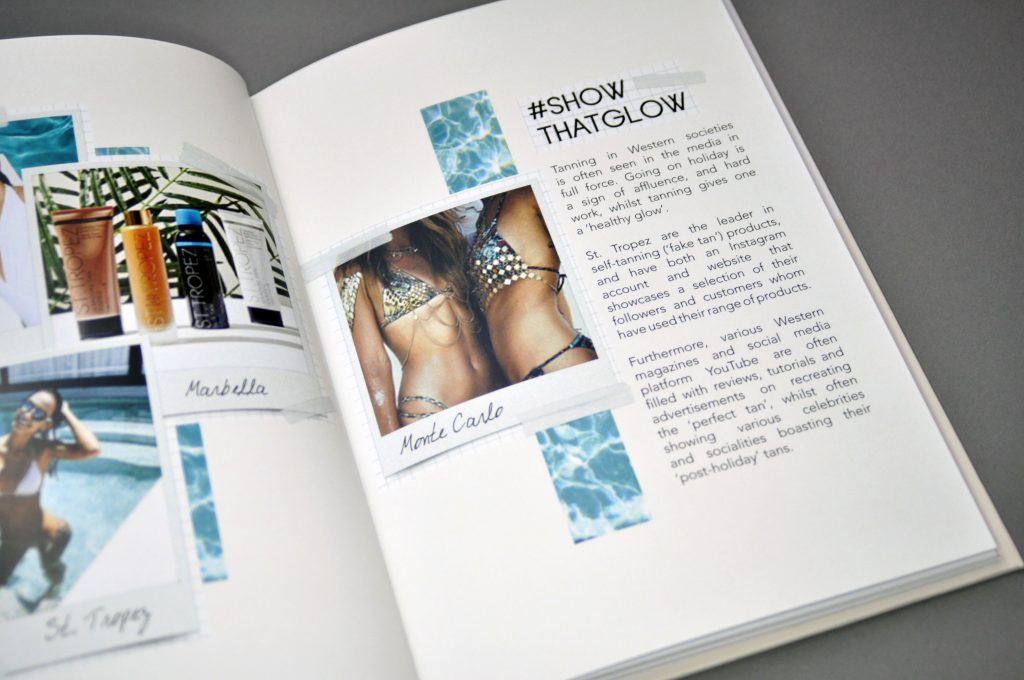
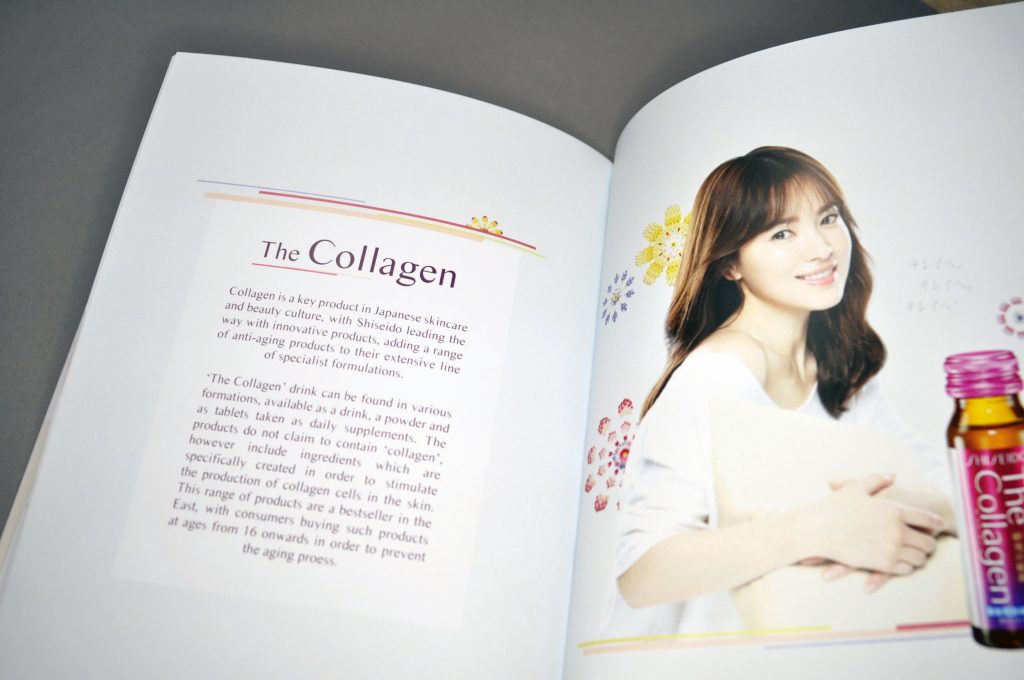
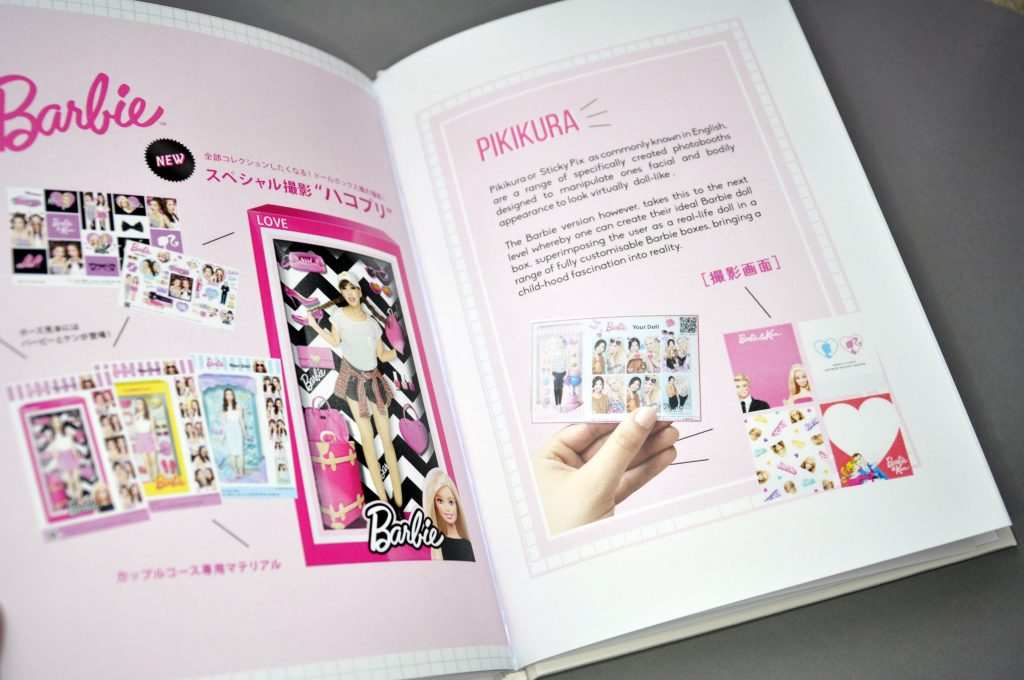
During this semester, one practical project was undertaken, a sourcebook of beauty trends, looking cross-culturally at two contrasting cultures, looking at socio-cultural norms, expectations and ‘ideals’. This was derived mainly from my International research trip to Japan and my findings, which I found extreme in regard to Western culture and trends. Each spread reflects a trend with supporting blurb that has been written to explore and explain the trend whilst touching on self-perception issues, theory and ‘ideals’, relating back to my research and dissertation. However, I plan to look at this much more in regard to theory and heavy analysis Semester 3, when producing my independent magazine. The sourcebook was originally going to be a mini-magazine or zine, testing the target audience for the ‘final’ version in Semester 3, however, I realised whilst designing that this book should be more of a sourcebook of trends to highlight to those, male or female, in the industry the contrasting beauty trends and cultures, opposed to producing a magazine twice.

In Semester 3, I aim on producing an independent magazine which collates the research and interviews carried out in both the UK and Japan, using interviews as articles as the main anchor point of the magazine. I feel as though I have had to carry out all of the research done to date in order to reach this point of deciding how to go about the practical work for both Semester 2 and 3, yet feel that research has informed the direction of my practice and the practical work itself. I also plan on collaborating with photographers, interview participants and the beauty blogger I met in Japan in Semester 3 in order to produce the magazine.

Feedback from various designer friends, whom gave advice and feedback the copywriting and typesetting in particular, especially in relation to the justification of text, widows and alignment in order to perfect the editorial aspects of the book. Feedback on practical work in Semester 2 was given from various designer friends, whom gave advice and feedback the copywriting and typesetting in particular, especially in relation to the justification of text, widows and alignment in order to perfect the editorial aspects of the book. I found this particularly useful to the perfection of the book, whilst also listening to the advice of printing services whilst printing and binding the book. In addition, spreads, cover art and development posts, were shared on my Instagram account to test reception from a relevant beauty and fashion related target audience; and positive feedback was received and reassured themes/aesthetics. Please see screenshots below:

screen-shot-2017-03-07-at-19-35-54

screen-shot-2017-03-07-at-19-35-38

screen-shot-2017-03-07-at-19-35-27

screen-shot-2017-03-07-at-19-35-18

screen-shot-2017-03-07-at-19-34-58

screen-shot-2017-03-07-at-19-34-37

screen-shot-2017-03-07-at-19-34-09

screen-shot-2017-03-07-at-19-33-57

screen-shot-2017-03-07-at-19-33-36

Source: https://www.instagram.com/daniellemuntyandesign/

Professional Context 2: Reflection and Evaluation

This module has allowed for learning objectives to be met, whilst working towards objectives 1, 2, 3 and 4 in relation to my research topic. I have found this module really enjoyable, and challenging and have utilised different research methods and methodologies in order to achieve a bound dissertation for Professional Context 2, collating findings and analysis to date whilst answering my working research question.  In addition this module has allowed me to make critical judgements in order to meet the learning objectives, which can be found below.

Learning Outcomes:

screen-shot-2017-03-12-at-17-55-35

Reflection/Evaluation:

Research discussed in the evaluation/reflection for Research Methods 2 has allowed for the noted research methods and methodologies to be applied to this module in order to produce an analytical, critical and theoretical body of work to be produced in the form of a written, academic dissertation. I have found this process enjoyable and challenging and have found that the management of time has been crucial whilst also making critical judgements and decisions in order to keep within the noted word count. Any feedback given by my tutor has also been accounted for, researched into and implemented where necessary, which I feel has strengthened the outcome of the study.

I feel using self-directed research throughout has been of major benefit to this study and dissertation, allowing critical arguments and perspectives to be related back to modern day, whilst utilising various literatures looked at over the past 2 semesters. Overall, I found that working through the essay systematically and planning ahead has enabled me to produce a body of work which I am very proud of and feel embodies much of the research collated today (both primary, secondary, qualitative and quantitative), whilst also embarking upon new research during the writing process where necessary.

I feel that given a larger word count, as my final draft approached 11000 words, that I could of included more detail at times in certain areas, however feel that the editing process allowed me to refine the body of the text to be concise and to the point, which I feel has also helped with my research journal/blog, taking into account feedback from Semester 1.

Practice 1: Reflection and Evaluation

This module has allowed for structured and streamlined work to be undertaken in relation to my research topic and current practice. I have found this module really enjoyable, and have experimented with digital and print-led processes in order to achieve a practical outcome meeting objective 4, as shown below. In addition this module has allowed me to make critical designs judgements based on research and previous exploratory work in order to meet the learning objectives.

screen-shot-2017-03-08-at-11-41-34

4. To prototype a range of design work targeted at 18-24 year old women, highlighting impacts of cross-cultural beauty/fashion trends on self-perceptions and body image.

East Meets West: A Sourcebook of Beauty Trends

During this semester, one practical project was undertaken, a sourcebook of beauty trends, looking cross-culturally at two contrasting cultures, Britain/the US and Japan, looking at and focusing on socio-cultural norms, expectations and ‘ideals’. This idea was derived mainly from my International research trip to Japan and my findings, which I found extreme in regard to Western culture and trends. Each spread reflects a trend with supporting blurb that has been written to explore and explain the trend whilst touching on self-perception issues, theory and ‘ideals’, relating back to my research and dissertation.

This idea was originally derived from a plan to design and construct a magazine, half of which would be English and reflect Western culture, and the other half in Japanese, reflecting Eastern culture and my research findings. I decided however, due to time and the workload involved in this to carry this out in Semester 3, under Practice 2, however this idea has once again changed slightly. I am now looking to produce a magazine which covers the research and interviews carried out as a more independent magazine, whilst working on promotional platforms to advertise and gain feedback/direction. This has been discussed more in my objectives and goals evaluation.

In relation to this semester and the practical work carried out, I feel that I have covered complex issues researched, which have been implemented in a visual manner which is suitable for either a male or female target audience interested in my research topic, as well as the beauty and fashion industries in general. I have found working on this project interesting in regard to experimenting with a range of digital collage and binding techniques, looking at different paper stocks and print methods, whilst also exploring layout and typography, strengthening my graphic design and editorial skillset.

By creating this book, it has enabled me to collate ideas and research findings in a streamlined and structured manner. I feel as I had collated such a large amount of visual and theoretical research, this module has enabled me to synthesise these together in an understandable and suitable outcome which is relevant to both my personal and professional practice.

As in Semester 1, feedback was gained from online sources, utilising Instagram to reach the specific target audience set out in my research topic, whilst also seeking editorial design-led feedback from designer friends and freelance clients.

In terms of binding, several methods were experimented with, whilst also utilising a professional printers in order to gain a hardback version for my professional portfolio of work. Even though I experimented with binding methods myself, I felt it was beneficial to source a professionally printed version also for my portfolio, being finished to the highest of standards.

I feel it has been of benefit that all 3 modules undertaken throughout this semester combined, with key theoretical approaches such as self-perception being applied to my practice continually. I have also found being aware of, and interviewing professionals and interdisciplinary/creative practitioners has added further context and support to both the aesthetics, format, content, context and tone of my work. Therefore, it has become apparent over the course of this module that these have become heavily intertwined, and that my research findings have directly influenced my practice.

I would of liked to of gained more feedback on the finished, printed and bound book however feel that this can be done in Semester 3 prior to starting my FMP as discussed briefly above.

For the submission, I have included design boards for this practical project, which includes in-depth contextual information supporting research and professional context in relation to my practice. This also showcases photography by myself, which has been taken in support of using these images on my professional website and digital portfolio going forwards, as well as being able to showcase this project in a more professional manner. The boards also include an evaluation on areas of improvement allowing for critical, future development going into Semester 3, whilst critical thoughts and problem areas have been flagged throughout the design process on my blog.

These boards can be found both on my blog and within a labelled folder within my submission portfolio.

Research Methods 2: Reflection and Evaluation

This module has allowed for various objectives to be worked towards and learning objectives to be met, whilst working towards objectives 1, 2, 3 and 4 in relation to my research topic. I have found this module really enjoyable, and have utilised different research methods and methodologies in order to achieve a practical outcome for Practice 1 and dissertation for Professional Context 2 also.  In addition this module has allowed me to make critical judgements and discussions in order to meet the learning objectives, which can be found below.

Learning Outcomes:

screen-shot-2017-03-12-at-17-51-14

Objectives and goals:

1. To understand the ways in which Social Media and Magazines can affect self-perceptions and issues:

A) With body image (Females, 18-24)

B) With body image on a cross-cultural scale (Females, 18-24; Tokyo, Japan).

2. To understand policies and guidelines within the Fashion and Beauty Industries currently encouraging positive body image.

3. To work with and interview those both actively working in the Fashion and Beauty Industries, and those on a consumer/follower/user basis, to compare behaviours and perspectives in relation to body image and self-perceptions.

4. To prototype a range of design work targeted at 18-24 year old women, highlighting impacts of cross-cultural beauty/fashion trends on self-perceptions and body image.

This module has allowed for various objectives to be worked towards and learning objectives to be met, whilst working towards my objectives in relation to my research topic.

This module has allowed for me to research into:

  • Topics within the Professional Context module
  • Topics/processes related with Practice and Professional Development
  • Theoretical Perspectives
  • Technological Advances
  • Industry Contacts – New and Existing
  • Contextual Information
  • Quantitive and Qualitative Data
  • Cross-Cultural/Cultural Perspectives

To achieve the above, the following research methods have been used, utilising pragmatic, and interpretivist research philosophies in order to gain both qualitative and quantitative data:

  • Online Sources; particularly for sourcing new contacts/links, policies related to practice/statistics, facts, etc
  • Instagram and Social Media, i.e. YouTube, Facebook for Videos, Photos and Feedback led Research
  • Freelance Clients/Designer friends/contacts for Feedback led Research
  • Contacting existing Contacts both Nationally and Internationally
  • Phonecalls and Emails
  • Practice based Researched: Print (Graphic Design, Collage, Digital Collage, Layout, Book Binding and Printing)
  • Questionnaire’s, whilst utilising International Contacts in Japan, LCA Inter-College Connections and the Ethics Policy
  • Critical-design (used throughout exploratory practical work, discussed in separate post)
  • Magazines
  • Trips to London and Japan
  • Interviews and Meetings with Professionals regarding policies, design work and organisational views on research topic
  • Documentaries
  • Field-research (technologies, visual, publications, copywriting, photography, etc) on both a National and International basis (London and Tokyo)

This module I have met up and interviewed with those contacted in order to gain the best research to work towards answering my research question and meeting my objectives/goals, in both the UK and Japan, such as speaking with Vogue Japan, ASOS and Tam Dexter for example, (objectives 1.A, 1.B, 2 and 3) and both British and Japanese participants of my anonymous participant questionnaire (25 participants in total) (objective 1.A, 1.B, 3).

I have found researching into key theoretical perspectives to be key to working towards my goals and objectives, and have found that my practice informs my research, and in turn, my research also informs my practice (see Practice 1 Reflection/Evaluation post). In addition to the theories researched in Semester 1, I have also found that further research has been needed into other tightly-related theories in order to strengthen/critique points in my dissertation and emphasise triangulation.

Furthermore, discussion of different perspectives as of that of Brittany Rhodes, and male perspectives as found in my anonymous research questionnaire, and literary/article-led research has also strengthen research and theoretical perspectives,  (objectives 1 and 3), whilst strengthening my practical work; (objective 4). This as noted, has allowed for a different perspectives to be considered in regard to my research question, and have allowed me for the reflect on both my practice and current research to date, whilst also informing a new sub-section of my dissertation which otherwise would not of been included.

In order to carry out the above, the LCA ethics policy has been of most importance whilst deigning and planning my research studies, as well as writing a consent form and information sheet to be distributed to participants in due course. These were sent to those who are being interviewed in advance for forward planning, and have undergone ethical checks by both my tutor and the course leader. This way of working/research is something which I have got used to doing and have found this good practice, and has also enabled my participants to fully understand the project, their role, pros, cons and details on data use, confidentiality and assessment for example. In regard to the online anonymous participant questionnaire, similar ethical checks were also undertaken by the college in order to check suitability before being shared with the Fashion courses in the college, and before being sent out/distributed via social media platforms (objective 1.A, 1.B and 3).

In addition to this, two field-research trips to both London and Tokyo were undertaken in January in order to gain different perspectives, insights and both comparable and quantifiable data, in aim of working towards objectives 1 – 4 specifically. Evidence of this can be found throughout my blog in regards to planning, itineraries and findings. I found that by planning ahead for such trips and planning both research and practical work in advance, time management this semester was better utilised, whilst taking into account the feedback given last semester in regard to my approach to documenting my findings in a more concise manner.

East Meets West: A Sourcebook of Beauty Trends – Hardback Photos

Below shows a small selection of photos which have been taken documenting the hardback version of my Beauty trend sourcebook which has been outsourced and printed professionally. I wanted to achieve a high-end, professional, quality finish which would be able to be used in my professional portfolio going forwards.

The inner stock is 135gsm matte paper, with no show through. I am really happy with the outcome, and feel it was worth outsourcing this print to show what the book would be like if for sale, whilst also showing the artwork to the highest of standards.

dsc_0706

dsc_0724

dsc_0730

dsc_0727

dsc_0750

dsc_0747

dsc_0701

VICE Documentary: How Narcissists Took Over the World

I came across the below documentary whilst on the Vice website, highlighting how self-perception and narcissism is a major, current issue amongst social media users. Even though I have completed my dissertation, I found that this is a subject which I wrote about heavily in relation to my research question, believe that this mini-documentary by Vice would be great information to take forwards into Semester 3/Practice 2, in regard to my research-based practical proposal of an independent beauty/fashion magazine exploring cross-cultural trends and issues and its affects on ones self-perception.

Article: Social Media has Created a Generation of Self-obsessed Narcissists

I came across the below article via Facebook, and have noticed more and more similar articles being shared and re-shared, highlighting how self-perception is a major, current issue amongst social media users, whilst more and more people are becoming aware. Even though I have completed my dissertation, I found that this would be great information to take forwards into Semester 3/Practice 2, in regard to my research-based practical proposal of an independent beauty/fashion magazine exploring cross-cultural trends and issues.

“Listing all the ways that it has altered our world is a fool’s errand, as is tracing all of its side-effects, but there is an argument that I will make: it has turned an entire generation into vapid narcissists.

From deceptive selfie angles that make average-looking people appear attractive, to curating your Facebook feed so it looks like you’re having more fun than you actually are, social media has taken neoliberalism’s self-centered mantra and pumped it full of cocaine-laced steroids.

All social media platforms are comprised of a mass of individuals competing against each other for followers, likes, retweets, favorites, and whichever other show of approval exists out there rather than any sort of collective goal.

Sure, this isn’t its only purpose, and plenty of benign interaction occurs without any sort of agenda, but there are masses upon masses of people who utilize it as a means of projecting an idealized version of themselves out into the world – an avatar of the person that they wish they were, rather than who they are in reality.

It’s logical that such an extreme focus on the self has a tendency to spill over into self-obsession, but this goes far beyond people taking too many photos of themselves and treating every action as a hashtagging opportunity. Every life event, however irrelevant to their social media audience, becomes a source of self-promoting content.

I doubt that anyone would be able to explain why they do it, because it’s likely a reflexive behavior: they’ve learned that sharing gets them validation, which feels good, so they continue to share. Every like and retweet gives the brain a small rush of dopamine comparable to a tiny hit of coke.

This is why people pathetically attach #tagsforlikes #likeforlikes and #likes4likes to their Instagram photos. The yearning for validation is so pronounced that it has spawned an entire exchange economy where people pimp themselves out to the world, offering to repay insincere engagement with equally insincere engagement. The sentiment doesn’t matter as long as that little ego-affirming notification bubble pops up on their screens.”

Source: http://www.highsnobiety.com/2017/03/14/social-media-narcissism/?utm_campaign=Highsnobiety+Post&utm_source=facebook

Article: Where Super Thin Is Still In: Attitudes to Body Image in Japan

I came across the below article via a friend in Tokyo, whom sent me a link. Even though I have completed my dissertation, I found that this would be great information to take forwards into Semester 3/Practice 2, in regard to my research-based practical proposal of an independent beauty/fashion magazine exploring cross-cultural trends and issues.

“According to the data from the Health Ministry’s annual national surveys on health and nutrition, underweight Japanese women in their 20s, 30s and 40s have been increasing.

According to the data from the Health Ministry’s annual national surveys on health and nutrition, underweight Japanese women in their 20s, 30s and 40s have been increasing.

Using Body Mass Index (BMI) as a gauge, the number of Japanese women in their 20s who are too thin (BMI under 18.5), far exceeds those that fall into the overweight range (BMI over 25).

Compared to the many Western countries coping with rising obesity levels, this might seem like an enviable position, and as a nation, Japanese people naturally tend to be on the slender side. However, those who maintain their weight at unnaturally low levels could face health risks down the line.

weight-loss-supplements-for-men-and-women

These trends are probably not surprising when the media promotes a culture populated with kawaii idols with proportions that look more like prepubescent children than adult women. As for muscles—forget it!

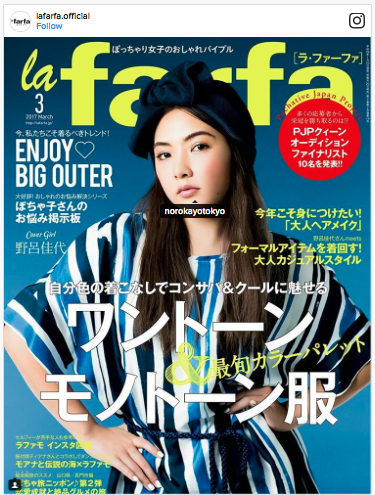
Speaking of the media, the terms pocchari girl or marshmallow girl made a splash a few years back, with the advent of La Farfa, Japan’s first fashion magazine for “chubby girls”. These curvy models, however, would still fall at the small end of the fashion sizing range in Western countries.

As for women who are definitely overweight by anybody’s standards, they are generally relegated to the role of comic buffoons by the media, and are the frequent target of teasing on TV variety shows.”

screen-shot-2017-03-17-at-00-40-41

Source: https://blog.gaijinpot.com/attitudes-to-body-image-japan/

East Meets West: A Sourcebook of Beauty Trends – Book Developments

20170313_195303_1489434863756_resized

Below shows a range of developments of the sourcebook created for this module. A various range of books have been printed and bound using different paper stocks and binding methods. I found that each had different pros and cons as noted below.

20170313_194314_1489434941645_resized

The above have been printed using laser printing on 110gsm paper stock and have been stapled to bind. I found that this would be perfect for a zine, being quick and cheap to produce being very cost effective to produce in mass, however do not give a ‘book’ finish. The print was very good quality and found that the colours really popped on the page and left no ‘lines’ as found with other print experiments shown below.

20170313_194333_1489434939477_resized

Above shows the staple binding leaving a crisp finish, whilst below shows the high print quality on the inner pages.

20170313_194351_1489434937270_resized

20170313_194417_1489434935042_resized

Above shows another book produced using laser print, however a 135gsm gloss stock was used, opposed to a matte finish as shown above. I really love the quality of the print, as it gives a glossy finish mimicking that of a magazine. I also found the colours to be much more vivid on gloss stock than on matte. I found this the closest to the desired aesthetic as possible. No lines were also found on the print, however 2 pages were found to have not fully flattened layers when printed, showing an outline of a bounding box from the InDesign document. The paper stock was too thick to saddle stitch, and found that stapling was a much more suitable outcome, whilst also being easy to reproduce, however the paper stock is slightly more expensive.

20170313_194437_1489434932693_resized

20170313_194506_1489434930497_resized

Below shows a laser print copy printed on 80gsm stock. I found this to be the weakest of all the prints due to leaving lines on the pages when printed, as well as many bounding boxes to be seen, as the InDesign document didn’t embed the images properly. This was rectified on later copies. With this test print, I also found that some artwork needed amending due to being too close to the bleed line, whilst also needing to amend the alignment of some body copy and artwork, as when trimmed was too close to the paper edge, leaving an unprofessional finish. This was amended digitally prior to printing any further books/experiments. In addition, with the paper being quite thin, print on the previous side was visible, showing through.

20170313_194708_1489434925652_resized

20170313_194724_1489434921930_resized

20170313_194741_1489434919420_resized

20170313_194803_1489434916915_resized

20170313_194821_1489434913861_resized

Below shows two booklets which were saddle stitched in different techniques. I used white cotton for one, and pink for another but found that the pink was too much with the cover artwork, and also made any small errors very noticeable, whilst the white cotton allowed for a much cleaner, sleeker finish. I would of been happier with this bind had the paper not been so thin, 80gsm, again showing through print on the other side of the paper. Using an inkjet print for these two books however left a perfect print, with no bounding boxes or lines to be shown, and found this the highest quality print so far. Canvas paper was used for both covers, giving a thicker, textured cover, and contrasting matte inner pages. I found though that on occasion as shown below, show through was still visible, dampening the overall quality of the book.

20170304_155035_1489434946396_resized

20170313_194851_1489434910281_resized

20170313_194921_1489434905840_resized

20170313_194939_1489434900210_resized

20170313_194940_1489434896404_resized

20170313_194943_1489434893438_resized

20170313_194954_1489434890815_resized

20170313_195010_1489434887555_resized

20170313_195028_1489434884028_resized

20170313_195041_1489434881348_resized

20170313_195056_1489434878654_resized

Above shows one test print (pink cotton saddle stitch) whereby, the cover was printed 10% larger to allow for allowance on the edges of the paper, whilst adding a slightly different aesthetic to that of the other books produced. The print quality on this version however was the best I believe out of the experiments shown, with no show through due to using a 140gsm card stock on an ink jet printer, allowing for more of a ‘book’ feel and finish and a more luxury aesthetic.

20170313_195204_1489434875790_resized

20170313_195216_1489434873150_resized

20170313_195227_1489434870254_resized

20170313_195243_1489434867434_resized

Ditch the Label: Are You Living an Insta Lie? Social Media VS Reality

Source: https://www.youtube.com/watch?v=0EFHbruKEmw
Last Accessed: 7th March 2017

If you’re guilty of living an Insta Lie or know somebody that is, then this video is most certainly for you. We’re partnering up with boohoo.com to call out some of the funniest and most common Insta Lie’s posted on social media.
Insta Lie (verb): an intentionally false representation of real life on social media. Examples include:

1.) Tagging an edited and made-up selfie with #IWokeUpLikeThis;
2.) Taking a million selfies before deciding on just one to post as #Effortless;
3.) Going all the way to Starbucks, buying a coffee and opening up your Macbook – taking a photo of your #WorkSpace, closing your Macbook and then going back home;
4.) Using filters to edit your travel photos – making them literally look #Unreal.

I came across this video via Facebook yesterday and found this quite powerful in regard to my research topic. I feel that this video summarises different aspects of Instagram and how it is so easy to ‘edit’ or ‘filter’ images in order to affect how one is perceived and therefore perceptions of others, and in turn how this can be mentally quite damaging to viewers and followers. I feel the video has been really well done, and feel that by teaming up with Boohoo, Ditch the Label have created a really great platform for those interested in Fashion to watch this video and be aware of such issues. I feel it really stimulates and provokes thought, conversation and debate and as of today has been viewed in the region of 9m times.